

AI SOC Technoscope Series: Building the Trusted SOC (Part 1)
The Operating Model for Transforming AI SOC into the Trusted SOC


Key Actionable Summary
If you lead a security operations function today, you already know the feeling this report starts from. The market is loud, crowded, and hard to tell apart. Triage that felt novel eighteen months ago now ships inside almost every SIEM, EDR, XDR, and SOAR product you already own. New logos arrive every week. The acronyms multiply faster than anyone standardizes them. And underneath the noise sits a harder problem that the noise is hiding: your team can now understand an incident faster than ever, and still cannot act on it any faster than before.
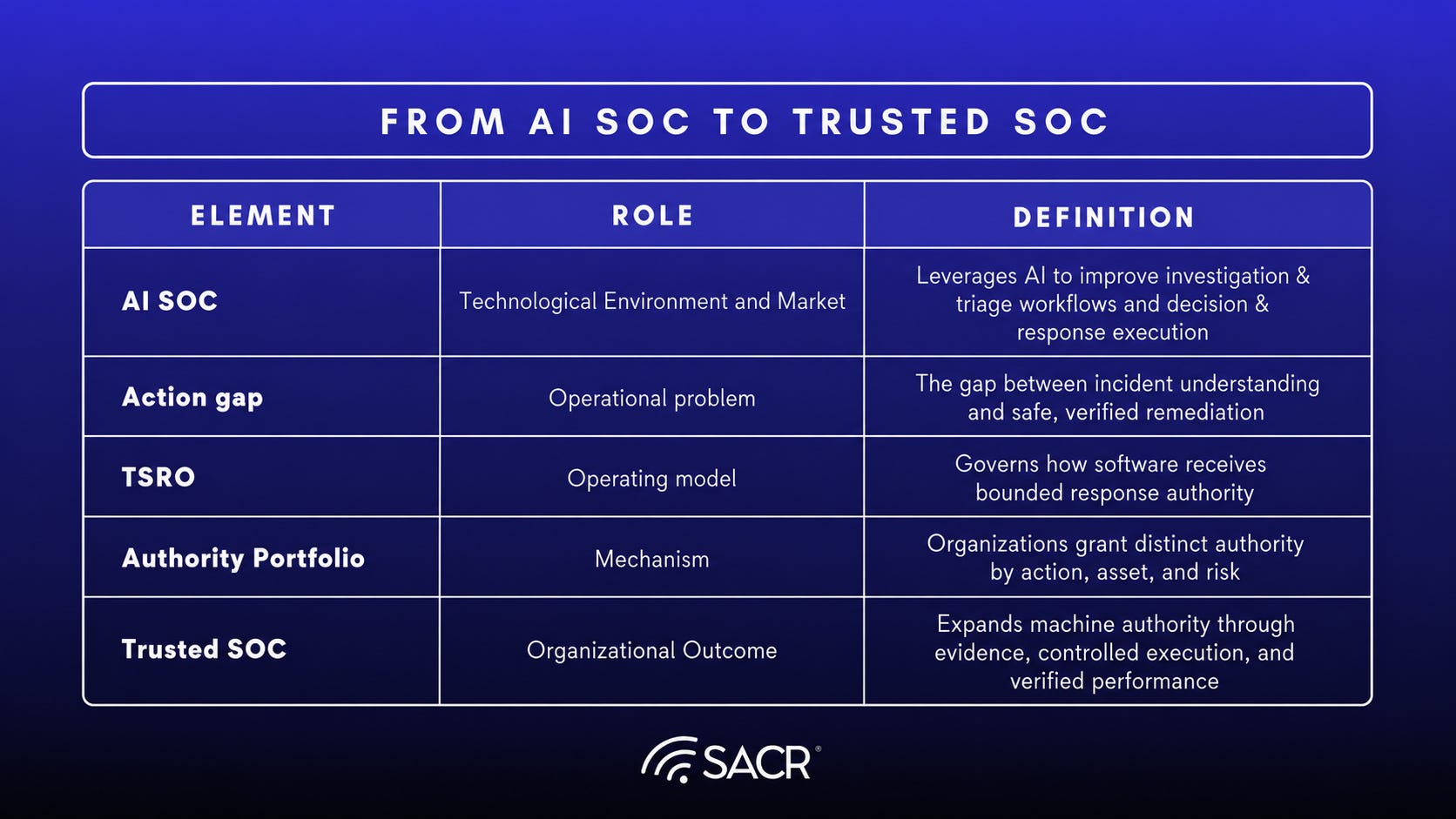
We call this the action gap, the distance between a validated incident and a safe, verified, state-changing response an organization is willing to stand behind. The first wave of AI in the SOC compressed investigation. It did very little for the part that actually changes risk, which is response. Knowing the threat exists is only half the battle.
Security practitioners and vendors alike have tried to address the action gap in their own ways, but there hasn’t been a model that can be applied to any environment or any level of maturity to let practitioners close that gap. That’s why we’re introducing Trusted Security Response Operations (TSRO): the operating model through which a security team grants software bounded authority to recommend, prepare, execute, and verify specific response actions, under explicit requirements for evidence, policy, credentials, scope, and accountability.
Building on SACR’s AI SOC Research
We developed this report as a continuation of our coverage of the AI SOC market. Revolutionizing Security Operations: The Path Toward AI-Augmented SOCs explored how AI and agentic systems were entering investigation and analyst workflows, while SACR AI SOC Market Landscape For 2025 mapped the expanding vendor landscape as the category took shape. This report builds on that foundation by defining the Trusted Security Response Operations model and the Trusted SOC to help CISOs and security leaders move from faster investigation to trusted, governed response.
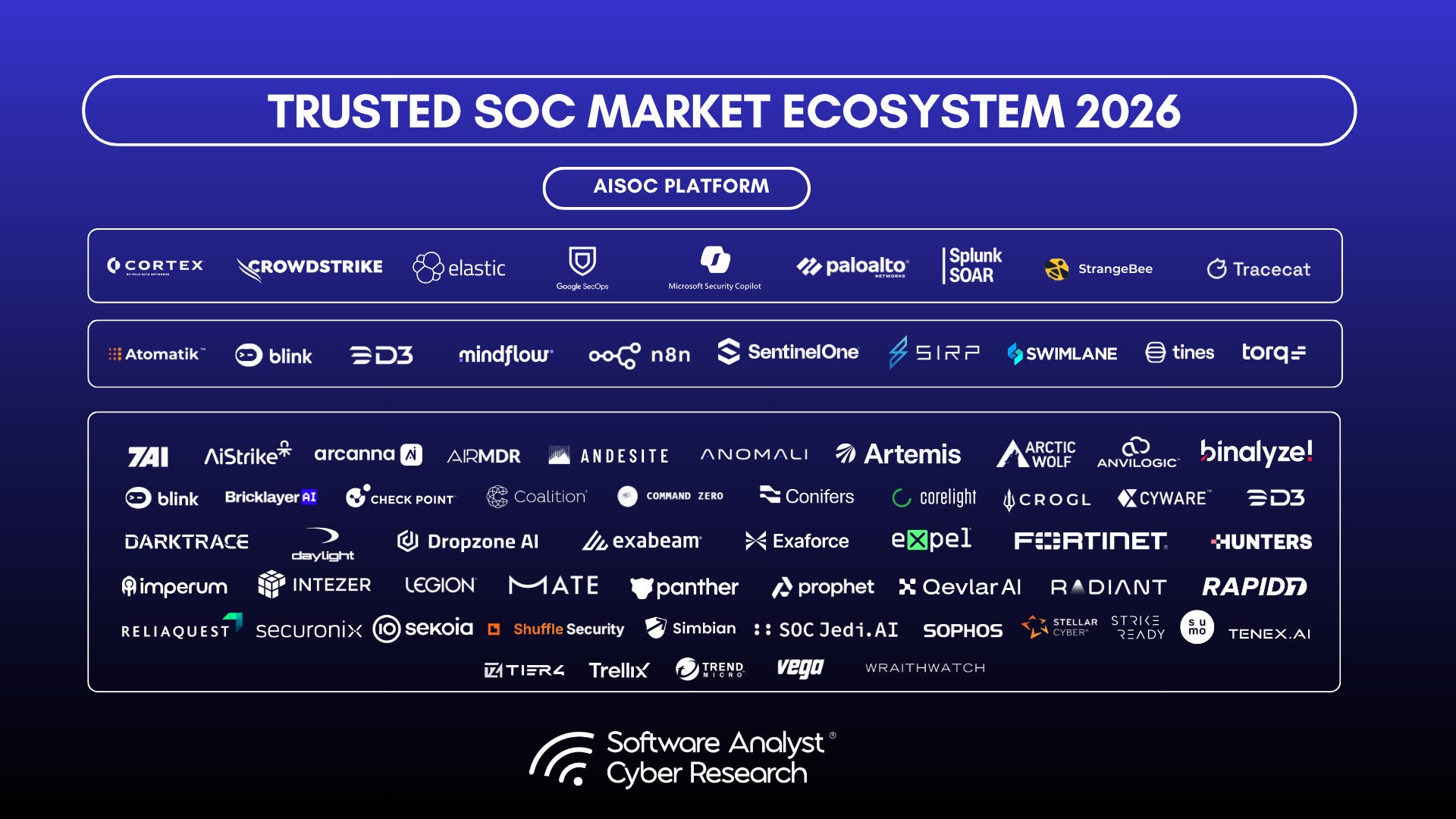
AISOC Market Map
These reports reflect extensive primary and secondary research over the past several months: structured interviews with 20 security leaders and practitioners, briefings and live demonstrations with 23 vendors, and targeted surveys across the market. Peer trackers such as SecOps Unpacked now map close to 140 vendors touching this space. SACR assesses more than 60 of these as pure-play AI SOC vendors. Our market analysis analyzes a focused set of 18 platforms in depth.
How to Use This Report
This Part 1 focuses on building the Trusted SOC, defines the problems faced today, establishes the CISO operating model for addressing them, and explains our rationale behind it.
Part 2 of our report focuses on vendor market categorizations and market rankings. The accompanying market analysis applies the model to reality, ranking a focused set of vendors across the three operating environments we see the most:
A mature regulated SIEM-centric enterprise SOC where the SIEM remains the system of record.
A Hybrid mid-market SOC with a leaner team operating across a mixed SIEM and data-lake stack.
An engineering led cloud native data lake SOC that prioritizes direct data access and lightweight administration.
Trusted Security Response Operations (TSRO)
We talked about the Trusted Security Response Operations (TSRO) earlier in our report. Using the TSRO model, practitioners will be able to achieve the outcome of a Trusted Security Operations Center (SOC). A Trusted SOC is one that has earned the authority to take specific actions through demonstrated decision quality, controlled execution, and verified outcomes.
The single most important reframe in this report is this. You are not making one decision about whether to trust AI in your SOC. You are making a portfolio of narrow delegation decisions, one action at a time, each of which can be granted, expanded, narrowed, or withdrawn on evidence. That is the difference between a marketing question, “Can we trust AI?” and an operating question you can actually govern: “Which action, under whose authority, based on what evidence, and verified how?”
What changed. AI improved triage, investigation, summarization, and enrichment to the point where those capabilities no longer differentiate a platform. Trust in automated response is now the binding constraint on adoption, and therefore on the return you get from any AI SOC purchase.
Category definition. A Trusted SOC is not a product you buy or a badge a vendor wears. It is a dynamic description of a SOC that has earned action-specific authority through evidence, controlled execution, and verified performance.
Buyer takeaway. Treat the Trusted SOC as the outcome of governed delegation, not a feature list. Require every vendor to show, per action, what the system can recommend, prepare, and execute today, how that authority is constrained, and how the outcome is verified with proof after execution. Discount any answer given at the level of the whole platform.
Market prediction. SACR expects the Trusted SOC to become the North Star operating outcome through which the modern AI SOC earns the authority to act. As the market consolidates around platforms, the winning question shifts from how much a system can automate to how much authority it can be trusted to hold and prove.
What The Market In 2026 Tells Us
It’s important for us to start with the reality that security leaders are facing today, because our TSRO model and the Trusted SOC outcome only earn their keep when they address the problems people face today. Five recurring pressure points came up in nearly every conversation we had:
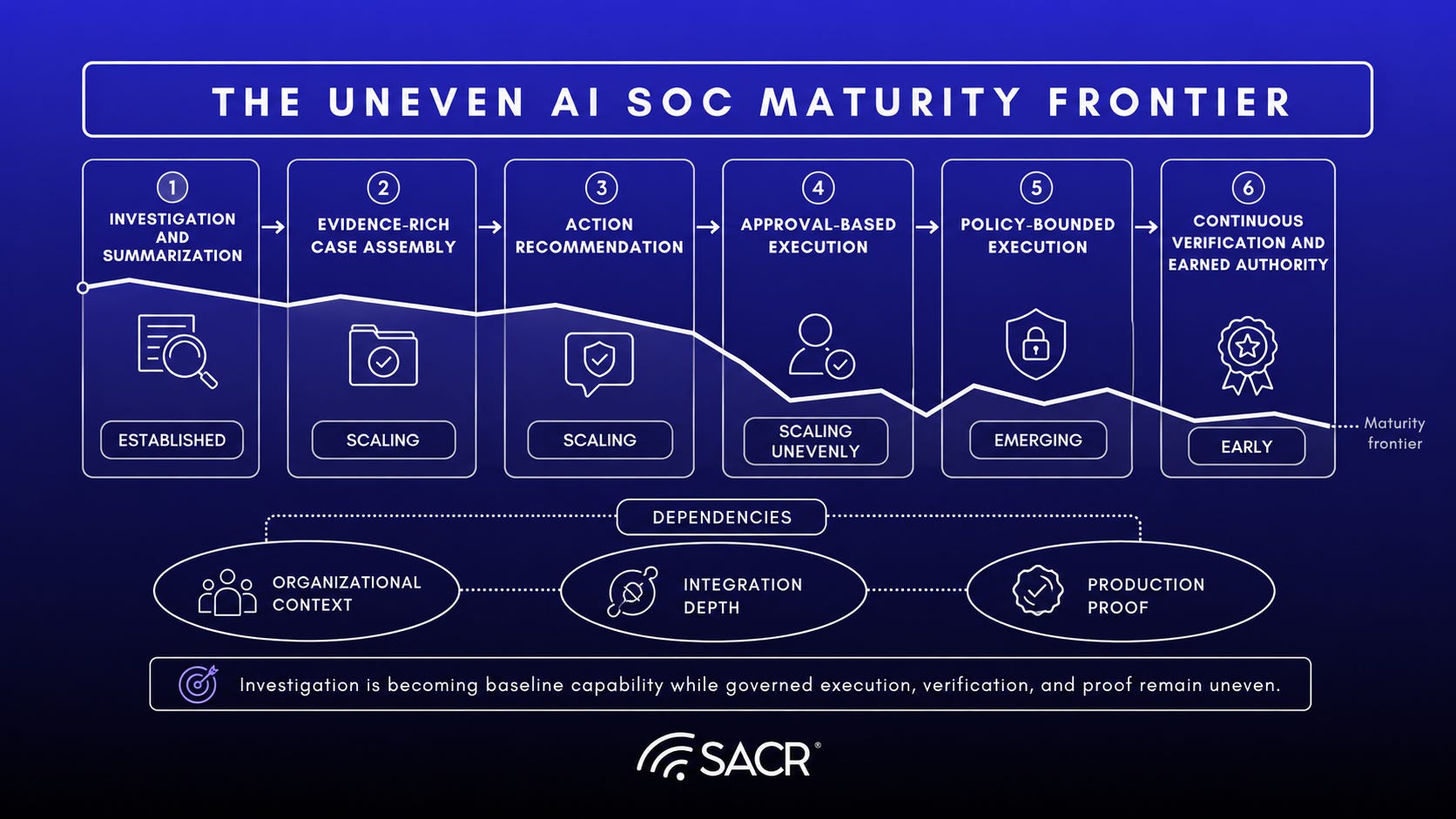
Fragmentation. The systems that investigate an incident are still separate from the systems and processes that authorize and execute a response. Evidence lives in one place, authority in another, proof in a third.
Noise. Every vendor demo looks similar. Summaries, enrichment, entity extraction, and guided investigation now present a nearly identical analyst experience, even when the evidence handling and the response authority underneath differ enormously.
Lack of differentiation. Because investigation has commoditized, front-of-funnel capability no longer separates products. The real differences have moved downstream, into governance, execution, verification, and proof, which are exactly the things a demo does not show well.
Too many players. Independent trackers now count well over a hundred vendors claiming a capability here, and the number keeps climbing. Buyers cannot evaluate a hundred products. They need a way to reduce the field to the handful that fit their environment and the specific actions they intend to delegate.
No standard definitions. Vendors market AI SOC, agentic SOC, autonomous SOC, ISOC, XDR with agents, AI-native MDR. Analyst firms have not converged either. Gartner has introduced an Integrated Security Operations Center (ISOC) category, while Forrester kept the XDR name and added agentic systems as a distinct evaluation criterion, with SIEM replacement treated as real rather than experimental. When the taxonomers disagree, the buyer pays the tax.
These pressure points highlight two major structural shifts taking place:
Category consolidation. Every AI SOC conversation has become a consolidation conversation. Buyers are rarely satisfied with triage alone; they want to reduce or replace SIEM, SOAR, and MDR costs at the same time. Vendors have responded by expanding out of the triage middle: some move left into detection engineering, threat hunting, and even SIEM, while others move right into response, automation building, and managed services. Data-pipeline vendors are moving up the stack into detection and AI SOC as well. The line between a pure-play AI SOC and an AI SOC capability bolted onto an incumbent platform is blurring, and for many buyers it is no longer the deciding question. What matters is whether the capability is a genuine, governed response engine or a checkbox.
Urgency. For two decades the SOC was organized around a human sitting at the center of every decision that matters. That model assumed human judgment could keep pace with the threat. Frontier models in the hands of adversaries have started to break that assumption, compressing reconnaissance, exploitation, and lateral movement toward machine speed. The industry, including several vendors building operating-model frameworks of their own, now argues that bolting AI onto a human-speed process only relocates the bottleneck. We agree with the diagnosis, but our emphasis is different: speed without governed authority is a liability. The answer to a machine-speed adversary is a response that is fast, bounded, evidence-based, and provable. That is precisely what TSRO is designed to produce.
The Practitioner Signal
Our interviews with security leaders surfaced the following themes often enough to shape our analysis:
The context moat. Security telemetry alone rarely contains enough to justify a response. The same behavior means different things in a media company and a regulated bank. Practitioners consistently told us that the platforms worth trusting are the ones that let an operator inspect the context behind a conclusion, add what is missing, challenge the hypothesis, and watch the recommendation change.
Detection quality is critical. Several AI SOC vendors are adding detection engineering and even SIEM capabilities, partly because weak detections upstream cap the value of any downstream investigation or response.
Proof lags ambition. Vendors define investigations, actions, and time saved differently, so headline metrics do not compare. The most credible teams measure at the level of the individual action, through execution and verified outcome, not at the level of the whole platform.
The Wider SOC Architecture
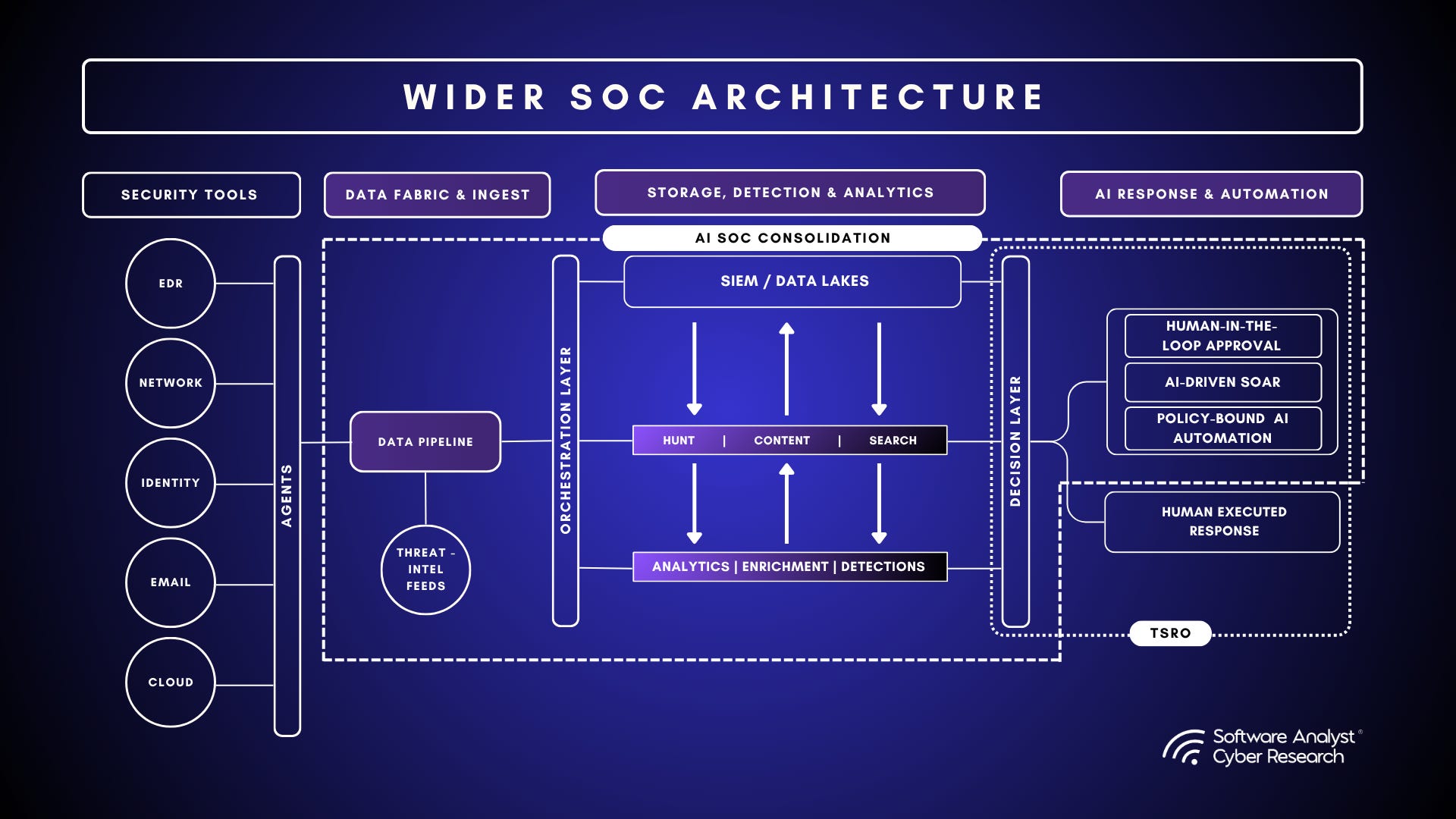
SACR’s 2025 research described the SOC as a layered architecture spanning the data fabric, storage and detection, and response and automation. Those layers remain relevant, but the boundaries between them have become less stable. The most important architectural change over the past year is that capabilities previously purchased and operated separately are being pulled into a more continuous operating layer. AI SOC vendors are moving upstream into detection engineering, threat hunting, security data, and SIEM. SOAR vendors are bringing model-based investigation and decision support into their workflows. Data-pipeline vendors are adding detection and AI-assisted operations, while incumbent platforms connect their own telemetry and analytics to enforcement. Buyers are now evaluating how far a provider can carry an incident through the workflow and which existing costs or systems can be consolidated.
Reinforcing Detections
This expansion has pulled detection engineering back into the AI SOC discussion. The first generation of products relied on alerts from external sources, while newer platforms generate and tune detections in addition to the traditional AI SOC capabilities. This shift is a natural market response to a recurring theme in our research: weak upstream signals and poor context correlation undermine the investigation and response decisions built on them.
Investigation and Response Consolidation
Investigation and response have also begun to shift to a continuous runtime across the traditional layers of the SOC. Evidence collection, case development, decision-making, and execution were historically distributed across different tools and human handoffs. Modern AI SOC tools are increasingly attempting to maintain a case state across that path, mixing AI reasoning and deterministic automation to take dynamic and repeatable actions.
This report focuses heavily on this theme. Vendors approach this layer from three architectural starting points:
AI-native platforms begin with dynamic evidence collection, case development, and decisioning.
SOAR-derived platforms build on established strengths in workflow automation, case management, and repeatable deterministic execution.
Platform-consolidated vendors connect these functions to telemetry and control surfaces they already own. Each path creates distinct advantages and adoption burdens, but the required outcome is the same: a defensible path from incident to verified remediation.
AI’s role in security operations should remain distinct from deterministic automation. Repeatable enrichment, normalization, and containment are inherently safer and less expensive when handled through fixed logic, while AI provides greater value when the system must interpret ambiguous circumstances and recommend an action under uncertainty. Through TSRO, a mature architecture should make the division between AI and fixed logic visible, allowing operators to understand when a model is reasoning, when a workflow is executing, and how they work together to build the Trusted SOC.
Introduction of Governance
Governance now sits inside the architecture. Approval routing, policy constraints, credential separation, action scope, audit records, and outcome verification determine whether a system can move beyond investigation. These controls connect an AI-generated conclusion to a response action the organization is willing to authorize. TSRO applies at this boundary, giving security teams a model for granting and expanding authority one action at a time, based on the evidence and controls attached to that action.
Most buyers will end up with a hybrid SOC architecture. An independent AI SOC layer can sit over the existing stack, while some organizations will consolidate around a platform that already owns telemetry and enforcement. Others will keep a SOAR-derived execution layer or have a managed provider operate the capability. Few will replace every component at once. The practical questions are where the incident’s evidence and case state live, which system holds the authority to act, and how the organization proves the intended change occurred.
How SACR Defines the Market
The expansion of AI SOC across detection, investigation, response, and service delivery has made the category harder to define under a single term or product shape. Vendors use terms such as AI SOC, Agentic SOC, Autonomous SOC, Integrated SOC (ISOC), XDR with agents, and AI-native MDR to describe capabilities that increasingly overlap. These labels are useful for identifying where a platform began and how it is delivered, but they provide limited insight into the authority an organization should grant it.
SACR uses AI SOC to describe the broader technological environment and market. Within that environment, Trusted Security Response Operations defines how a security team governs software authority, and the Trusted SOC is the resulting operating state: a SOC that has earned authority to perform specific actions through demonstrated decision quality, controlled execution, and verified outcomes.
Defining Trusted Security Response Operations
Trusted Security Response Operations (TSRO) is the operating model through which security teams grant software bounded authority to recommend, prepare, execute, and verify response actions under explicit requirements for evidence, policy, credentials, scope, and accountability.
TSRO does not require or build toward blanket autonomy in the SOC. It can begin with recommended or prepared actions that remain subject to human approval. The key is the controlled process connecting evidence, decisions, authority, execution, and verification.
Security teams grant authority one decision at a time. An organization can often trust a system to close a clearly understood case while still requiring oversight or approval for more impactful state-changing action. These decisions form an authority portfolio that can expand, narrow, or be withdrawn as performance is monitored.
Trusted Security Operations Center
The objective of TSRO is to build a Trusted SOC. It is a dynamic description of a SOC that has earned authority to execute specific response actions through demonstrated decision quality, controlled execution, and verified outcomes. Trusted SOC should not be viewed as a category or market label applied to a series of products.
As the evidence supporting Trusted SOC actions becomes stronger, an organization can expand the system’s authority across different risk levels. The Trusted SOC is progressive by design, built through a growing portfolio of authorities bounded by policy and accountable to the people who own the security and business outcomes.
Where TSRO Sits Among Existing Frameworks
We did not arrive at this in an empty field, and it would be dishonest to present TSRO as if the market had said nothing about autonomy and trust. Several strong frameworks already exist. TSRO is designed to occupy the specific gap they leave open. It helps to see the market’s frameworks as answering three different questions.
Question one: where does a vendor play across the lifecycle? This is the mapping question, and the clearest work here is the SecOps Shift Map from SecOps Unpacked, which tracks how vendors that began in the triage middle have moved left into detection and SIEM or right into response and automation, with a separate lane for those adding MDR services. Analyst firms answer the same question at the category level, Gartner with the Integrated SOC (ISOC) label and Forrester by extending XDR to include agentic systems. These are coverage maps. They tell you what a platform touches.
Question two: what infrastructure makes autonomy possible? This is the architecture question. The clearest recent example is ExtraHop’s Context, Harness, Model operating model, which separates the real-time evidence an agent reasons on (context), the governed control plane that mediates and scopes every action an agent may take (harness), and the swappable model layer that does the work. Its companion idea, an open alliance of interoperating best-of-breed layers, argues that no single vendor delivers the whole model. This is an infrastructure blueprint. It tells you how the pieces fit.
Question three: how independent is the agent, in the abstract? This is the autonomy-ladder question, and it has both academic and industry versions: peer-reviewed SOC frameworks that define five levels of AI autonomy mapped to human-in-the-loop roles and task-specific trust thresholds, the Cloud Security Alliance’s six-level agentic autonomy and control framework with boundary enforcement, and vendor progressions from human-in-the-loop to human-on-the-loop. Kaspersky’s Trusted Autonomy framing sits here too. These are capability tiers. They tell you how much a system could do.
TSRO answers a fourth question that the others assume: how does a specific organization earn, govern, and prove authority for a specific action, over time?
Two distinctions make that a genuinely different question rather than a rebrand.
Authority, not autonomy. Autonomy is a capability a vendor claims. Authority is a permission a buyer grants. The autonomy ladders describe what a system is technically able to do. TSRO describes what a named organization has decided to let it do, on which action, on what evidence, with which owner accountable. The locus of control moves from the vendor’s roadmap to the buyer’s governance.
A portfolio, not a level. Every framework above tends to place a platform at a level or in a layer. TSRO holds that a single platform occupies many positions at once: proven authority to quarantine confirmed malicious email, policy-bounded authority to block a confirmed indicator, approval-bounded authority to isolate an endpoint, and advisory-only authority for privileged identity actions, all in the same deployment on the same day.
The honest overlap is with the governance layer of the architecture frameworks. What ExtraHop calls the harness, a governed control plane that scopes and audits agent actions, is the technical substrate that a TSRO program needs. We see them as complementary. The harness is the enforcement mechanism. TSRO is the operating discipline that decides what the enforcement should permit, how authority is earned, and when it expands or is revoked. Infrastructure alone does not tell a CISO which business risks to accept. TSRO is the layer that does.
Where TSRO Begins
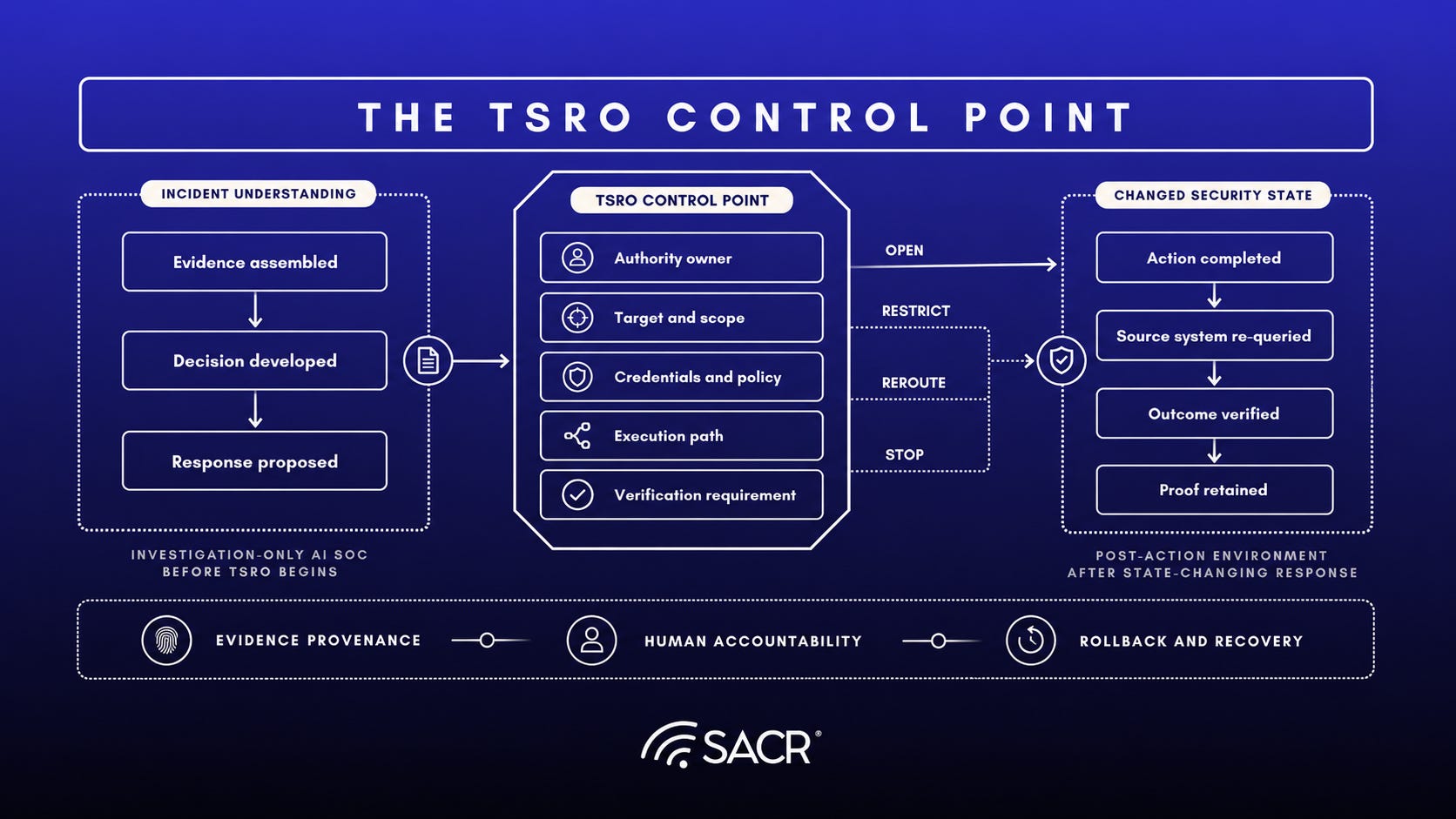
Many products improve an analyst’s understanding of an incident without affecting the response path. These capabilities accelerate AI SOC workflows, but they do not establish TSRO on their own.
TSRO begins when software enters the governed path to a remediation action. A product supports TSRO when it can define or prepare an action, route it to the proper authority, and contribute to execution and verified outcome at its granted stage. The clearest distinction is whether a product helps move the incident beyond completed investigation toward controlled, verifiable remediation.
The Buyer Problem: Why the Action Gap Persists
Even with visible product consolidation, the systems used to investigate an incident remain separate from the processes used to authorize a response in most environments. Even after the SOC reaches a conclusion, evidence from fragmented sources has to be translated into a proposed action and carried into a different operational process.
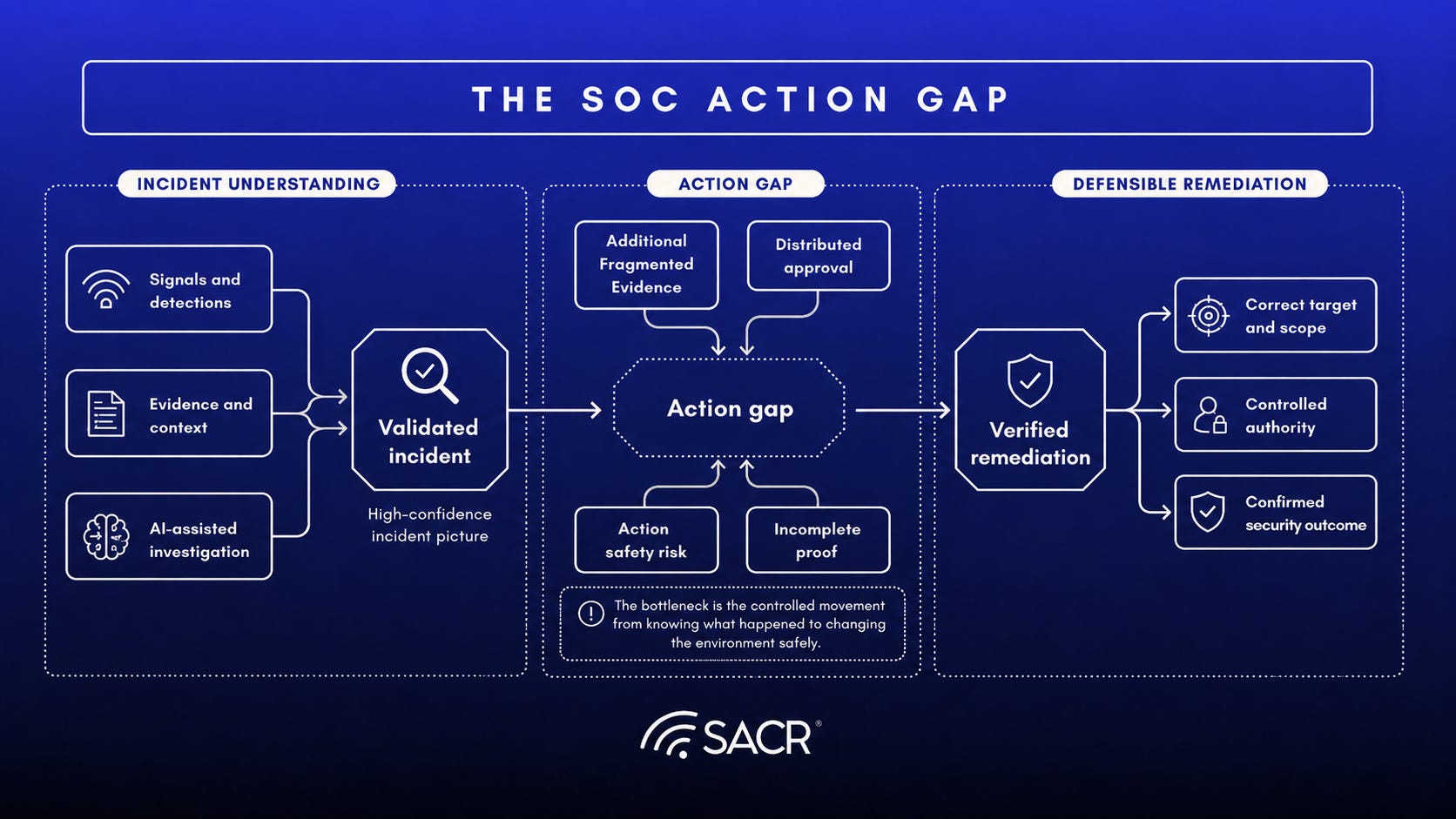
Ownership is fragmented in the same way. The SOC can identify a compromised account, but authority over directory, endpoint, and workload actions is distributed across other teams. The delay often has nothing to do with uncertainty about the incident. It comes from determining who can authorize the action, what evidence they require, and how to execute without creating new risk.
And that risk varies sharply by action. Quarantining an email is usually bounded and reversible. Isolating a production server or changing a firewall rule can interrupt critical operations. The decision has to weigh asset criticality, blast radius, and the available recovery path, and existing workflows rarely bring that context into the moment of decision.
Finally, the process leaves an incomplete record. Many systems can show that an action was initiated, but not why it was chosen, what evidence supported it, who authorized it, or how the outcome was verified. Without that record, an organization cannot compare performance across incidents or decide whether software has earned broader authority. TSRO closes these gaps by bringing evidence, authority, execution, and verification into one operating process. The buyer problem then becomes tractable: how to make delegation operationally safe, organizationally accountable, and defensible over time.
Different Actions Require Different Authority
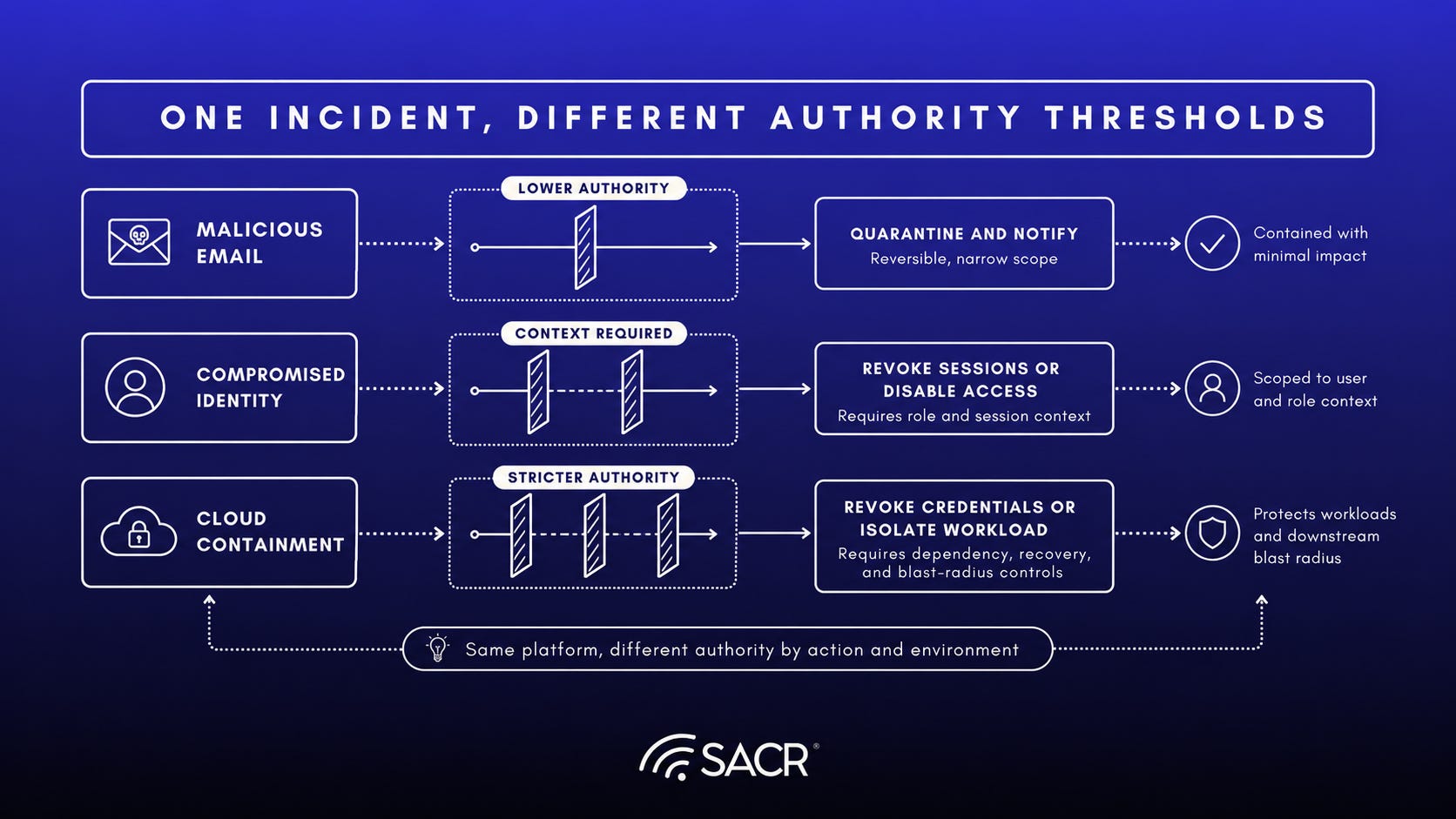
Email response is a common starting point because it is contained. A platform can inspect the message, correlate recipient activity, review related identity events, and prepare a quarantine. The affected systems are known, the action is usually reversible, and success can be verified across mailboxes.
Identity response requires more organizational context. An unusual login may signal compromise, or it may be a known administrative jump host. The right response depends on privilege, active sessions, device state, business role, and access to sensitive applications. Incomplete context turns a reasonable response into an avoidable business disruption.
Cloud containment raises the threshold again, because a credential, policy, or workload may support several dependent services. The platform needs service ownership, production criticality, credential scope, dependency information, and a recovery path before action can be delegated safely.
The point is that each action carries its own evidence, policy, and authority decision. The same platform may hold policy-bounded authority for email quarantine while remaining advisory-only for identity revocation and cloud containment.
Building the Trusted SOC: The TSRO Trust and Delegation Model
TSRO treats trust as an operational state that is earned and maintained. An organization does not decide that an AI SOC or automation platform is trusted as a whole. Trust is determined incrementally as the system recommends and takes specific actions. The accumulation of those trusted actions is what builds the Trusted SOC.
Understanding this distinction is important because the consequences of error change with the risk level of the action. Recommending quarantine of a clearly malicious email carries less operational risk than disabling privileged identities or isolating production workloads.
There are conditions that can limit the progression of trust. Weak data and telemetry can undermine investigations, allowing routine incidents to be handled reliably while ambiguous cases expose missing context, poor data quality, and uncertainty. Business accountability also remains with the CISO and security operators regardless of whether software recommends or executes an action.
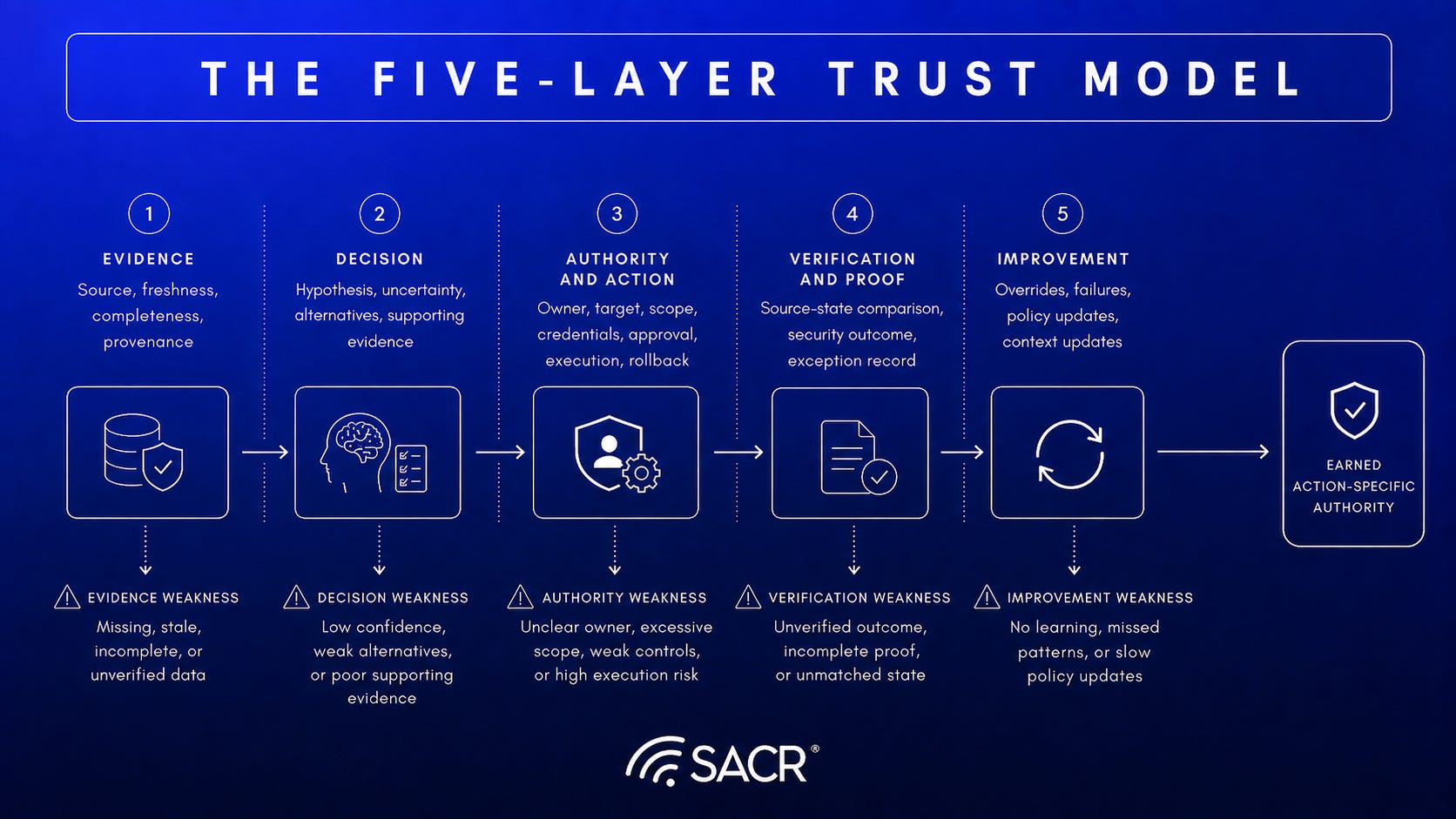
The TSRO model addresses these conditions through a chain of evidence, decision, authority and action, proof, and improvement. Weakness in any part of the chain provides clear justification to limit the authority granted to the system.
The Five-Layer Trust Model
Evidence
The foundation of trust begins with evidence. The evaluated platform must collect the information needed to support a decision and preserve where it came from, how it was used, and when it was collected. Outdated or contradictory evidence should be clearly annotated, along with the absence of evidence. A lack of evidence should not be treated as justification for safe action; it should be a warning sign.
Decision
The evidence collected supports the decision layer. A defensible decision surfaces the leading explanation of the incident, how the evidence supports it, uncertainty, and plausible alternatives. The decision layer should give the operator enough information to challenge the conclusion and understand what additional context could change the outcome.
Authority and Action
The action layer governs both authority and execution. It defines who can authorize a response and the target, scope, execution method, stop conditions, and recovery options associated with it. An evidence-supported decision can still produce a harmful outcome if authority or execution is not properly controlled.
Proof
The proof layer connects the decision and action to the resulting outcome. It records what was authorized, what was executed, whether the action achieved the intended objective, and whether rollback or recovery is required. A narrative record supports accountable human review, while structured output supports measurement and comparison across incidents.
Improvement
The improvement layer uses structured outputs to inform future operations. Details about accepted and rejected recommendations, failures, human overrides, and successful actions can drive updates to policy and workflows. This layer closes the loop across the five layers of trust and supports continued improvement.
Stages of Graduated Authority
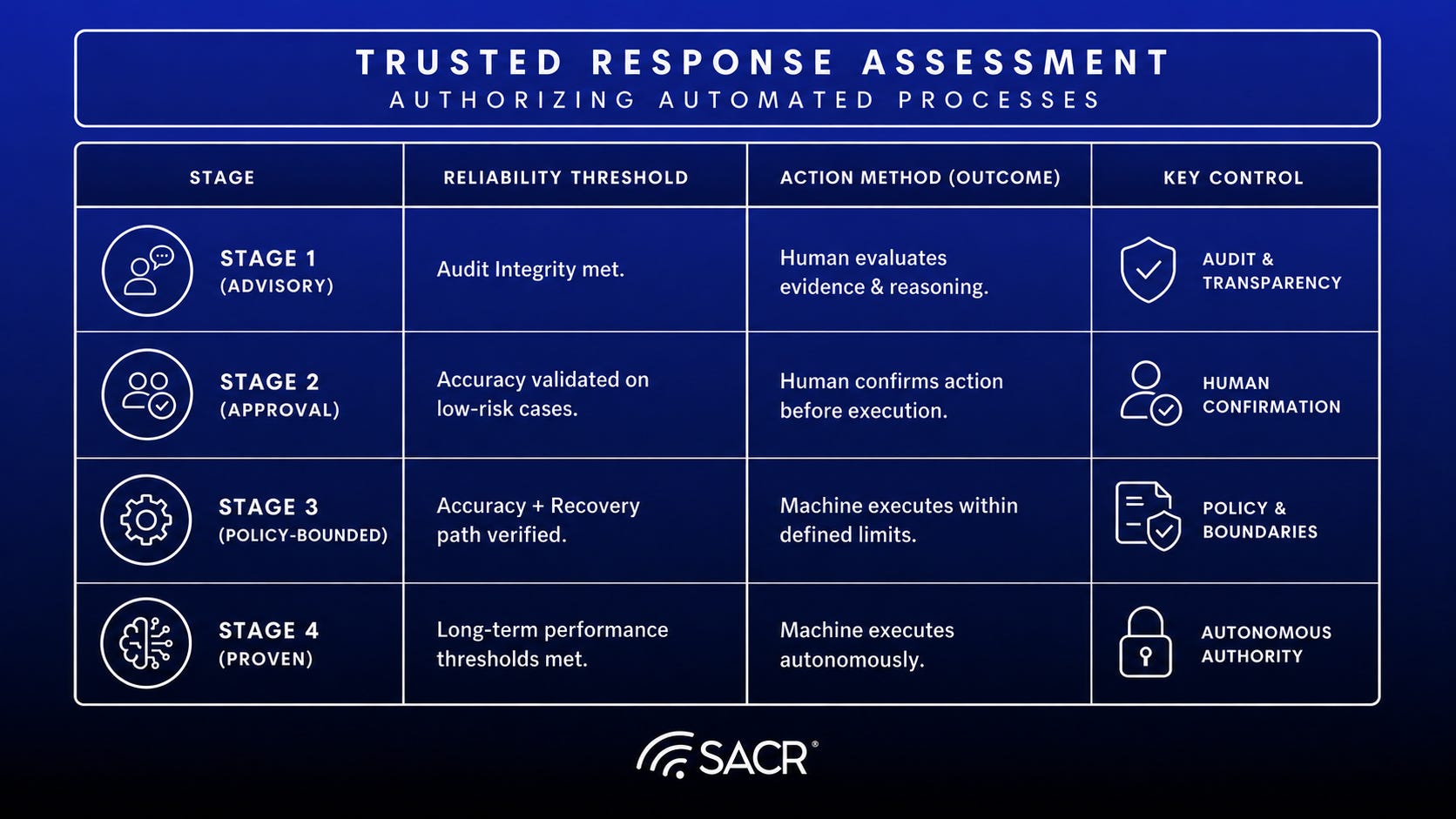
We designed the stages of authority around the conditions that exist today in the market. Our surveys and interviews showed a consistent progression from recommend-only workflows through approval-required and policy-bounded actions. The data showed broader support for partial autonomy, while a fully autonomous or “lights-out” SOC remains constrained by trust, ownership, and business process.
Stage 1: Advisory Authority
The platform gathers evidence, develops a conclusion, and proposes an action while humans retain decision and execution authority. This stage tests investigation quality, relevance, and the platform’s ability to explain uncertainty without placing production systems at risk.
Stage 2: Approval-Bounded Authority
The platform prepares the action, defines the target and scope, presents the supporting evidence, and routes approval to the accountable owner. Human authorization remains part of the execution path, while much of the delay and manual handoff can be removed.
Stage 3: Policy-Bounded Authority
The platform may act for approved action types, assets, identities, scopes, and risk tiers without case-by-case approval. Policy replaces the one-off decision while preserving accountability. Clear stop conditions, exception paths, rollback, and verification are required.
Stage 4: Proven Authority
The organization maintains delegated execution authority for a specific action because evidence quality, decision accuracy, control reliability, false-action rates, rollback performance, and outcome verification have remained within accepted thresholds over time. Proven authority does not mean unrestricted control. High-impact actions may remain approval-bounded permanently.
The Authority Portfolio
An organization will usually operate at several stages of authority simultaneously. It may grant the same platform proven authority to quarantine confirmed malicious email, policy-bounded authority to block confirmed malicious indicators at selected control points, approval-bounded authority to isolate endpoints, and advisory authority for privileged identity actions.
Together, these action-specific decisions form the authority portfolio. Each individual authority should identify:
Eligible incident and action
Required evidence
Decision threshold
Action scope
Accountable owner
Blast radius assessment
Rollback and recovery method
System’s performance history on similar actions
The maturity of the Trusted SOC is determined by the breadth and reliability of this portfolio. Authority may expand as records support it, narrow when conditions change, or be withdrawn after a failure.
How Authority Varies by Action Type
Low-risk response actions can often move into policy-bounded automation first. Selected email quarantine, session termination, and temporary blocks on confirmed malicious indicators are usually reversible and have limited business impact. The main control requirements are accuracy, verification, and a clear audit trail.
Medium-risk actions should usually begin with approval-bounded execution and expand only after validation. Endpoint isolation and narrow containment can reduce risk quickly but may disrupt users or systems. The evidence threshold, owner, and rollback path should be explicit.
High-risk actions should remain advisory or approval-bounded until the platform proves decision quality, scope control, recovery, and audit-grade proof. Privileged identity revocation, broad cloud containment, and network policy changes can create business-wide effects. Evidence requirements should match the consequence of error, and automation should expand only when the proof supports it.
Failure Modes and Design Risks
The authority portfolio must respond to failure in practice. A system that performed reliably under one set of circumstances can encounter new data sources, attack techniques, and organizational constraints. TSRO therefore requires organizations to identify where the trust chain breaks and adjust authority appropriately as the environment changes.
Evidence-layer failures include missing, incorrect, stale, or poorly normalized data. Business context used by AI investigations can also be improperly correlated or maliciously modified by attackers. Source controls and rules for handling incomplete context are required before evidence can be trusted to support an action.
Decision-layer failures include unsupported claims, inflated confidence levels, and failure to consider plausible alternatives. They can be hidden when an investigation is compressed into a summary. Evaluators should test ambiguous incidents, conflicting evidence, and cases outside a vendor’s common demonstrations to assess reasoning in non-standard situations.
Execution-layer failures include an inability to complete the state-changing remediation, excessive permissions, incorrect targets, and API errors. Confirmation that a task ran through an API does not prove that the security objective was met. Verification of the completed objective is critical to evaluating the execution layer.
These failures should directly influence the authority portfolio. Consistent collection of metrics and evidence provides security operators with the basis for granting, adjusting, and revoking authority.
Measuring the Trusted SOC
The authority portfolio depends on continuous measurement. Organizations need evidence that a system continues to meet the thresholds attached to each delegated action, along with clear signals for when authority should expand, narrow, or be withdrawn. The Trusted SOC measurement stack connects technical performance, reliability, response outcomes, and operating economics to those decisions.
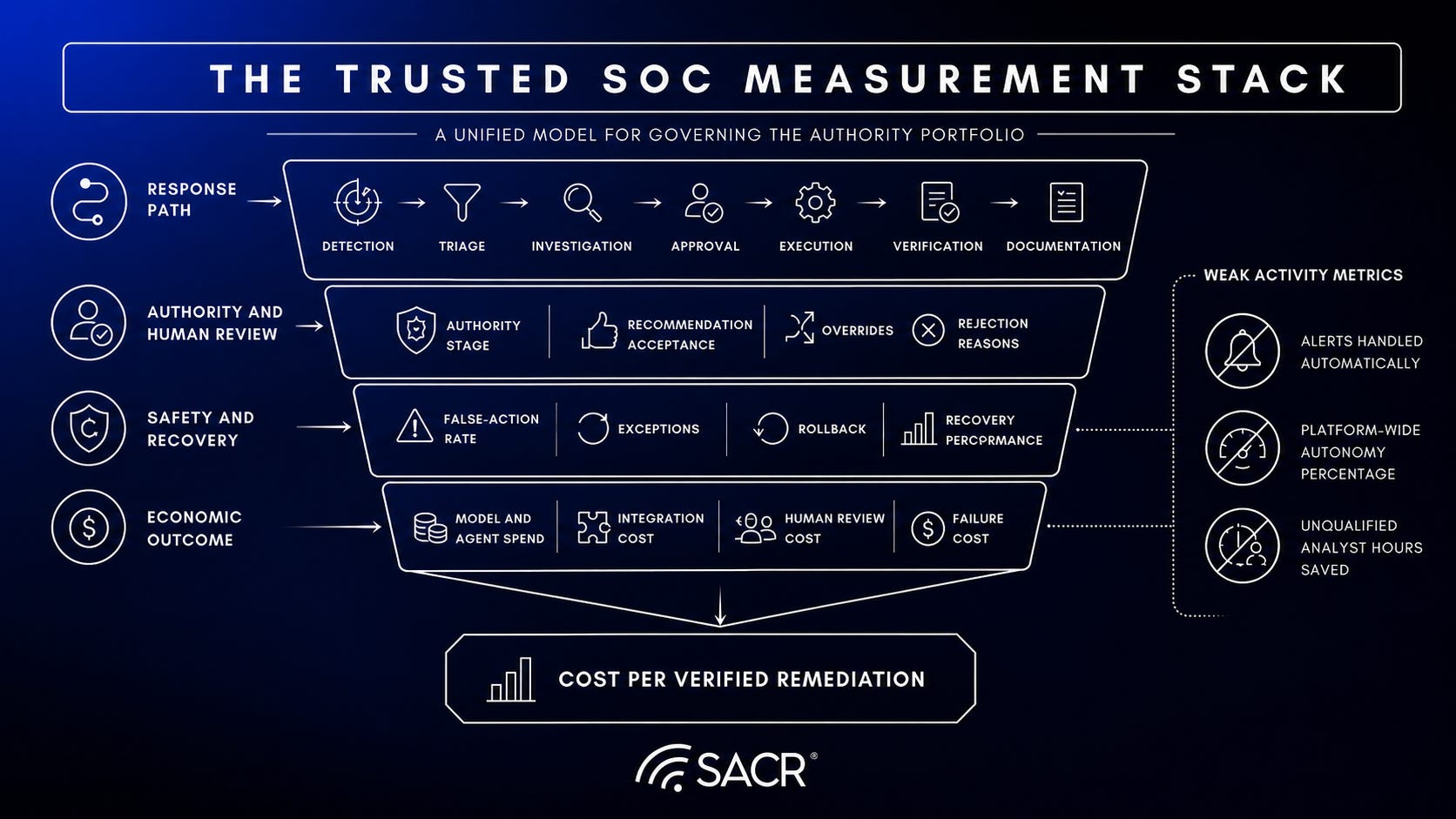
The most useful unit of measurement is the individual response action. Platform-wide automation rates combine activities with very different levels of risk and operational value. Quarantining an email, isolating an endpoint, and revoking a privileged identity should not be counted as equivalent forms of automation.
Measuring the Response Path
Time from detection to verified remediation remains an important measure because it identifies when the state of the environment changed. It should be divided into detection, triage, investigation, approval, execution, verification, and documentation.
This phase view is important because a single mean-time-to-respond figure can conceal the actual operational bottleneck. A platform may reduce investigation time while approval or execution time remains unchanged. Breaking the process into phases shows where technology created value and where organizational ownership or workflow continues to introduce delay.
The same approach should be applied to verification. An action is not complete when an API call returns a successful status. Endpoint isolation must be confirmed, and a malicious email must be removed from the intended mailboxes. Mean time to verify remediation measures the period between execution and confirmation that the security objective was achieved.
Measuring Authority and Human Review
Delegated execution should be reported by action type and authority stage. The organization should know how many actions remained advisory, how many required approval, how many executed within policy, and how many operated under proven authority.
Recommendation acceptance rate shows how often analysts or system owners agree with the platform’s proposed response. Rejection and override reasons provide more useful information than the acceptance rate alone. They should distinguish incorrect conclusions, missing context, business exceptions, and reviewer preference.
This distinction helps the organization identify the source of disagreement. A rejected recommendation may reveal a product failure, but it may also expose incomplete data or a policy that does not reflect current operations.
Measuring Safety and Recovery
False-action rate should include actions that were incorrect or unsupported by the available evidence. It should be calculated separately for each action type because the consequences of error vary significantly.
Rollback and exception rates show how often an action must be reversed, escalated, or completed outside the normal process. These measures should capture both technical and operational failures, including incorrect targets, approval errors, and unintended business impact.
Recovery performance is also important. An organization should know whether the platform identified the failure, initiated the correct recovery path, and restored the affected system. A low failure rate provides limited assurance when the system cannot recover safely from the failures that do occur.
Metrics to Approach with Caution
Broad mean-time-to-respond measures often combine too many phases to identify where improvement occurred. The percentage of alerts handled automatically may include duplicate suppression, enrichment, ticket creation, or low-risk closure without distinguishing state-changing response.
Analyst-hours-saved claims require a baseline workflow, defined task boundary, sample period, and quality control. Time saved has limited value when the work must be repeated, reviewed extensively, or corrected after an unsafe action.
A platform-wide autonomy percentage is particularly weak. Authority is granted to specific actions under defined conditions, not to the platform as a whole. Activity metrics become meaningful once they can be connected to a measurable operational outcome.
The Economics of AI-Driven Operations
Once response is measured at the action level, the organization can evaluate its true cost. The cost of AI-driven security operations extends beyond the platform license. It includes:
Model inference
Agent runtime
Data movement
Storage
Retrieval
Connector development
Workflow design
Implementation
Credential governance
Testing
Human review
Exception handling
Ongoing maintenance
Failures add cost as well. An incorrect action may consume analyst time, disrupt users, or create business impact. A platform with a low license price can still produce an expensive operating model when integration and oversight requirements are high.
AI also changes the cost structure of security work. Security telemetry and operational artifacts are converted into model input. Costs increase when several agents process the same evidence, context is rebuilt at each step, tool responses are unnecessarily verbose, or the system retries and validates work without maintaining a reusable case state.
More capable workflows will require larger contexts, longer reasoning paths, additional tool calls, multimodal evidence, and repeated validation. Each may improve decision quality but will also increase consumption. Complex incidents can consequently cost substantially more than routine cases, making a simple average cost per investigation an unreliable forecast of production spend.
Commercial pricing can further obscure the relationship between cost and value. Flat platform fees may include usage ceilings, overage rates, or model-routing policies. Per-agent, per-investigation, per-action, and token-based pricing all tie costs to different forms of activity. Buyers need visibility into model selection, context size, and quality thresholds to understand how costs will change at production scale.
Economic discipline depends on using the appropriate method for each task. Fixed enrichment, normalization, ticket creation, approval routing, and repeatable response steps often fit deterministic automation. Model use should be concentrated where interpretation, adaptation, or judgment materially improves the result. Efficient retrieval, reusable case state, selective context, and observable model routing reduce duplicated work without weakening decision quality.
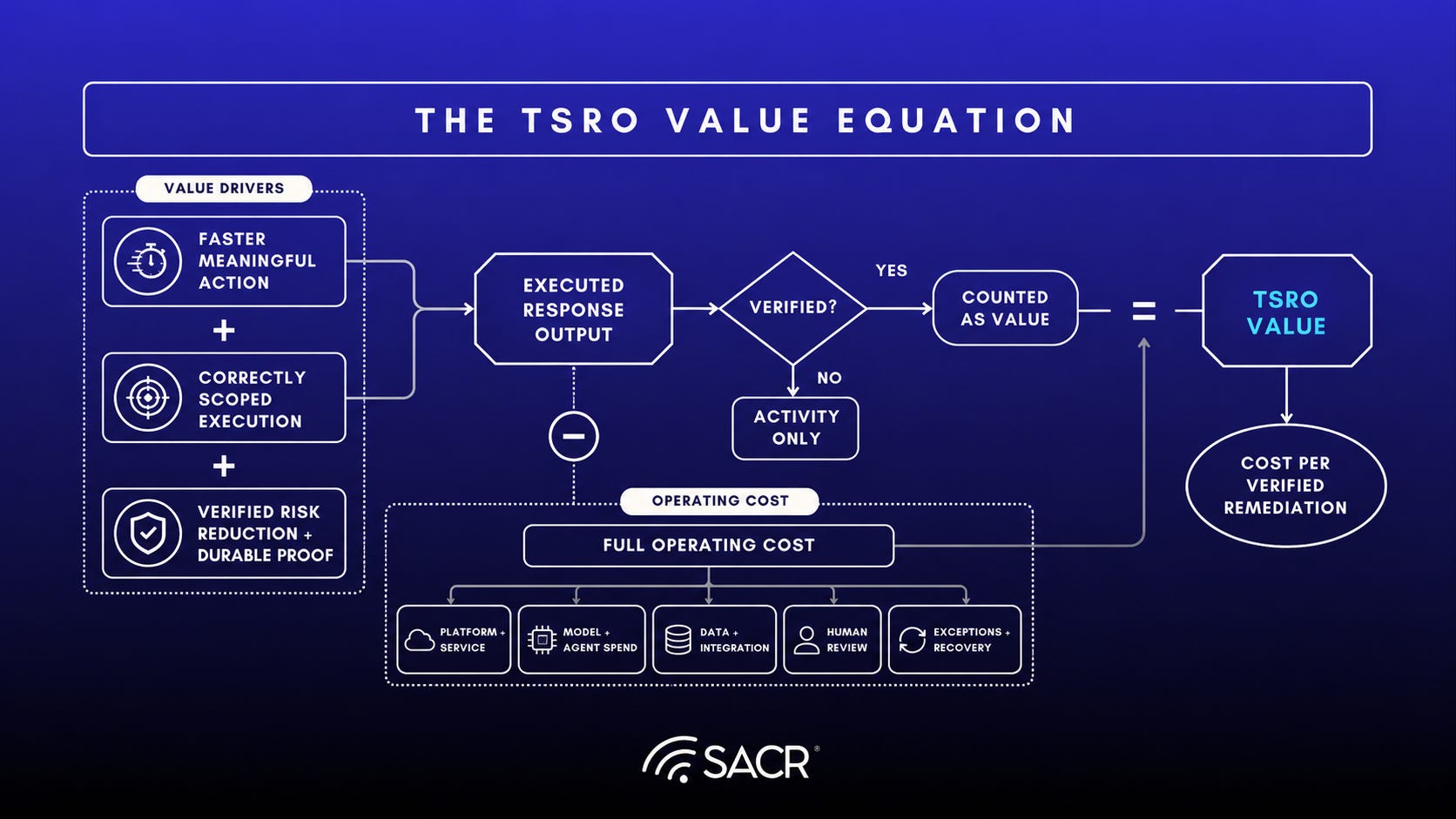
Organizations should measure model and agent spend by use case, repeated retrieval and retry rates, the proportion of work handled deterministically, and the cost of human review, failed actions, and verification. Cost per investigation remains useful for workload analysis, but cost per verified remediation is the stronger operating measure because it connects the full cost of the response process to a confirmed reduction in risk.
CISO Implications and TSRO Adoption
The CISO Decision
The CISO’s practical decision is which response actions can be delegated today, what evidence is required to maintain that authority, and what performance would justify changing it.
Those decisions will vary by organization. A financial institution, healthcare provider, technology company, and public-sector agency may reach different conclusions about the same action because their operating environments, regulatory obligations, and tolerance for disruption differ. TSRO provides a common decision structure without prescribing one acceptable level of authority.
The CISO must also determine who can grant or change that authority. Security may own the incident, but it does not always own the affected identity, application, or business process. Authority must reflect the organization’s actual accountability boundaries.
Adoption as Controlled Expansion
Adoption should begin with a small number of response actions whose scope, owner, evidence requirements, and expected outcomes can be clearly defined. The first use case should be meaningful enough to test the operating model but bounded enough that errors can be identified and recovered safely.
The initial evaluation should include normal incidents, benign anomalies, incomplete evidence, edge cases, and situations that cross team boundaries. The evaluation should surface disagreements between analysts and the platform, revealing missing context, inconsistent practices, and policy that needs clarification.
A time-bounded pilot using a representative set of cases can provide an initial baseline, but elapsed time and case volume are not sufficient on their own. The evaluation must include enough diversity to test uncertainty, escalation, ownership, and proof. A platform that performs well on repetitive phishing cases has not necessarily demonstrated readiness for privileged identity or cloud actions.
The authority stages established earlier in the report should operate as decision gates. Advisory operation tests the quality of the evidence and recommendation. Approval-bounded execution tests action preparation, scope, routing, and execution. Policy-bounded authority tests whether those controls remain reliable without case-by-case authorization. Proven authority depends on sustained performance rather than completion of a predetermined pilot period.
Expansion should follow the evidence, not a deployment schedule. An action may advance, remain at its current stage, return to an earlier stage, or be withdrawn. Different actions supported by the same platform will progress at different rates.
Governance Ownership
TSRO does not transfer accountability from the organization to the product. The SOC may own the investigation and recommend containment, while the teams responsible for identity, cloud, endpoint, applications, or affected business processes should participate in defining the conditions under which those actions may be delegated.
A cross-functional authority group should oversee material changes to the authority portfolio, review failures and recurring exceptions, and resolve ownership conflicts. Its role is to govern policy and authority, not approve every incident.
Build, Buy, or Hybrid
The three architectural paths described earlier—integration through an AI-native platform, extension of existing automation, and consolidation within a broader security platform—create different build, buy, and hybrid decisions. Each path can support TSRO when the organization retains control of its authority portfolio.
Building internally may fit organizations with mature SOC engineering, strong data and detection foundations, durable AI development resources, and workflows that commercial platforms cannot support. It can provide greater control over models, context, routing, deployment, and process design. The long-term burden includes maintenance, evaluations, model changes, and exception handling after the original development team moves on.
Buying may fit organizations that need packaged integrations, case workflows, and a faster path to production. The buyer still needs to determine how much configuration and service support the platform requires, whether it preserves existing investments, and whether its governance model fits internal ownership boundaries. A platform that deploys quickly but requires a new data architecture or operating process may create costs elsewhere.
A hybrid model will likely be the most common. A vendor platform may provide connectors, workflow, policy enforcement, and proof while the organization retains internal models, custom automations, decision logic, and managed context. Hybrid design is most effective when responsibilities are explicit and the organization does not maintain two overlapping control planes.
Regardless of the technical path, the organization must retain ownership of its authority portfolio. Vendors can provide the infrastructure for evidence, decisioning, execution, and proof. They cannot determine which business risks the organization should accept or who remains accountable for the outcome.
Conclusion
The shift from AI-assisted investigation to governed response changes how AI SOC maturity should be judged. More alerts summarized, cases investigated, or workflows initiated may improve productivity, but those measures do not establish whether software can be trusted to act. Maturity is demonstrated when the organization can define an authority, control how it is exercised, and verify that the action produced the intended outcome.
TSRO provides the operating model for managing that progression. Each authority is tied to a specific action, operating context, evidence requirement, policy owner, execution scope, and performance record. Authority expands when the evidence supports it and can be narrowed or withdrawn when conditions change. The resulting portfolio gives the organization a more defensible measure of progress than a platform-wide autonomy percentage.
The resulting Trusted SOC defines exactly what software is permitted to do, under whose authority, within which boundaries, and with what evidence of success. Humans retain accountability while intervening more precisely. Trust is earned through the organization’s ability to turn security decisions into controlled, verified, and accountable outcomes.