


Executive Summary
AI agents are becoming operational actors inside the enterprise. These agents do not merely generate text. They call tools, request credentials, query data, invoke APIs, modify records, create tickets, generate code, trigger workflows, and they can act as insider threats or collaborative threat actors.
This progression changes the identity security problem. Traditional IAM, IGA, PAM, NHI governance, and gateway controls remain necessary, but they were not designed to decide whether a live agent action should continue at the moment of execution.
In this report, SACR defines ARISE, Agentic Runtime Identity Security Enforcement, as the runtime enforcement layer for agents in motion. It evaluates whether a live agent action, tool call, data access request, credential use, or workflow step still makes sense before the action completes.
The report builds upon earlier work AIAP and Runtime for Agents. Earlier this year, AIAP was the authentication layer for AI agents; and ARISE is the runtime and authorization layer.
The crux of ARISE was built around: should this agent be allowed to take this action, with this tool, credential, data, and delegated authority, for this purpose, right now?
Thesis: The Imperative Now
A new market is developing centered on the substantially growing enterprise problem, where probabilistic AI agents are beginning to act with real credentials, tool access, delegated human authority, and machine-speed execution, while legacy identity, endpoint, gateway, and governance controls were not designed to supervise agent actions continuously. While traditional static identity controls remain foundational, the rapid, autonomous execution and delegated authority of AI agents necessitate a shift toward Agentic Runtime Identity Security Enforcement (ARISE), a runtime checkpoint layer designed to evaluate live actions, execute pre-completion interventions, and preserve auditable evidence.
ARISE is needed because enterprise identity has moved through four security eras. Each era solved the prior control problem, but each left a new gap as enterprise actors became more distributed, more automated, and finally more autonomous.
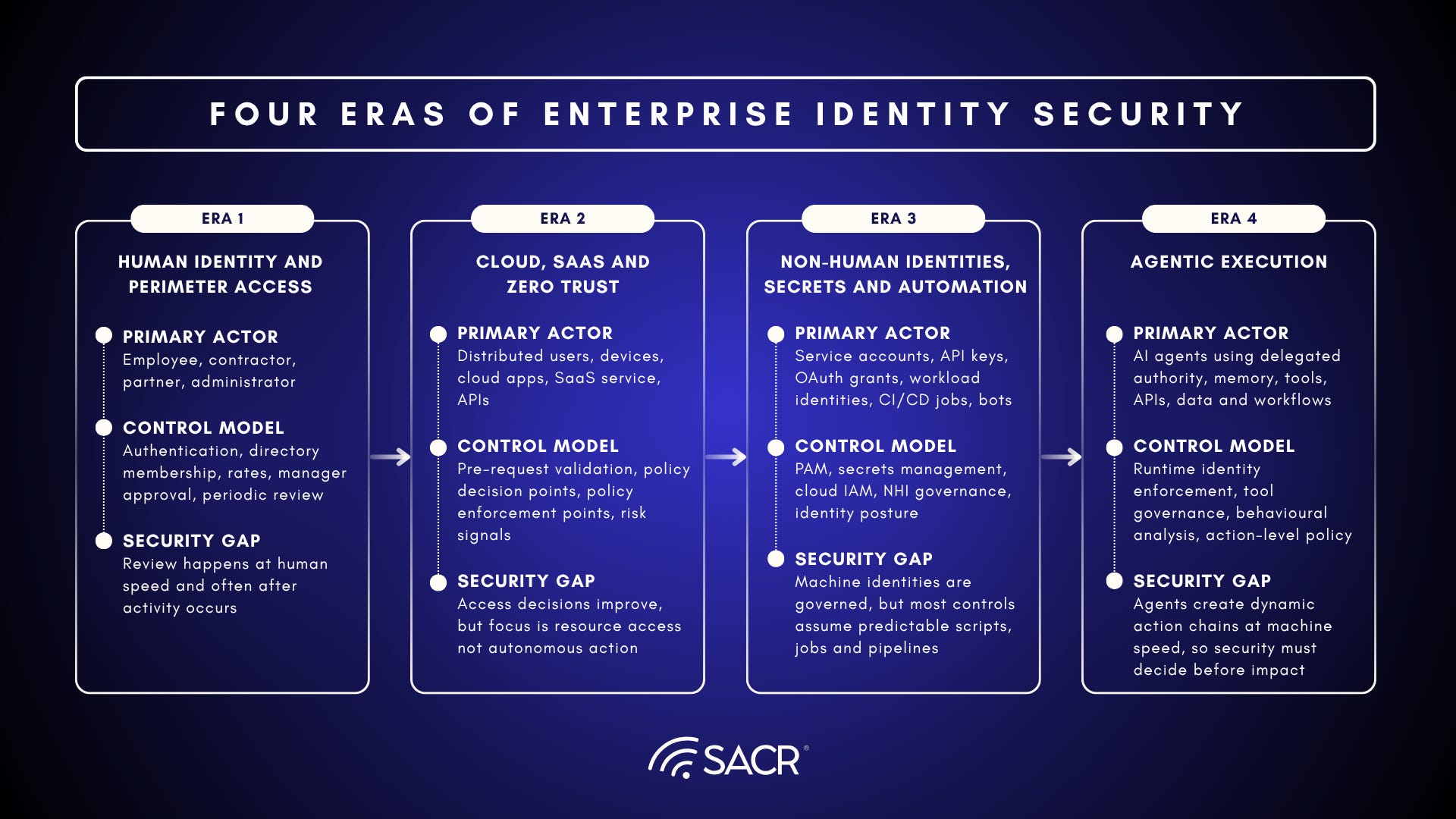
Era 1: Human identity and perimeter access.
As referenced, early enterprise IAM assumed that the primary actor was a human employee, contractor, partner, or administrator. The control model centered on authentication, directory membership, role assignment, manager approval, and periodic access review. A person requested access, a manager approved it, the user logged in, systems generated activity, and security reviewed logs or certifications later. This was already imperfect, but it matched the speed of the actor: humans worked at human speed.
Era 2: Cloud, SaaS, and Zero Trust.
As work moved to cloud services, SaaS applications, APIs, and remote access, the perimeter weakened. Zero Trust shifted the industry toward per-request decisions over users, devices, resources, workflows, and policy enforcement points rather than static network location. NIST’s Zero Trust architecture framed access as a policy decision and enforcement problem: the subject must be authentic, the request must be valid, and risk signals can change whether access should be allowed. This was a major advance, but it was still mostly built around access to a resource, not autonomous reasoning over a chain of actions.
Era 3: Non-human identities, secrets, and automation.
DevOps, cloud infrastructure, CI/CD, service accounts, OAuth grants, API keys, workload identities, bots, and machine-to-machine integrations created a much larger non-human identity population. PAM, secrets management, cloud IAM, NHI governance, and identity posture tools emerged to discover, scope, rotate, broker, and review these identities. This reduced credential risk, but most automation still followed a relatively predictable path: a job, script, pipeline, or service executed known steps.
Era 4: Agentic execution.
AI agents change the control problem again. They can reason, plan, use tools, maintain memory, call APIs, browse, retrieve data, write code, modify records, create tickets, and trigger workflows. OWASP distinguishes agents from traditional LLM applications because agents can take actions and use tools, creating risks beyond prompt injection alone. NIST’s AI Agent Standards Initiative similarly frames agents as systems capable of autonomous actions on behalf of users, requiring secure interoperability and trust.
The practical historical lesson is simple: every major shift in enterprise computing created a new control plane. Networks created perimeter controls. Cloud created identity-centric and posture controls. DevOps created secrets and workload identity controls. SaaS created CASB, SSPM, and API governance. Agentic AI now requires runtime identity enforcement for agents in motion.
Across SACR vendor briefings, vendors converge on four control themes:
Agent discovery and inventory: Identifying AI agents, MCP servers, tools, service accounts, owners, delegated users, and connected resources.
Runtime enforcement: Blocking, allowing, masking, routing, or escalating agent actions before the action completes.
Identity and entitlement context: Connecting agents to humans, non-human identities, OAuth tokens, service accounts, groups, roles, and resource-level permissions.
Behavioral and intent analysis: Using graph analytics, prompt/tool-call context, LLM judges, risk scoring, red teaming, or specialized models to infer whether agent behavior matches expected intent.
The market is not yet uniform. Some vendors approach ARISE from identity governance and access management, some from AI security gateways, some from secrets and privileged access, and others from runtime AI application security. This fragmentation is useful for market definition because it shows that ARISE is less a single product category today than a control plane pattern: runtime identity security for agents in motion.
The ARISE Control Gap
The problem is not merely that agents are non-human. The problem is that they are non-human actors with delegated authority, dynamic plans, tool access, memory, and machine-speed execution. Traditional automation usually followed a predefined path. Agentic automation can generate the path at runtime. The agent may choose different tools, retry failed steps, summarize context, infer missing information, combine permissions, or act on untrusted content. A valid credential can still be used for an invalid action.
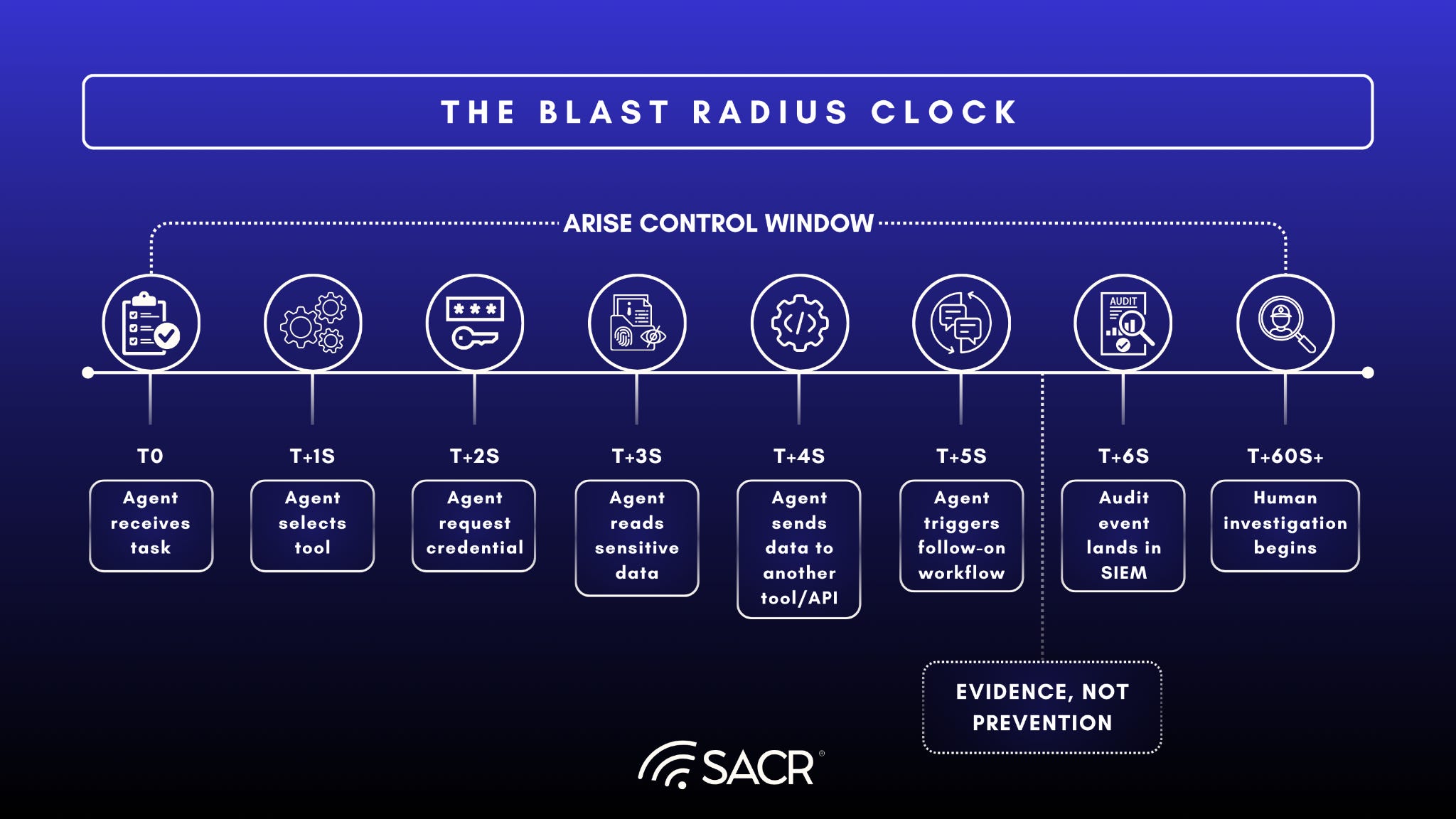
Blast Radius Clock
When buyers are evaluating agentic security, many are considering the blast radius effects of agentic misbehavior or misalignment, as recent examples of agentics breaching other organizations become a clear and present danger and a new insider threat. The race to get as much telemetry and data to make the best decisions continues to evolve as vendors build greater control around agents.
This history explains why existing categories are necessary but incomplete:
IAM and IGA can say who or what has access, but not always whether a live agent action still matches the business purpose.
PAM and secrets management can broker credentials, but not always evaluate the intent and sequence of tool use after a credential is issued.
NHI governance can inventory and govern machine identities, but not every machine identity is an autonomous agent.
Zero Trust can continuously evaluate access, but agentic systems require the same discipline to extend from access requests into action chains, tool calls, delegated authority, and data movement.
AI gateways can inspect prompts and responses, but agent risk also lives in identity context, tool invocation, API behavior, data sensitivity, and workflow outcomes.
The need for ARISE therefore comes from a timing mismatch. Identity governance historically asked questions before access was granted or after activity was logged. Agents create risk while the action chain is unfolding. A risky tool call, credential use, data movement, SaaS change, or workflow trigger may complete before a human reviewer sees an alert.
The Machine-Speed Problem
ARISE exists because after-the-fact review is too slow for autonomous execution. The issue is that not only do agents act faster than people, but the surrounding threat environment is accelerating. Vulnerability discovery, exploit development, reconnaissance, credential misuse, data movement, and workflow execution are all compressing from days or weeks into hours, minutes, or seconds.
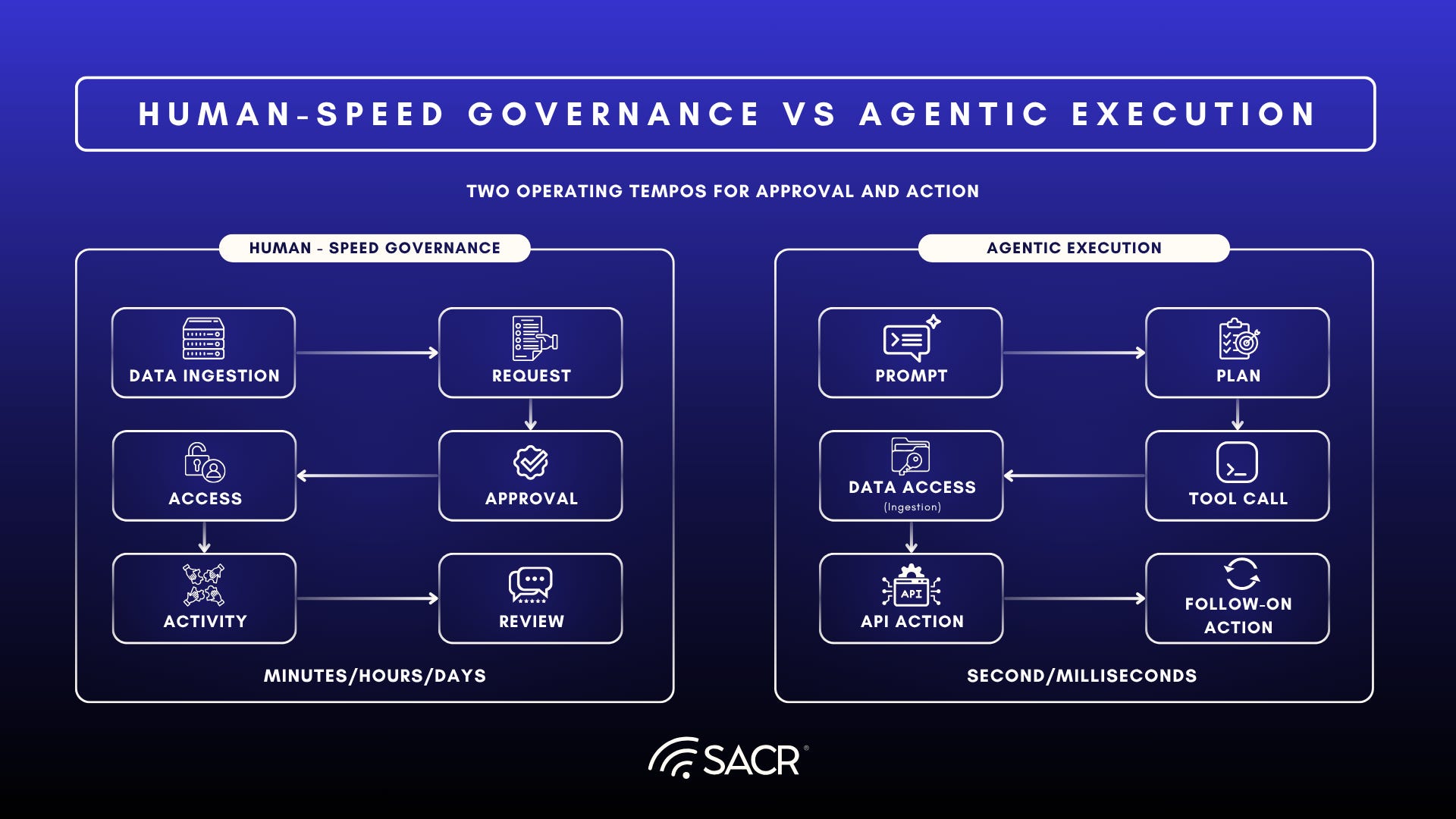
This speed of human governance versus agentic execution creates a structural mismatch. Most enterprise governance assumes a sequence of data collection, request, approval, access, activity, logging, alerting, investigation, and remediation with each of these steps taking significant time to execute and subject to delays. Agentic systems compress the activity portion of that chain. A single agent run can select tools, request or use credentials, query data, invoke APIs, write code, modify records, and trigger follow-on workflows before a human reviewer has enough context to intervene.
The same compression is visible in the broader cyber market:
AI-assisted cyber operations are moving from advice to execution. Anthropic reported disrupting a cyber espionage campaign in which a threat actor used Claude Code’s agentic capabilities not merely for guidance, but to execute parts of the attack flow against roughly thirty targets, with successful intrusions in a smaller number of cases. Anthropic characterized the activity as a large-scale cyberattack executed without substantial human intervention.
Frontier cyber models are changing vulnerability economics. Anthropic’s Project Glasswing announcement stated that Mythos Preview had already found thousands of high-severity vulnerabilities, including vulnerabilities in every major operating system and web browser. The UK AI Security Institute’s evaluation of Claude Mythos Preview found that the model could autonomously attack small, weakly defended and vulnerable enterprise systems in a cyber range once network access had been gained. Even when constrained to defensive release channels, these capabilities show that vulnerability discovery and exploit construction can become more automated, scalable and repeatable.
The disclosure-to-exploitation window is collapsing. Google Cloud Security reported that the window between vulnerability disclosure and active exploitation collapsed from weeks to days in the second half of 2025, alongside AI-assisted probing and continued data-focused theft. Google concluded that organizations should move toward more automatic defenses.
Attackers are using AI for vulnerability exploitation and initial access. Google Threat Intelligence Group has documented adversaries leveraging AI for vulnerability exploitation, augmented operations and initial access. This does not mean every exploit is fully autonomous, but it does mean that AI is accelerating the attack workflow at multiple stages.
Zero-day and rapid-exploitation pressure is increasing. CISA’s Known Exploited Vulnerabilities Catalog reflects the need to treat actively exploited vulnerabilities as urgent priorities rather than leave them to ordinary patch cycles. The CrowdStrike 2026 Global Threat Report separately reported that average eCrime breakout time fell to 29 minutes and that zero-day vulnerabilities exploited before public disclosure increased.
These examples matter for ARISE because an enterprise agent can become part of the same speed problem from the inside. A compromised, misdirected, over-permissioned, or poorly governed agent does not need to “break in” like an external attacker. It may already have access to tools, SaaS connectors, cloud roles, code repositories, ticketing systems, data stores, and workflow engines. If it is manipulated through prompt injection, poisoned context, tool abuse, excessive delegation, or a vulnerable integration, it can convert legitimate authority into harmful action very quickly.
Prompt-injection-resistant design therefore requires restricting sensitive-data access and placing additional confirmation or authorization around high-impact actions.
A realistic machine-speed failure pattern looks like this:
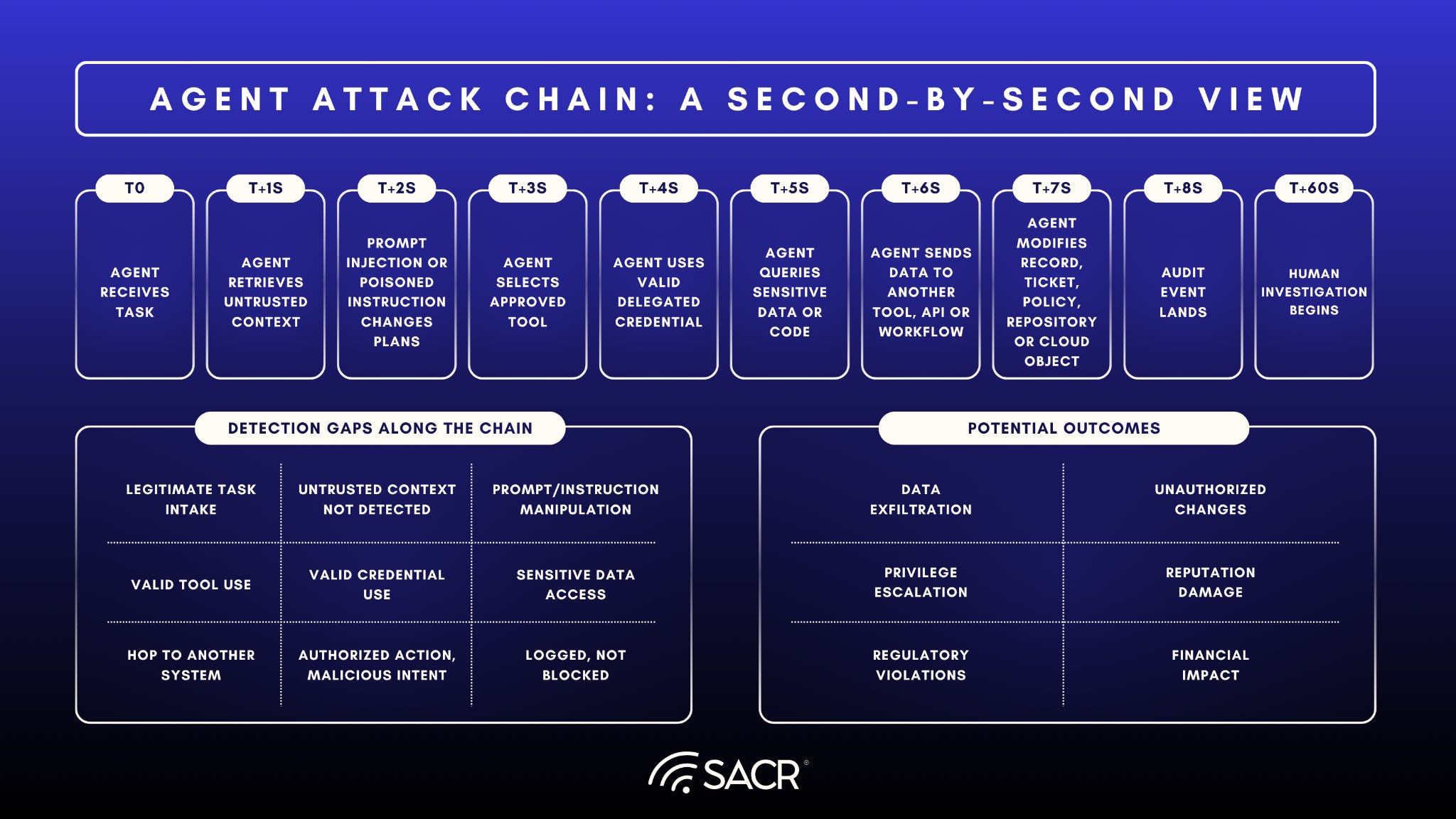
At human speed, this is one suspicious workflow. At agent speed, it is already a completed action chain.
This is why “detect and alert” is not enough for production agent governance. Detection still matters, but the key ARISE question is whether the system can make or influence a decision before the risky action completes. Specifically, ARISE asks:
Can it stop a tool call when the agent’s intent has drifted?
Can it narrow or revoke a credential during a session?
Can it block data movement to an unapproved destination?
Can it require human review before code, SaaS, cloud, or ticketing changes are committed?
Can it quarantine an agent that is chaining tools in an unusual sequence?
Can it preserve evidence linking the prompt, delegated authority, tool, data, policy decision, and outcome?
Lineage of SACR Identity Security Research
The ARISE report is intrinsically and historically related to SACR’s own back catalogue of research from 2025 and 2026 in both the Identity Security and Cybersecurity Governance domains which espoused the concepts of “runtime as the new perimeter” and the convergence of AI and Data security controls and frameworks. ARISE is also a direct response to the rapid adoption of AI-agentic workflows and the need to retrofit agentic runtime controls and governance.
Suggested Further Reading: SACR Identity Research
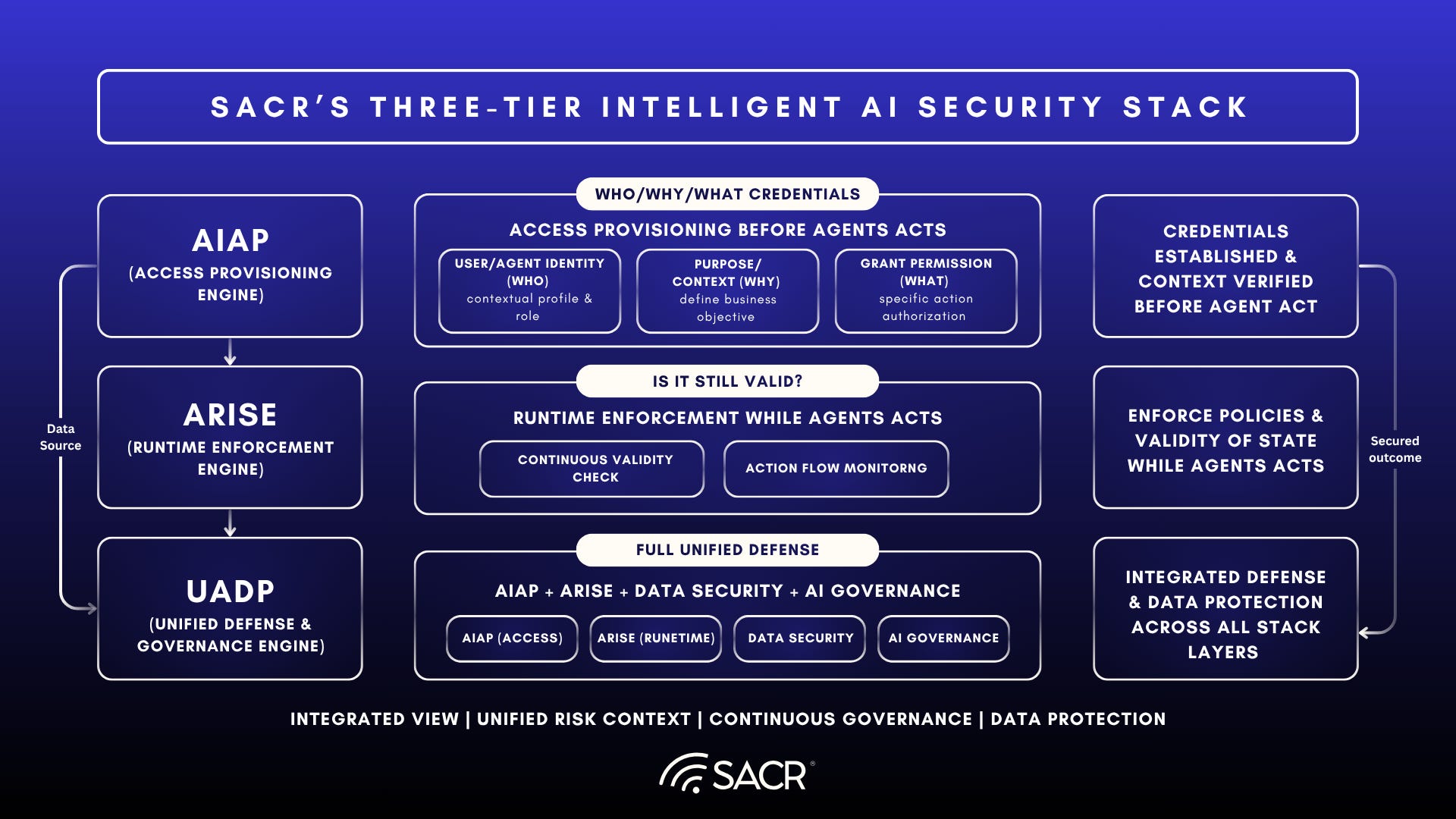
AIAP (Emerging Agentic Identity Access Platforms (AIAP): This report pre-dates the ARISE report and originally charted the emergence of Agentic Identity platforms.
Runtime Security for AI Agents: An Identity Governance Perspective. A report that set the scene for ARISE, published by SACR, including academic research from Kevin He, Shachar Ram and Lauren Place - it introduced the concept of a move from Deterministic Access to Intent-Aware Governance and provided a framework for managing agents.
The Convergence of AI and Data Security: An Industry-Wide Technoscope of Unified Agentic Defense Platforms. The initial report by Lawrence Pingree of SACR that introduced the UADP (Unified Agentic Defense Platforms) definition and convergence of AI and Data security disciplines.
Taken together, this prior work establishes the architectural context for ARISE: AIAP addresses agent identity and access, while ARISE extends that control into live runtime action governance.
Emerging Market Definition for ARISE
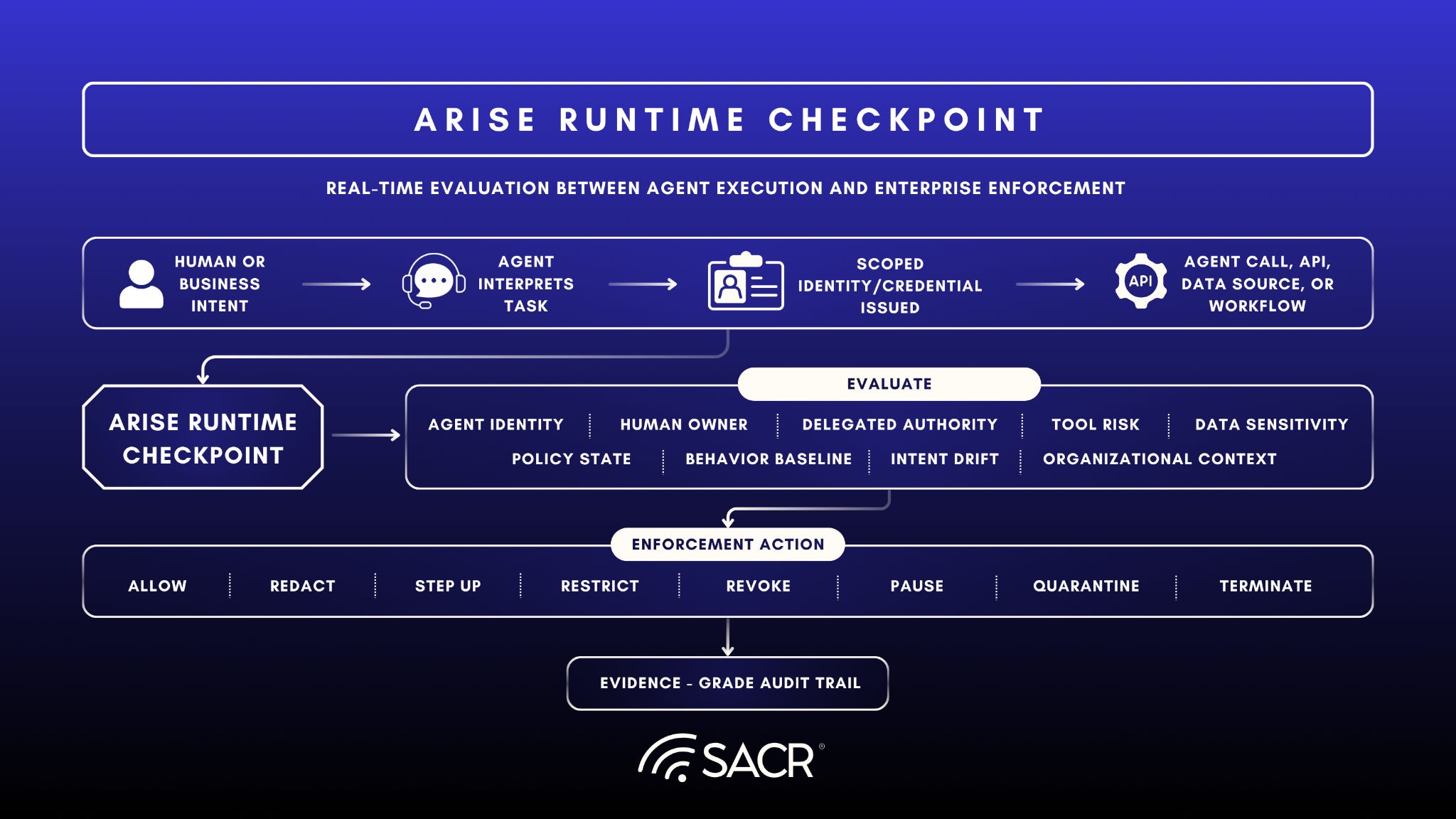
ARISE, or Agentic Runtime Identity Security Enforcement, is the security discipline and vendor category for governing AI agent actions while they are executing. It combines identity context, delegated authority, tool governance, behavioral analysis, organizational context, data sensitivity, policy decisions, and audit evidence to decide whether an agent action should proceed.
ARISE focuses on the point where agent intent becomes enterprise action:
Tool calls
MCP / A2A interactions
API invocation
Credential issuance or use
SaaS actions
Cloud actions
Data access, movement, or transformation
Workflow execution
High-risk autonomous remediation
ARISE is a narrower framework than generic AI security. Prompt and response controls help, but ARISE also needs identity, tool, data, policy, and runtime action context.
Breaking Down the ARISE Control Model
Recent runtime-governance research similarly argues that enforceable policy must operate outside the model itself, separating deterministic controls from probabilistic model judgment.
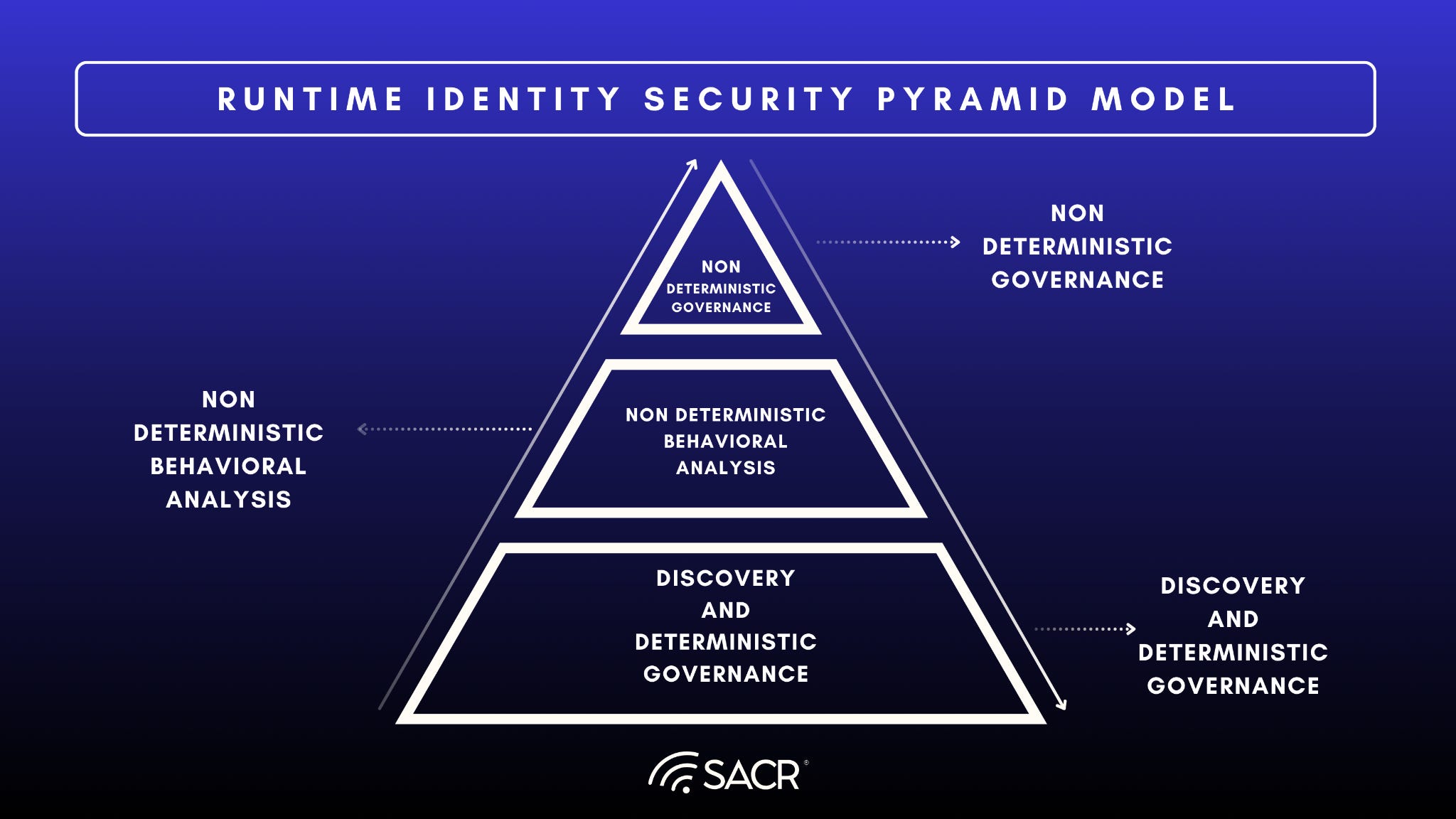
Layer 1: Deterministic governance
Question: What is this agent allowed to access?
Layer 1 defines baseline boundaries. It includes agent identity, ownership, scoped credentials, allowed tools, approved APIs, RBAC/ABAC policies, JIT access, least privilege, MCP authorization, and human approval requirements for known high-risk actions. MCP deployments can expose credentials, tokens, and secrets when authentication material is over-scoped, improperly stored, logged, or passed through agent workflows without adequate controls.This layer is necessary but not sufficient. It tells the enterprise what should be allowed under normal conditions, but it does not fully answer whether a live, context-specific action remains appropriate.
Layer 2: Behavioral and intent analysis
Question: What is the agent doing, and does that behavior make sense?
Layer 2 observes runtime behavior. It includes prompt-to-action reconstruction, tool-call telemetry, credential-use monitoring, intent drift detection, sequence analysis, behavior baselining, anomaly scoring, task-alignment analysis, and session-level evidence.
This is where ARISE begins to diverge from static identity security. A system must understand not only whether the agent has access, but whether the agent’s behavior still matches the task, policy, data context, and business purpose.
Layer 3: Dynamic runtime governance
Question: Should this action continue, be narrowed, escalated, or stopped right now?
Layer 3 uses live signals to change the outcome. It includes allow, block, redact, pause, step-up authentication, human-in-the-loop review, scope reduction, credential revocation, quarantine, termination, ticket creation, and SOC escalation. Layer 3 is where visibility turns into control.
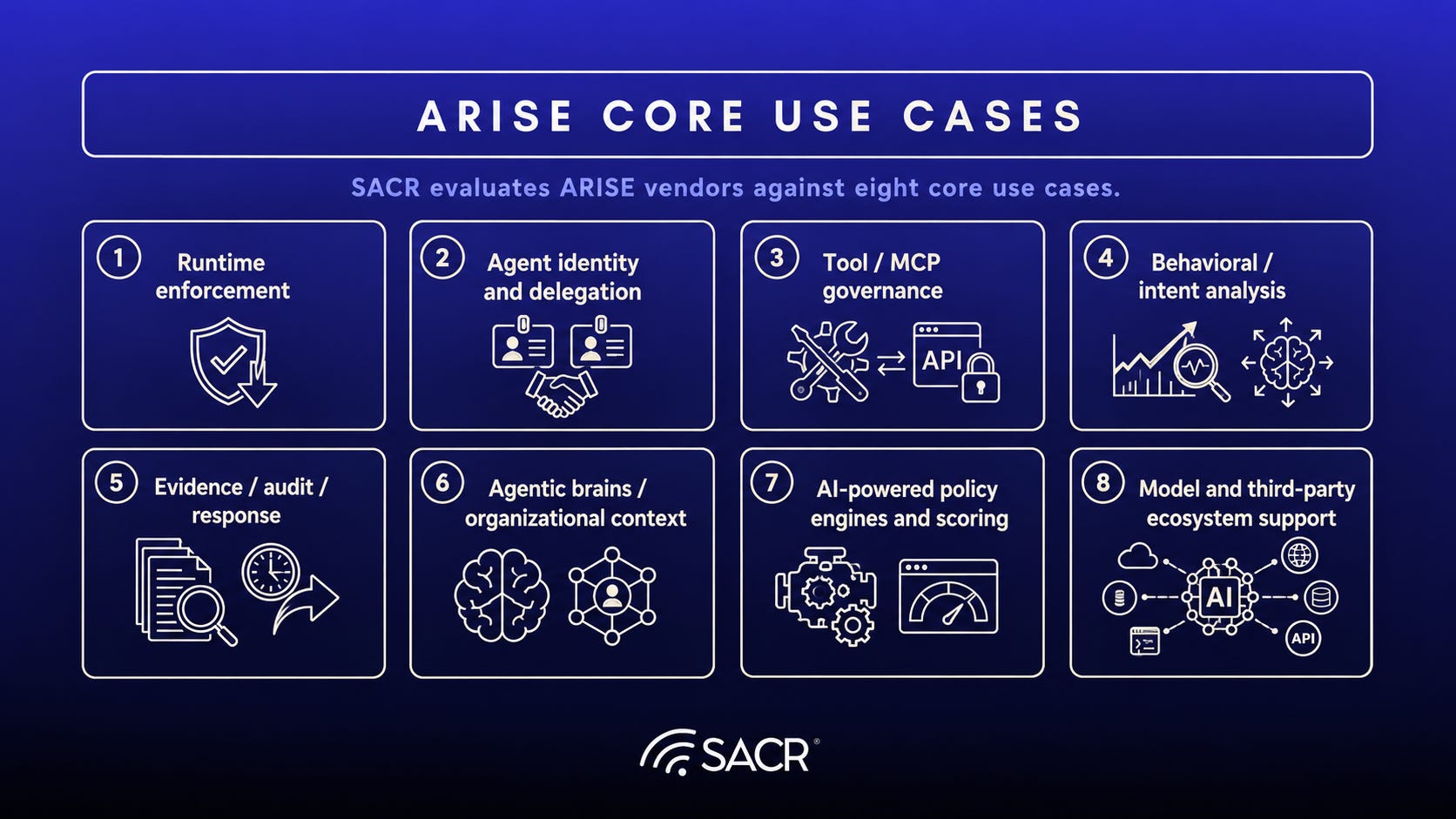
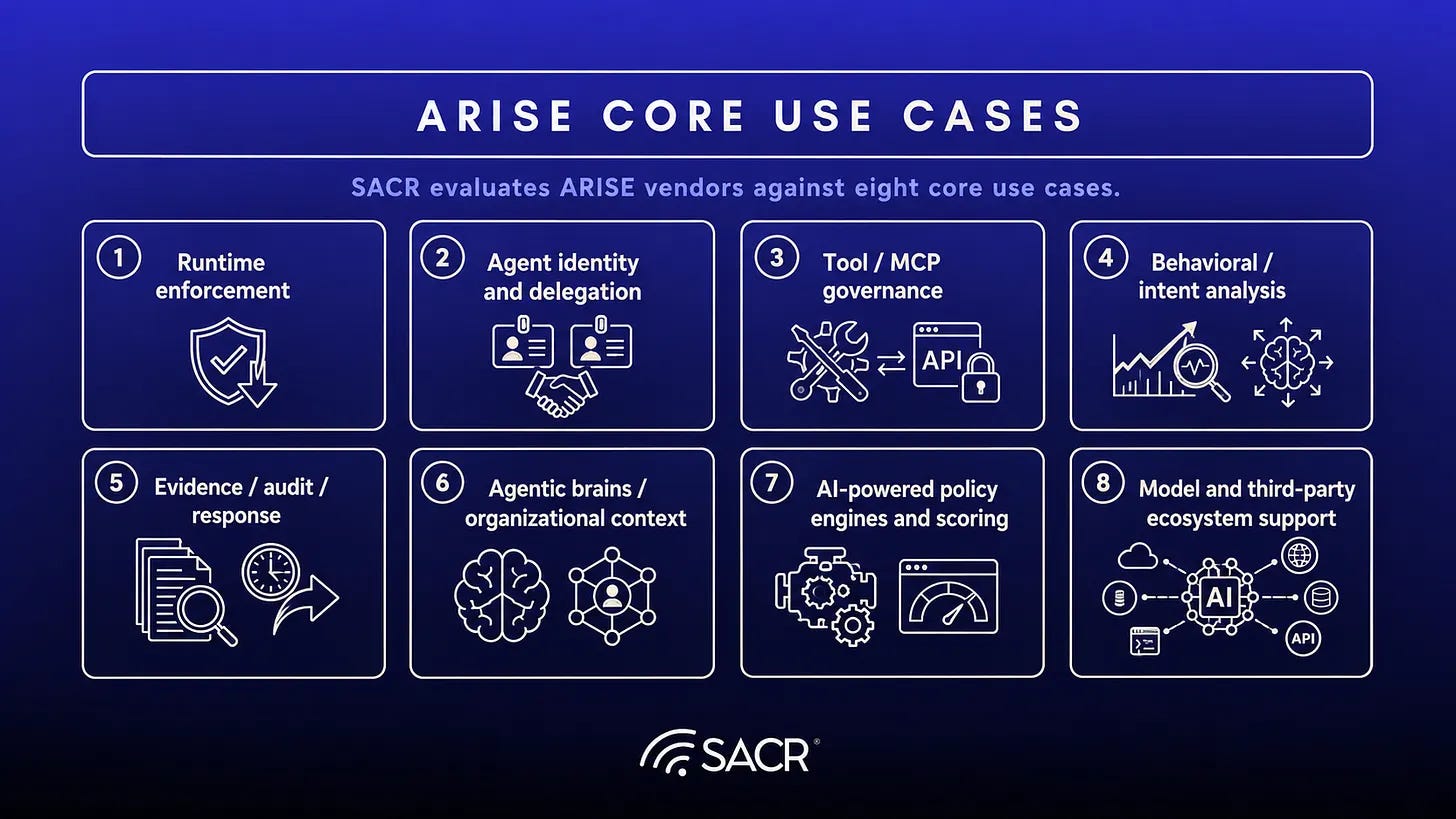
Runtime enforcement
Can the product block, allow, redact, pause, approve, revoke, quarantine, terminate, or restrict agent actions before completion?
Agent identity and delegation
Can the product tie agent activity to a human owner, NHI, credential, entitlement, delegated authority, session, and task?
Tool / MCP governance
Can the product inspect and govern MCP servers, tool calls, tool risk, tool authorization, and action-level policy? Is there a facility to manage token cost and recommend/enforce model choices?
Behavioral/intent analysis
Can the product detect intent drift, anomalous tool use, risky sequences, and deviations from expected task behavior?
Evidence/audit / response
Can the product reconstruct prompt, decision, tool call, data touched, action, outcome chains with audit-grade evidence?
Agentic brains / organizational context
Can the product build or use an organization-aware context graph across owners, agents, roles, workflows, policies, data, tools, identities, and prior decisions?
AI-powered policy engines and scoring
Can the product use AI or reasoning systems to author, recommend, simulate, tune, explain, or score policy and action risk?
Model and third-party ecosystem support
Can the product govern multiple foundation models, third-party LLMs, open-source models, self-hosted models, SaaS agents, browser agents, coding agents, MCP ecosystems, and customer-selected deployment patterns?
What ARISE is Not
ARISE is a runtime enforcement layer, not a repackaging of existing categories.
IAM and IGA govern identity, entitlement, access, and review as relatively static disciplines, whereas ARISE governs live action. This distinction places ARISE downstream of provisioning and policy, focused instead on the moment-by-moment validity of what an agent actually does.
PAM addresses privileged session brokering and credential management, functions that remain necessary but insufficient on their own. ARISE extends this by asking whether a specific agent action remains valid given its current context, a question that session-level controls are not designed to answer. Similarly, NHI governance tools discover and manage non-human identities at the inventory and policy level, yet coverage gaps persist: not every NHI functions as a reasoning agent, and not every NHI platform exercises control over runtime behavior.
ISPM and IVIP contribute meaningful visibility through identity posture assessment and relationship graphing, but visibility alone does not constitute enforcement. ARISE closes this gap by operating in-path, where decisions about agent actions are actually made. CNAPP and CDR similarly protect cloud workloads at the runtime layer, but agentic risk extends beyond workload protection into intent, delegated authority, tool invocation, and multi-step action chains that these platforms are not built to evaluate.
DLP and DSPM assess data sensitivity as a standalone concern, while ARISE incorporates data risk as one input within a broader agent action decision that also weighs identity, context, and intent. AI gateways offer prompt inspection and response filtering at the LLM layer, but this filtering operates without visibility into identity, delegation chains, tool usage, or business-process context, leaving a structural blind spot that ARISE is designed to address.
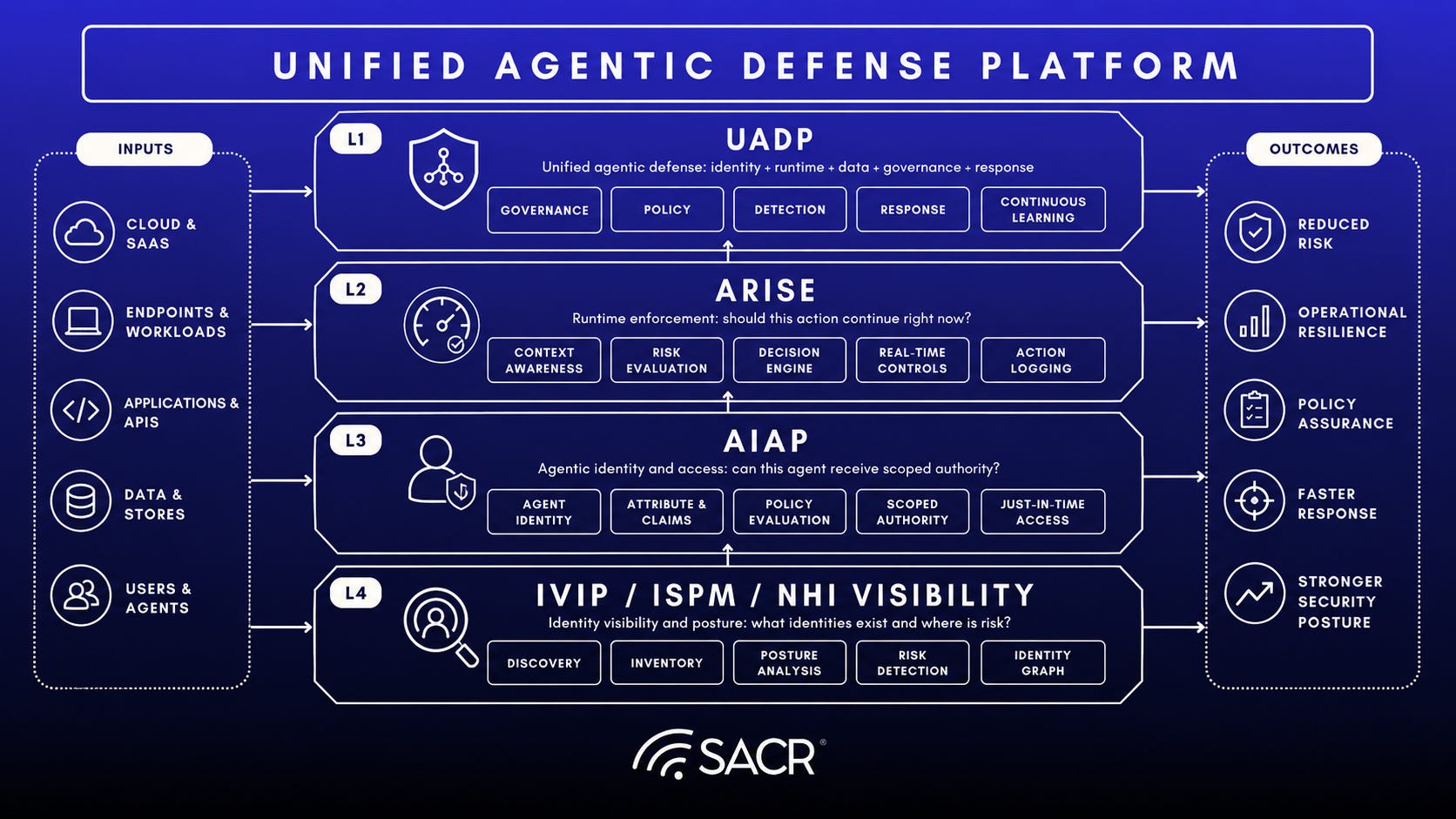
ARISE should be understood as a sub-discipline within the broader Unified Agentic Defense Platform (UADP) architecture, rather than a standalone category. It occupies a specific functional layer, responsible for runtime action governance, that complements and depends on the other capabilities described above.
Why Identity Context is a Central Theme
Agents act through authority. Identity security must therefore evolve from “who has access?” to “what is the agent doing with delegated authority right now?” ARISE adds the runtime identity question that IAM alone does not answer: a valid credential does not make a live agent action valid. The enterprise needs to know which agent acted, who owned it, whose authority it used, which credential was issued, which tool was called, what data was touched, what policy applied, what decision was made, and what evidence survived.
That authority may come from:
A human user
A service account
A workload identity
An API token
An OAuth grant
A cloud role
A SaaS connector
A privileged session
A short-lived credential
Another agent
Why Organizational Context Matters
The next phase of ARISE will depend on organizational context. Static rules and prompt filters cannot understand business purposes on their own. This context layer is what allows an enforcement engine to distinguish a legitimate high-privilege action from an unusual or excessive one.
The implication is straightforward: agent security is becoming a reasoning problem over enterprise context, not only a policy matching problem. Strong ARISE platforms will increasingly need context graphs that map:
Agents and owners
Tools and MCP servers
Identities and delegated authority
Business workflows
Data boundaries
Policies and exceptions
SaaS and cloud resources
Prior decisions and approvals
Normal vs. abnormal action sequences
Why Runtime Visibility, Real-Time Analysis, and Control Matter So Much
Runtime visibility, real-time analysis, and continuous control represent the critical threshold where security transitions from passive observation into active enforcement. In autonomous agentic environments, relying solely on static posture, discovery, or post-event logging leaves an enterprise exposed to high-velocity risk. Because agents operate by calling tools, requesting credentials, invoking APIs, and executing multi-step workflows in seconds, traditional after-the-fact detection creates a timing mismatch where audit events land long after the blast radius has already been established.
Achieving effective agentic security requires instrumenting and correlating three core runtime capabilities:
Runtime Visibility (Continuous Observability): Provides granular telemetry across prompt-to-action chains, tool calls, data access requests, credential utilization, and agent-to-agent interactions. It captures complete execution context to establish audit-grade evidence and session lineage.
Real-time Analysis (Behavioral & Intent Analysis): Dynamically evaluates live telemetry against organizational context, behavioral baselines, and policy boundaries. It detects subtle intent drift, anomalous tool sequences, privilege misuse, and unsafe data movement before execution completes.
Real-time Control (Dynamic Enforcement): Sits directly in the execution path to execute pre-completion interventions such as allowing, blocking, redacting, pausing, stepping up authentication, restricting scope, or terminating an action, ensuring delegated authority remains safe in production.
ARISE Control Depth
ARISE Control Depth (ACD) Framework
To objectively evaluate vendor capabilities and enterprise readiness, SACR establishes the ARISE Agentic Control Depth (ACD) Maturity Model. This framework measures the operational effectiveness of agentic security controls across six distinct levels of capability, ranging from passive observation to fully autonomous, self-healing runtime governance.
The three-layer ARISE model and the ACD framework describe different aspects of the same control problem. The three-layer model describes the functional architecture of ARISE: deterministic governance, behavioral and intent analysis, and dynamic runtime governance. ACD measures the maturity and depth with which those capabilities are implemented, from blind execution at ACD 0 through autonomous adaptive governance at ACD 5.
The Six Levels of ARISE Control Depth:
ACD 0 — Ungoverned / Blind Execution: The organization lacks visibility into agent deployment, tool usage, or delegated permissions. Agent actions occur without logging or policy boundaries.
ACD 1 — Static Discovery & Inventory: The system inventories non-human identities (NHIs) and static agent definitions. It maps static access rights but lacks visibility into real-time tool calls or intent.
ACD 2 — Post-Event Telemetry & Alerting: Agent activity, tool invocations, and data queries are captured in logs or SIEM/SOAR platforms. Alerts are generated after the action completes, providing auditability but no active prevention.
ACD 3 — Perimeter & Deterministic Guardrails: Static gateway rules, prompt-filtering guardrails, and role-based access control (RBAC) enforce hard boundaries. The system blocks known bad inputs or unauthorized APIs but cannot evaluate subtle intent drift or complex action sequences.
ACD 4 — Inline Pre-Completion Interventions (Production Baseline): The control plane sits in-path during tool selection, credential brokering, and API execution. It can evaluate live contextual signals such as data sensitivity, intent drift, and delegated authority to allow, block, redact, pause, step-up, or restrict the action before impact.
ACD 5 — Autonomous Self-Healing Governance: Real-time contextual graphs dynamically adjust policy boundaries, revoke compromised delegation, isolate rogue agents, and continuously recalibrate least-privilege scoping across multi-agent workflows without manual intervention.
For enterprise security teams preparing to deploy autonomous agents in production, the minimum operational threshold should generally be ACD 4 for any target use case involving sensitive data, credential usage, or critical workflow execution. Anything below ACD 4 leaves the enterprise reliant on post-event remediation after a machine-speed blast radius has already been established.
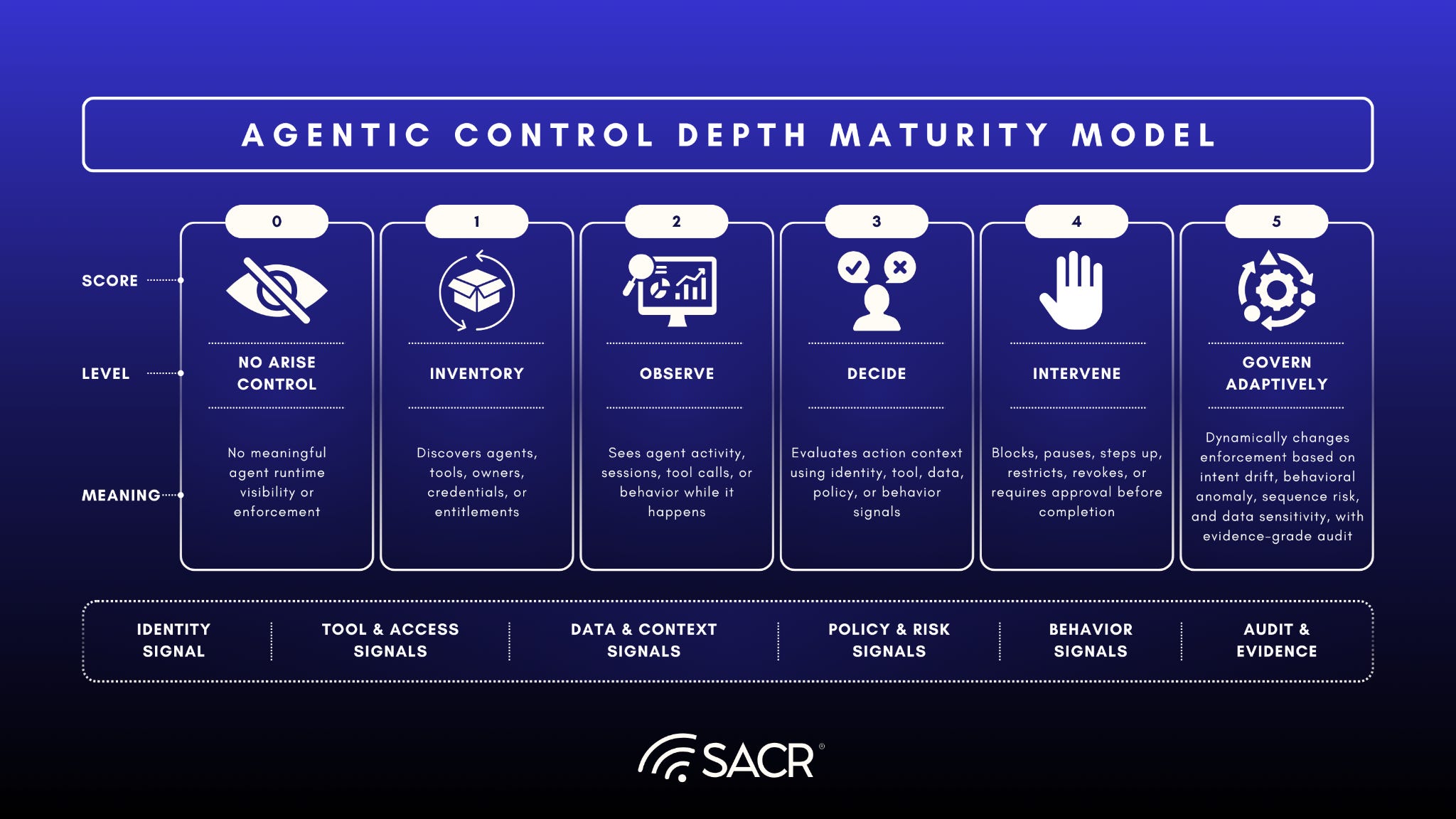
Important: No single control point covers the entire ARISE problem. Identity, gateways, endpoints, MCP, secrets, graph analytics, and runtime AI security each capture part of the risk surface. The minimum threshold for credible production ARISE should generally be ACD 4.
Vendor Evaluation Framework
SACR evaluated and scored ARISE vendors using evidence-weighted criteria. Vendors did not receive full credit for marketing claims, dashboard visibility, or after-the-fact logging alone.
Primary Evaluation Dimensions
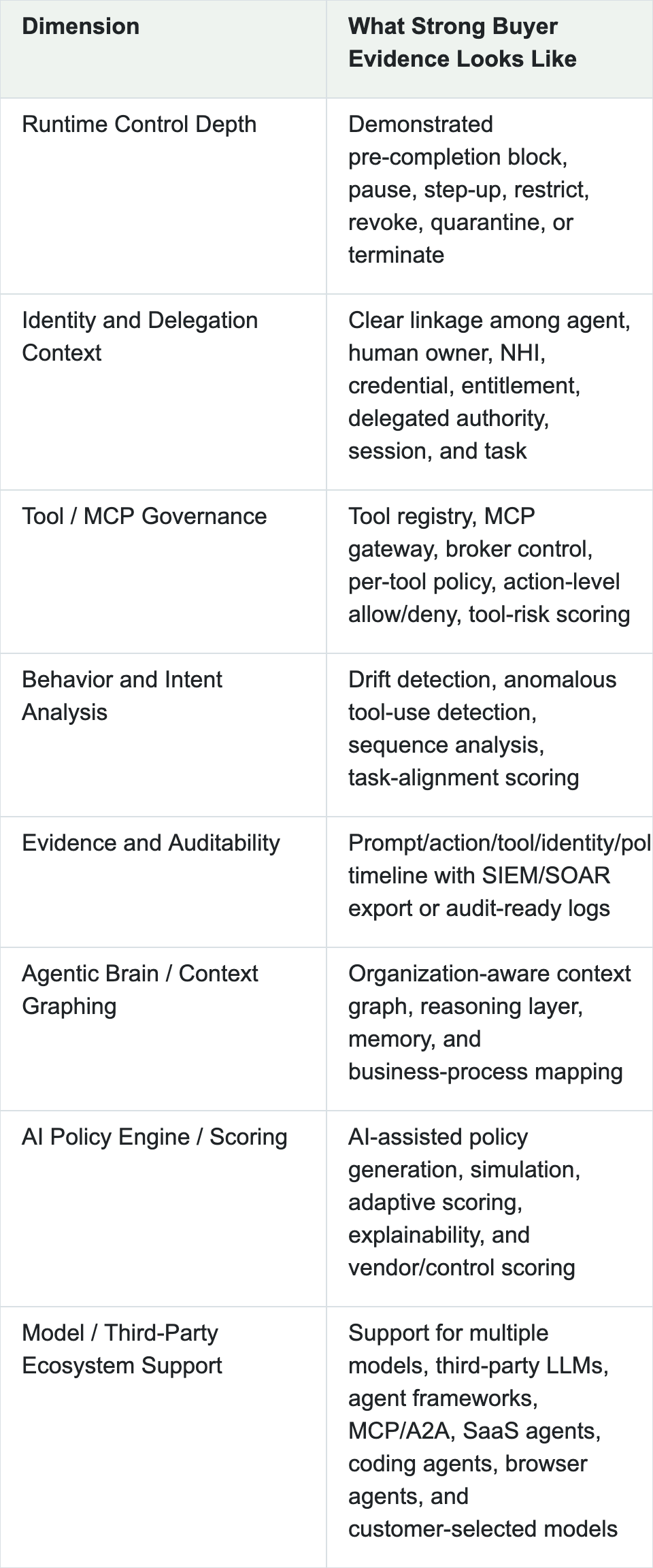
ARISE Vendor Landscape and Use-Case Trends
The ARISE market is forming across several existing security categories rather than emerging from one established product segment. The vendors assessed by SACR approach the problem from different architectural starting points, including identity governance, privileged access and secrets management, AI gateways, MCP and tool governance, runtime AI security, and agent lifecycle assurance.
These starting points determine what each platform can observe, which context it can use, where it can intervene, and how directly it can affect an agent action. Identity-oriented platforms typically provide stronger ownership, entitlement, credential, and delegation context. Gateway-oriented platforms sit closer to prompts, model interactions, and tool requests. Privileged-access platforms concentrate on credential brokering and time-bound authority. Runtime AI-security platforms tend to provide richer behavioral telemetry, sequence analysis, and agent-specific threat detection.
No single starting point automatically produces complete ARISE coverage. The relevant buyer question is whether the platform can connect identity, behavioral, organizational, and operational context to a live decision and influence the action before its consequences become irreversible.
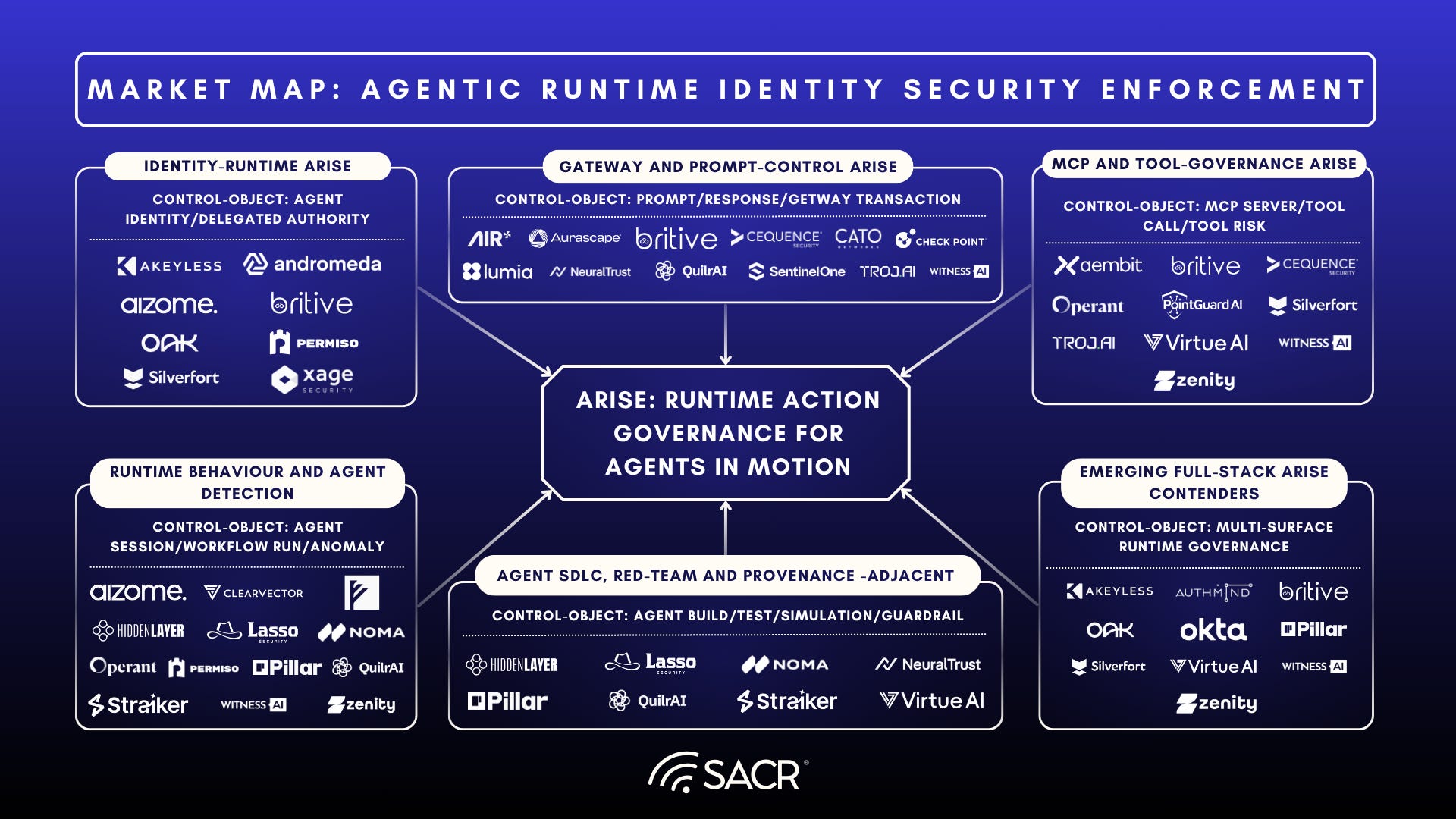
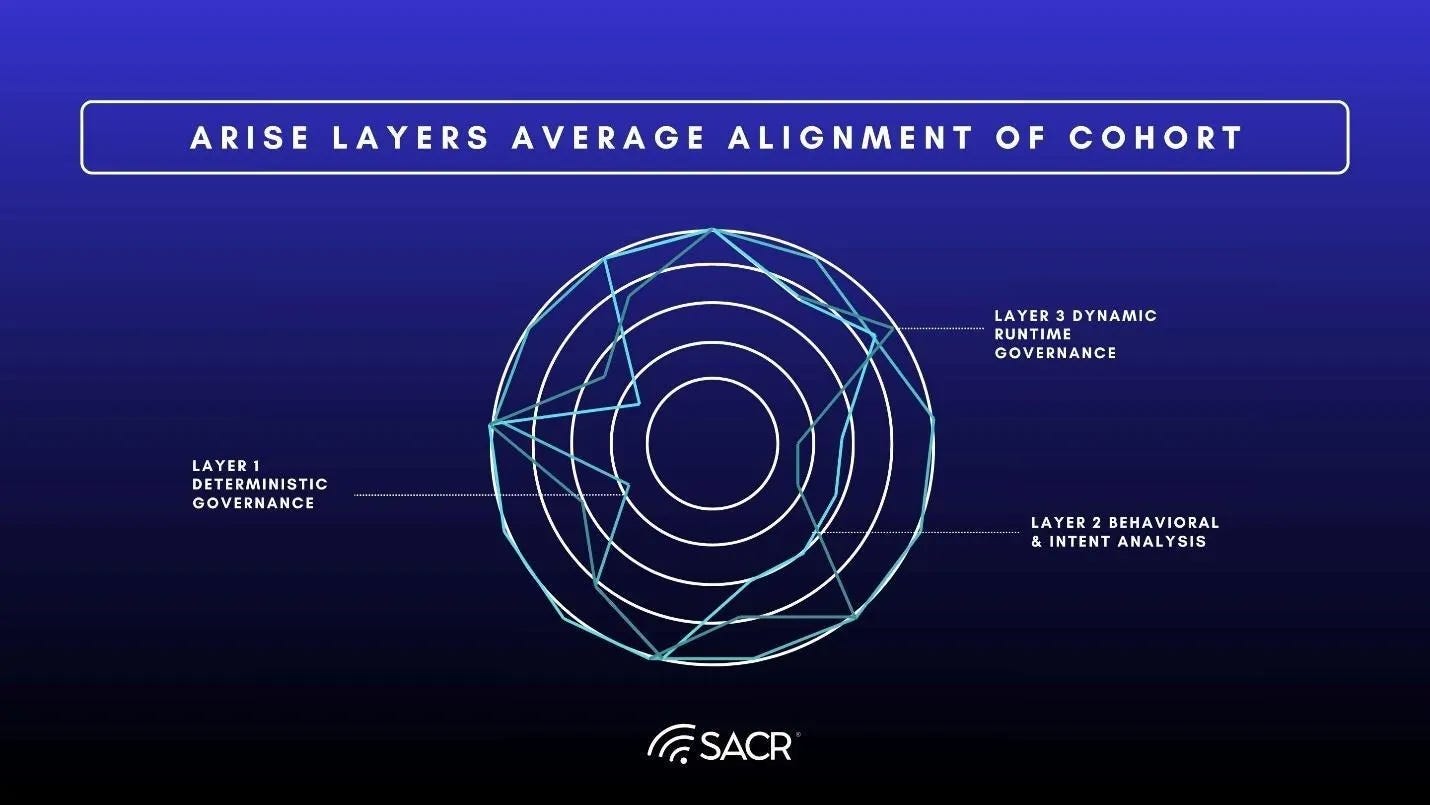
The Market Is Converging Around Three Control Layers
Despite their different origins, the assessed vendors are converging around the three layers of the ARISE model:
Deterministic governance: Establishing agent identity, ownership, permitted tools, approved resources, credential scope, access conditions, and predefined policy boundaries.
Behavioral and intent analysis: Determining whether an agent’s live behavior remains consistent with its assigned task, delegated authority, expected sequence, and organizational context.
Dynamic runtime governance: Using live signals to allow, block, redact, pause, narrow, revoke, quarantine, escalate, or require approval before an action completes.
The first layer is the most consistently represented across the cohort because it extends familiar IAM, PAM, gateway, and policy practices. The second layer is less uniform. Vendors differ in how deeply they reconstruct agent behavior, identify intent drift, correlate tool sequences, and incorporate identity, data, and business context.
The third layer is the clearest point of differentiation. Many vendors can discover agents, display activity, generate risk scores, or create alerts. Fewer can demonstrate that those signals change the outcome of a live action. Buyers should therefore distinguish between observing an agent, recommending a response, initiating an external workflow, and enforcing a decision directly in the action path.
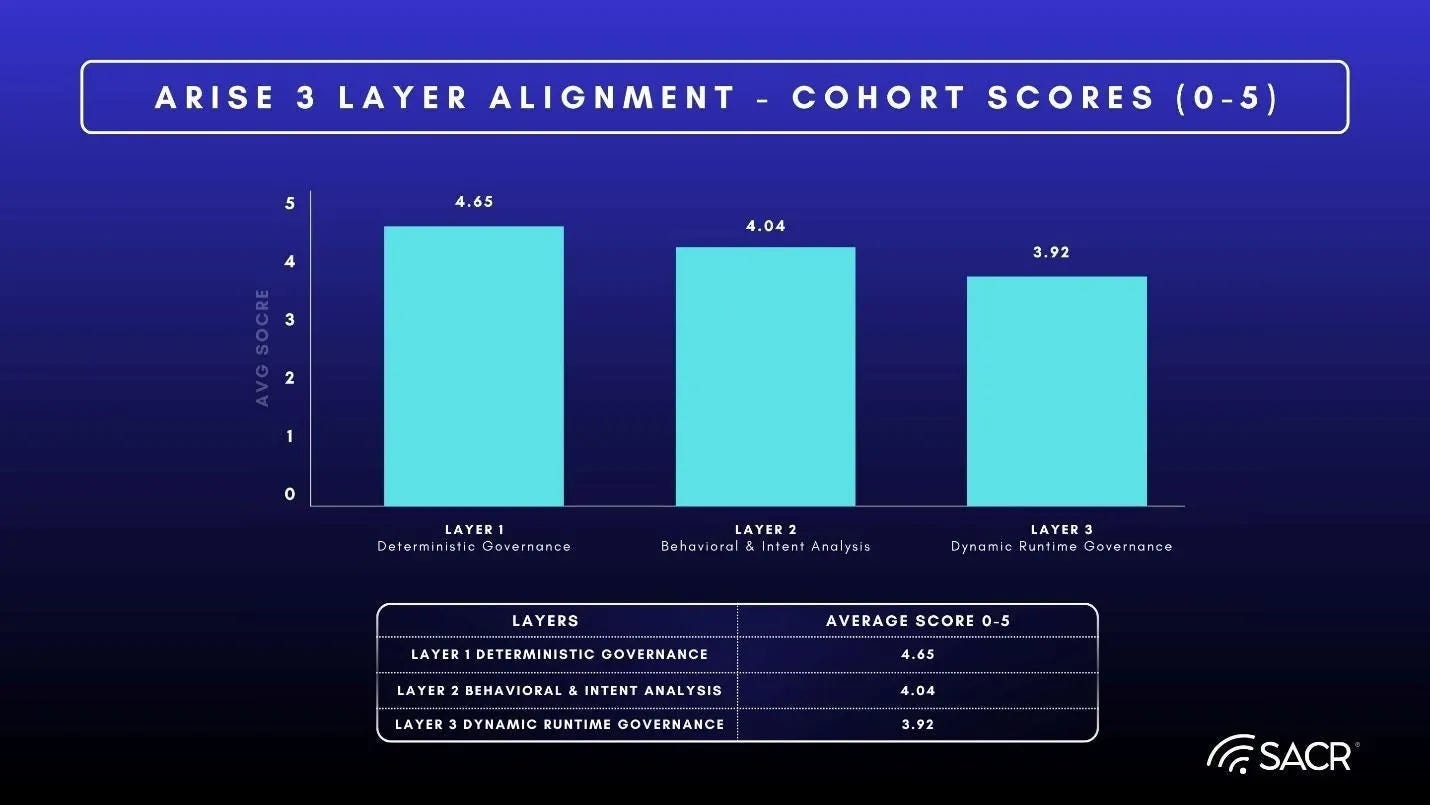
What the Vendor Study Revealed
Discovery and inventory are approaching table stakes
Most vendors can identify at least part of the agentic environment, including agents, MCP servers, tools, service accounts, credentials, owners, and connected applications. The depth of this discovery still varies, particularly across local agents, browser agents, SaaS-embedded agents, coding environments, multi-agent workflows, and shadow AI.
Discovery is foundational, but it does not establish ARISE alignment on its own. Inventory tells an organization what exists. ARISE must also help determine whether the agent’s current action is appropriate and what should happen next.
Identity context and runtime behavior are converging
Identity-oriented vendors are adding activity context, tool governance, and runtime enforcement. Runtime-oriented vendors are adding agent ownership, credential lineage, delegated authority, and entitlement context. This convergence is central to the ARISE market.
Identity data establishes who or what is acting and which authority is being used. Runtime telemetry shows what the agent is doing with that authority. Either signal in isolation can be misleading. A credential may be valid while the action is inappropriate, and anomalous behavior may be difficult to assess without knowing the agent’s owner, task, permissions, and business purpose.
The strongest ARISE implementations connect these forms of context at decision time.
Enforcement granularity is a meaningful differentiator
A broad allow-or-block decision at the application or tool level is less precise than controlling a particular action against a particular resource. For example, a platform may allow an agent to use GitHub while preventing it from deleting a repository, or permit database access while restricting writes to a sensitive table.
Buyers should test whether policy can operate at the level of:
Individual tools and tool functions
Named resources and data stores
Read, write, delete, export, or administrative actions
Particular credentials, scopes, and delegated identities
Specific workflow stages
Data classifications and destinations
Agent-to-agent handoffs
This level of granularity determines whether ARISE can reduce risk without unnecessarily stopping legitimate agent workflows.
Human approval remains the dominant pattern for consequential actions
Human-in-the-loop review is widely used for sensitive or ambiguous decisions. Vendors commonly support approval, step-up authentication, escalation, ticket creation, and guided remediation. Fully autonomous response is less consistently available and is often constrained to narrowly defined, high-confidence scenarios.
This is not necessarily a market weakness. Enterprises need enforcement that is explainable, reversible, and calibrated to operational risk. The more important evaluation question is whether the platform can introduce the appropriate intervention before completion, whether that intervention is an automated block, reduced scope, temporary pause, or human decision.
Evidence quality remains uneven
Vendors varied in the strength of the evidence supporting their ARISE claims. Some demonstrated live controls and provided technical documentation. Others relied more heavily on architectural descriptions, screenshots, roadmap statements, or adjacent capabilities.
SACR therefore distinguishes between capabilities that were:
Demonstrated during the research process
Supported by technical or product documentation
Described by the vendor but not directly demonstrated
Identified as planned or under development
Runtime-enforcement claims should be tested in a live workflow. Buyers should ask the vendor to show the complete sequence from agent request through policy decision, intervention, evidence capture, and final outcome.
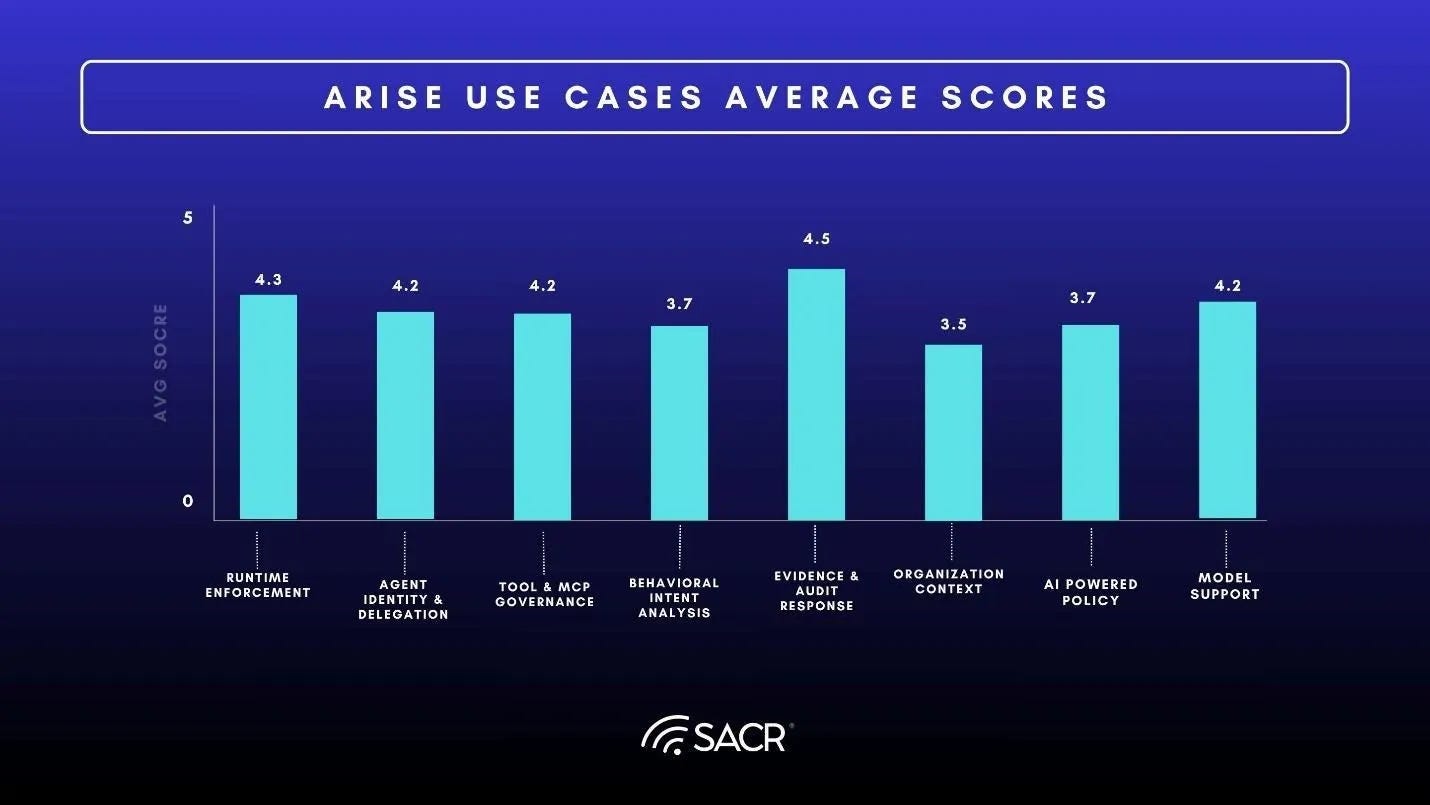
Where Vendors Differentiate
Across the cohort, the most meaningful differences appear in six areas.
1. Runtime insertion point
The insertion point determines which actions a platform can see and control. Current approaches include identity providers, credential brokers, gateways, MCP proxies, agent frameworks, SaaS integrations, endpoints, browsers, cloud workloads, and application APIs.
No insertion point provides complete coverage. Buyers must determine whether a vendor’s enforcement position matches the agent workflows that create the greatest risk in their environment.
2. Agentic Brains and organizational context
Agentic Brains provide the organizational intelligence needed to evaluate an agent’s actions in context. This capability connects owners, agents, identities, credentials, roles, entitlements, tools, data, workflows, policies, prior decisions, and business objectives. It enables the platform to assess not only whether an action is technically permitted, but whether it is appropriate for the agent’s assigned purpose and current operating context.
Vendors differ considerably in the depth and operational use of their Agentic Brains. Some provide a visual context graph or searchable inventory. Others use organizational context directly in policy decisions, behavioral analysis, risk scoring, and runtime enforcement.
Buyers should distinguish between platforms that merely map relationships and those that use the resulting intelligence to affect live actions. The key questions are what context the Agentic Brain contains, how frequently it is updated, whether it informs live policy decisions, and whether the platform can explain which organizational factors affected an outcome.
3. Behavioral and intent analysis
Vendors use different combinations of deterministic rules, behavior baselines, sequence analysis, graph analytics, risk scoring, specialized models, and LLM-assisted judgment. The important distinction is whether the analysis can identify a meaningful change in context or intent during execution.
Buyers should ask what evidence informs the decision, how the system handles uncertainty, whether expected behavior is defined manually or learned from activity, and whether the reasoning can be inspected after an intervention.
4. Action-level enforcement
Platforms differ in whether they can alert, recommend, initiate a workflow, or enforce directly. They also differ in the actions available to them, including allow, block, redact, pause, narrow access, revoke a credential, require approval, quarantine an agent, terminate a session, or escalate to security operations.
These options should be evaluated for latency, reliability, reversibility, exception handling, and production impact.
5. Audit and reconstruction
A useful ARISE evidence trail should connect the agent, owner, task, delegated authority, credential, prompt or request, tool call, data accessed, policy decision, intervention, and outcome. This allows security teams to investigate incidents, explain automated decisions, validate policy, and demonstrate control effectiveness.
Buyers should determine whether evidence is retained at the event, session, workflow, and agent levels and whether it is sufficiently complete for security operations, compliance, and post-incident review.
6. Token cost and model selection
As agent adoption grows, organizations must govern not only what agents can do, but also which models they use and how much they consume. Token-cost management and model-selection controls help enterprises manage operating costs, performance, data-handling requirements, approved-model policies, and regional or regulatory restrictions.
Relevant capabilities include:
Token metering by agent, user, team, application, or workflow
Usage limits and spending thresholds
Rate restrictions
Approved-model policies
Model routing based on cost, risk, performance, or data sensitivity
Controls over externally hosted, private, and self-hosted models
Reporting and attribution of model consumption
Alerts or enforcement when an agent exceeds approved parameters
Maturity remains uneven. Some vendors provide native metering, budget controls, and model routing. Others integrate with AI gateways or consume this information as additional policy context. Buyers should determine whether these capabilities are directly enforced by the ARISE platform, supplied through an integration, or identified only as roadmap functionality.
Six Vendor Patterns in the ARISE Market
The assessed vendors cluster around six overlapping patterns. These groupings describe their primary architectural orientation, not mutually exclusive categories or overall rankings.
Identity-first runtime governance
Identity-first vendors extend identity governance, NHI management, entitlement analysis, and access policy into live agent activity. Their strongest contribution is connecting agent actions to owners, identities, credentials, roles, and delegated authority.
These platforms are most relevant when the primary question is whose authority the agent is using and whether that authority can be constrained or revoked during execution.
Representative vendors: Akeyless, Britive, Silverfort, aizome, Andromeda Security, Oak, Permiso Security, Orchid, QuilrAI, and Xage Security.
Privileged access, secrets, and runtime authority
PAM and secrets-oriented vendors concentrate on preventing agents from holding standing credentials. They broker credentials, issue temporary access, enforce least privilege, and connect authority to particular tools, resources, and actions.
These platforms are particularly relevant where agents interact with privileged infrastructure, databases, cloud resources, development environments, or administrative workflows.
Gateway and prompt control
Gateway-oriented vendors inspect model traffic, prompts, responses, data movement, and tool requests. Many are expanding toward MCP governance, identity-aware policy, redaction, model selection, cost control, and action-level enforcement.
Their effectiveness depends on how much relevant traffic passes through the gateway and whether the platform can connect model activity to downstream identity, credential, application, and resource context.
Representative vendors: Cato, Check Point, NeuralTrust, SentinelOne, Lumia Security, Aurascape, TrojAI, Cequence Security, WitnessAI, AIR Security, Akeyless, Britive, and QuilrAI.
MCP and tool governance
MCP and tool-governance vendors operate close to the point where model intent becomes an external action. They register tools, inspect calls, apply authorization, enforce action-level policy, and retain evidence about how agents interact with enterprise systems.
These platforms provide a practical ARISE insertion point, but buyers should test whether they evaluate only predefined permissions or can also respond to behavioral changes during execution.
Representative vendors: Operant AI, PointGuard, Cequence Security, TrojAI, VirtueAI, Zenity, WitnessAI, SentinelOne, Check Point, Silverfort, Britive, aizome, AIR Security, NeuralTrust, QuilrAI and Aembit.
Runtime behavior and agent detection
Runtime-oriented vendors focus on behavior baselines, anomalous sequences, intent drift, agent activity reconstruction, and threat detection. Their strongest contribution is determining whether an agent’s activity remains consistent with its expected task.
The central evaluation question is whether detection changes the outcome in time or produces an alert after the action has already completed.
Representative vendors: Noma Security, HiddenLayer, Ent.ai, Permiso Security, Straiker, Pillar, Zenity, WitnessAI, Operant AI, Lasso Security, aizome, QuilrAI, and ClearVector.
Agent lifecycle assurance and adjacent controls
Some vendors begin with agent discovery, posture management, red teaming, MCP scanning, prompt-injection testing, development guardrails, or predeployment validation. These controls can reduce runtime risk, but they should not be treated as runtime enforcement unless the product can govern live actions.
Representative vendors: Pillar, Lasso Security, VirtueAI, Noma Security, HiddenLayer, Straiker, and NeuralTrust.
A smaller group of vendors combines several of these patterns. Their platforms bring together gateway controls, MCP and tool governance, runtime behavior analysis, agent identity and delegation context, Agentic Brains, audit evidence, and response.
Breadth can improve coverage, but buyers should still verify the depth and maturity of each claimed control rather than assuming that a broad platform provides complete ARISE functionality.
Representative vendors with broad ARISE alignment: AIR Security, Akeyless, AuthMind, NeuralTrust, Oak, Okta, Silverfort, and Zenity.
Common Capability Gaps
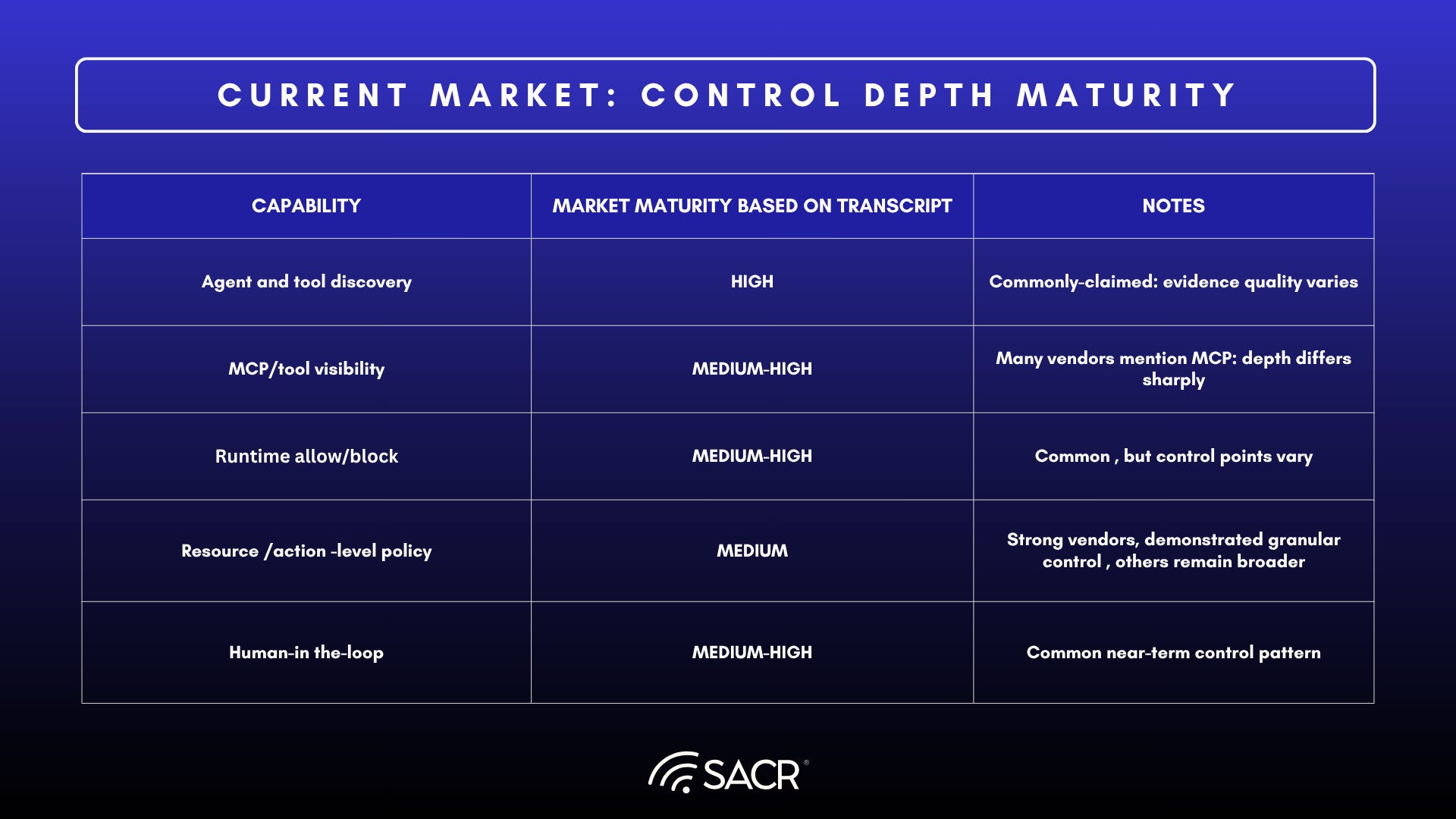
The study identified several areas where market maturity remains uneven:
Detecting behavioral drift after a tool or MCP server has already been approved
Connecting agent actions consistently to human and machine owners
Applying policy at the individual action and resource level
Combining identity, behavioral, data, and business context during a live decision
Using Agentic Brains directly in policy and enforcement rather than only for visualization
Intervening before completion across distributed and multi-agent workflows
Safely automating remediation without creating unacceptable operational risk
Attributing token consumption and model usage to particular agents, owners, and workflows
Enforcing model-selection and spending policies across heterogeneous AI environments
Preserving an audit trail that explains both the agent action and the enforcement decision
Distinguishing generally available functionality from demonstrations, limited previews, and roadmap plans
These gaps reinforce the need to evaluate ARISE through demonstrated outcomes rather than category labels or feature counts.
SACR Analyst Take
ARISE is currently a control-plane pattern in the process of becoming a more recognizable market category. Buyers should not shortlist vendors based only on whether they use agent-security language. Nor should they assume that identity, gateway, secrets, or runtime origins determine which platform is most mature.
The best fit depends on where the organization’s agent risk is concentrated and which intervention points are technically and operationally available. A company concerned primarily with privileged agent access may favor a different architecture from one focused on SaaS agents, coding agents, MCP ecosystems, adversarial manipulation, or model-cost governance.
Across these scenarios, the strongest ARISE implementations combine identity context, runtime control, and an Agentic Brain capable of interpreting an action within the organization’s operating context. Token-cost and model-selection controls add a further governance layer by determining whether agents are using approved models and resources within defined operational boundaries.
Buyers should require vendors to demonstrate who or what is acting, whose authority is being used, what action is being attempted, why the action is considered safe or unsafe, which model and resources are being used, and how the product can change the outcome before completion.
Market Direction
The current market patterns are likely to converge. Identity platforms are adding runtime telemetry and enforcement. Gateway and runtime-security platforms are adding identity and delegation context. PAM and secrets platforms are extending credential controls into agent and tool workflows. MCP-security vendors are becoming action-level policy enforcement points. Agentic Brains are increasingly connecting these controls through shared organizational context, while token-cost and model-selection capabilities are extending ARISE into the operational governance of enterprise AI consumption.
This convergence may occur through product development, partnerships, integrations, or acquisition. It does not require every ARISE vendor to become an end-to-end agentic-security platform. The nearer-term measure of market leadership is whether a vendor can connect relevant identity, behavioral, organizational, and operational context to a safe, timely, and auditable runtime decision.
Future View: ARISE Market Destination: Unified Agentic Defense Platforms (UADP)
Although we believe ARISE is an early emerging and rapidly growing category, SACR views ARISE as an emerging sub-category of Unified Agentic Defense Platforms from a market storyline perspective, corresponding to the rise of short term exponential adoption of AI Agents in the enterprise and as runtime monitoring requirements and implementation urgency has evolved increasing demand from enterprises to manage the emerging risks of Agentic Identities and the users that command AI agents. Over the longer-term horizon, SACR views UADP as the ultimate destination of end-to-end agentic security. ARISE provides the immediate-term necessary runtime identity enforcement for agents in motion; we believe ARISE providers will evolve towards UADP capabilities alongside comprehensive data security (DSPM/DLP) features, AI governance lifecycle management, shadow AI discovery, and end-to-end threat detection across the entire agentic attack surface. See (The Convergence of AI and Data Security: An Industry-Wide Technoscope of Unified Agentic Defense Platforms)
CISO Guidance
CISOs should use ARISE as a procurement, architectural, and governance lens when deploying and scaling production agentic AI. Beyond evaluating basic functional capabilities, security leaders must establish rigorous criteria across access boundaries, operational visibility, and real-time intervention points to ensure agent autonomy remains secure and aligned with enterprise risk tolerance.
Key Questions Buyers Should Ask
Which agents exist, and who owns them?
Whose authority does each agent use?
What tools, APIs, MCP servers, SaaS apps, and data sources can the agent touch?
Can access be scoped, short-lived, and revoked?
Can the product evaluate whether a live action matches the declared task?
Can the product detect intent drift or risky tool chains?
Can the product block, pause, restrict, revoke, terminate, or escalate before completion?
Can the product reconstruct the action chain for audit, incident response, and board reporting?
Can policies be simulated and tuned before enforcement?
Does the platform support the organization’s mix of first-party, third-party, open-source, SaaS, browser, coding, and self-hosted agent/model environments?
CISOs should evaluate each vendor against the following criteria:
Agent identity model: Does the product distinguish autonomous agents, delegated agents, NHIs, service accounts, and human users? Can it map ownership and responsibility?
Runtime enforcement point: Where does enforcement occur (identity provider, MCP gateway, AI gateway, endpoint, API connector, SaaS integration, workload identity broker)? Can the product block before action completion?
Granularity of control: Does policy apply at model, app, tool, API, resource, field, action, or data-classification level? Can it differentiate read/write/delete/export actions?
Behavior and intent analysis: Does the system correlate prompts, tool calls, outputs, sessions, and multi-turn behavior? Does it use deterministic rules, ML, LLM judges, or graph analytics?
Human-in-the-loop and JIT: Can sensitive actions trigger approvals, step-up authentication, or just-in-time access? Are approvals auditable and integrated into collaboration tools?
Credential and delegated authority handling: Are agents prevented from directly holding secrets? Does the system handle OAuth delegation, service accounts, and workload identities?
MCP and tool ecosystem coverage: Can it discover, score, approve, block, and monitor MCP servers and tools? Does it detect tool drift or only pre-launch risk?
Audit, reconstruction, and evidence: Can the buyer reconstruct what happened, who/what initiated it, what credentials or tokens were used, what data was touched, and why policy allowed or denied it?
Operational integration: Does it integrate with SIEM, SOAR, ITSM, Slack/Teams, IGA, IDP, XDR, MDM, cloud, SaaS, and developer platforms?
Maturity and roadmap: Which capabilities are GA, beta, preview, roadmap, or custom/professional services?
Buyer Decision Rules
Avoid treating visibility-only tools as runtime enforcement. For production agent governance, prioritize vendors that can prove the following are viable options for security enforcement for AI agents:
An in-path enforcement point
Clear identity and delegation mapping
Tool/MCP-level control
Behavioral or intent signals
Pre-completion intervention
Evidence-grade audit
Operational tuning and false-positive management
Coverage across the buyer’s real agent surfaces
Practical Recommendations
Actionable steps for leaders
Examine ARISE use cases and select and prioritize those that are most important to the individual organization/industry vertical. Make these the key criteria for the ongoing evaluation and select candidate solutions based on their ability to fulfil these specific needs.
Use the 6 listed patterns that define distinct groups of vendors to understand their specific strategic alignment and raison d’etre – as this may be a more significant factor than the otherwise small differences in actual capability between vendors in this cohort.
Since the solutions are mostly capable of meeting at least the first 2 layers of ARISE, assess whether the layer 3 dynamic runtime governance is a requirement now or in future and evaluate specific capabilities that provide the necessary real-time governance and enforcement that is needed now and projected for the future.
Determine whether the provided integrations and workflow connectors are able to provide strong 2 way actions between key business applications and operations toolsets out of the box. For any not listed or supported by a given vendor, understand the possibilities to build these integrations and evaluate this as part of a POC
Time to value and ROI are as important to consider as the technical capabilities of ARISE vendors, and the product selection process should also take care to select solutions that can be readily managed by the target organization without the need for protracted training, additional resources or 3rd party managed services.
Where vendors are unable to accurately forecast the licence costs, management overhead and especially any model/token costs, make sure that the procurement process and eventual contractual stipulations protect against unforeseen or punitive charging models that penalise heavy use of the system.
Work with candidate vendors to prepare a projected deployment plan, integration and migration schedule and identify key success criteria and time-bound project objectives as part of a 30/60/90-day view.
Identify metrics to track and the metrics that will be used to assess this – particularly important if the underlying objectives and success criteria are part of a wider AI transformation program or any other process that has pre-assumed goals relating to consolidation aims, resource reduction and efficiency gains.
Use SACR research and associated control frameworks and measurement criteria to inform the project and business of the compliance and risk management aspects of any underlying threats or risk exposure that the company is tracking and to verify whether the specific controls and governance facilities of ARISE vendors can meet those objectives.
Business Impact
ARISE should be framed as an enablement category, not only a defensive control. Enterprises want the productivity benefits of AI agents, but they need a governance model that allows safe autonomy. The business case is straightforward: ARISE lets the business use agents without asking security to accept blind autonomy.
ARISE supports five business outcomes:
Move agents into production safely
Security teams can approve agent use with enforceable controls rather than blanket prohibition.
Preserve productivity while reducing risk
Low-risk actions proceed automatically; high-risk actions receive friction, escalation, or denial.
Reduce blast radius
Agents can be constrained before risky chains propagate across tools, data, APIs, and SaaS apps.
Improve accountability
Every action can be tied to an agent, owner, delegated authority, policy, tool, data context, and outcome.
Support compliance and board reporting
Agentic workflows become auditable, explainable, and defensible.
Conclusion
AI agents will force identity security to operate in real time. The enterprise cannot rely only on provisioning, entitlement review, prompt inspection, or after-the-fact audit when agents can act through delegated authority at machine speed. The security control must move closer to the action. ARISE gives security leaders a practical framework for that shift. It defines the runtime enforcement layer that evaluates agent identity, delegated authority, tool risk, data context, behavior, policy, and organizational context before the action completes. It also gives vendors a clearer standard: do not claim ARISE based on visibility alone. Prove where the product can decide, intervene, and generate evidence. As agents move into production, the strongest platforms will govern more than access. They will decide whether the agent’s live action still makes sense.
SACR final takeaway: The future of agent security is runtime action governance, not access approval. Traditional access control models evaluate static permissions and entitlement grants before an interaction begins, but autonomous AI agents operate dynamically across multi-step action chains, tool invocations, and delegated authority. As agents execute tasks at machine speed, static authorization and post-event logging fail to prevent high-risk operations before impact occurs. Effective security requires continuous, in-path evaluation of every live tool call, API request, credential usage, and data movement in real time to determine whether an action should be allowed, constrained, or blocked before completion.
Research Methodology
This research by Software Analyst Cyber Research (SACR) is based on proprietary analyst interpretation of vendor briefings, market research, product materials, public technical sources, practitioner discussions, and SACR’s emerging ARISE evaluation framework. Findings are directional and should be validated against product demonstrations, GA capability status, customer evidence, and implementation details. The agentic AI security market is changing rapidly, vendor capabilities, terminology, and category boundaries may evolve after publication.
Full Vendor Profiles and Assessments:
The following section lists profiles and associated ARISE Use Case and layer alignment for all Vendors that provided a briefing and demo to SACR for this report. The selection in this report is not exhaustive but includes representative vendors from all of the 6 patterns observed and a variety of both pure play ARISE vendor solutions as well as some platform-play vendors who also offer a wider set of identity management, governance and compliance toolsets.
aizome
Vendor Overview
aizome positions its platform around accountable enterprise AI agents, with a focus on discovering agent use, applying identity-centered control, and containing drift at runtime. The solution is a pure-play ARISE rather than a broad security platform with ARISE added on, although the company draws on past experience in asset management, SSPM-style discovery, and normalizing data from many enterprise systems.
aizome will suit an organization already seeing agent adoption across SaaS, workflow automation, coding tools, local agents, and internal applications. The promise is: know which agents exist, what they connect to, and whether their actions remain in policy. The operational appeal is also evident, particularly around enabling agents to use enterprise systems without leaving a messy trail of static API keys, overly-permissioned tokens, or one-off integrations.
aizome describes demand from customers for token and cost management, and says this capability is already working. That matters, because agent accountability is not only a security question. It quickly becomes a control-plane question for consumption, governance, and ownership.
AIR Security
Vendor Overview:
AIR Security is a Tel Aviv-based AI security company founded in 2025. The founding team and leadership bring an experienced Israeli cyber background, with experience across offensive operations, vulnerability research, AI research, and threat intelligence. The team also includes considerable experience and repute in the CSO function. The product’s raison d’etre is that As enterprises deploy AI agents, they’re connecting to more tools, data, and third-party services, the agents make decisions based on the information they encounter, leaving security teams with limited visibility into what is influencing them, what they can access, and what actions they take. AI agents effectively need a new kind of firewall; one that protects what enters their context.
AIR has raised $50M at a $250M valuation from Sequoia and GreenOaks. The team cited roughly 40 engineers and said the company is already working with customers and expanding its capability. SACR’s initial view is that AIR sits between AI supply-chain security, runtime agent control, and identity-aware data movement control. AIR covers a broader agent security platform, with ARISE alignment strongest where AirControl and AirDefend govern live agent behavior, tool use, MCP use and data movement.
The main offering is presented as four product areas: AirControl, AirDefend, AirFilter and AIR Marketplace. AirControl is the base governance and posture layer for endpoint, cloud and SaaS agents. Next, AirDefend is the runtime protection layer with observability, alerting, blocking and steering. Meanwhile AirFilter is the agent context firewall, originally focused on skills, plug-ins, MCPs and add-ons, and extending toward web and dynamic organizational content. AIR Marketplace is the curated “app store for agents” concept, curated by client teams, departments and custom groups.
The likely buyer is a security organization that already has agent adoption pressure from engineering, AI transformation teams, automation groups or business users building their own add-ons.Those enterprises need a secured by default ‘marketplace for agents’. AIR’s own customer examples included large enterprises and banks, some of whom are already seeing tens of thousands of internally built add-ons. If agent skills and add-ons grow like browser extensions and internal scripts did in the past, security teams will need a control plane to cope with this.
Akeyless
Vendor Overview
Akeyless is a broader identity and secrets security platform rather than a pure play ARISE vendor. The ARISE-relevant capability is presented as Agentic Runtime Authority, sitting alongside established secrets management, certificate and key management, dynamic secrets, PAM and password management, and discovery and observability capabilities.
The company positions its current platform around three operating pillars: discovery and observability, protection and management, and access and permission. Its customer pitch is built around unifying credential and secure access management for humans, machines, and AI agents. That wider platform context is relevant for ARISE because the agent controls are not separate. They inherit the same gateway, authentication, authorization, API, CLI, SDK and audit center used elsewhere in the platform.
Akeyless cited Fortune 10 and Global 50 customers, major cloud provider partnerships, and an embedded integration with Thales CipherTrust. It also stated that the platform processed more than 200 billion transactions in 2025 and expects to double that figure in 2026. The design has clearly been exercised at machine identity scale.
The usual buyer profile is a large enterprise with mixed managed-identity types and maturity. Akeyless does not assume that every customer can jump straight to a secretless pattern. It supports persistent identities, ephemeral or just-in-time identities, and secretless access in the same platform. Useful for organizations that have older static processes in production and newer agentic automation arriving at pace.
AuthMind
Vendor Overview
AuthMind positions its main offering around agentic AI identity security, covering discovery and visibility of agents and non-human identities, governance and policy enforcement, behavioral analytics, continuous audit, and responsed automation. The product is a broad offering. It sits in the wider identity security and runtime protection area, with ARISE-relevant coverage across shadow agent discovery, agentic ITDR, agent governance and posture, NHI and secret usage monitoring, and automation-led response.
The company has been operating for five years. The first three years were bootstrapped, followed by a larger funding round, with the vendor stating a runway of at least 18 months. Claimed revenue nearly doubled in the last quarter, driven by demand around agentic AI, NHI security, and identity runtime protection. Most customers were described as Fortune 100 organizations. IBM OEMs AuthMind services, and the company is backed by Ballistic Ventures, IBM, F5, and others.
Go-to-market messaging is aimed at larger organizations that have already run into blind spots around agents, service accounts, secrets, and cloud or SaaS access. The practical customer question is not just “find me shadow agents”, but “what do I do about the unauthorised access”. It is built for environments where visibility alone is not enough and where findings need to be pushed into identity systems, ServiceNow, Jira, SOC and SOAR processes, SASE tooling, network controls, or Terraform.
Industry focus was not described as sector-specific. The vendor points more to enterprise-scale cyber operations, cloud, SaaS, and identity teams that need to handle agent and NHI growth across mixed estates and on-premises. The suggested fit is for firms with substantial identity complexity, multiple directories or IDPs, secrets management, cloud platforms, and a need to link activity back to human owners. That will suit banks, telcos, healthcare, technology, and other regulated organizations, rather than midsize looking for a lighter governance add-on.
Britive
Vendor Overview
Britive is aligned with the privileged access, cloud entitlement and identity security market rather than as an ARISE-only point product. The relevant ARISE capabilities are delivered through Britive ARCTM (Agentic Runtime Control), an extension of its existing platform model: human users, service or non-human identities, and agentic identities are treated as first-class identity types with common access, ownership and policy controls.
The current organizational fit is strongest where the client already operates just-in-time access, zero-standing privilege, credential checkout, cloud access governance and service-account governance, then wants to apply the same operating model to agents and MCP tools. This is, however, not framed as a separate agent security console. The typical customer profile is a cloud-heavy enterprise, or its security engineering team, platform engineering group, or any regulated technology organization that wants identity and privilege controls to remain close to the point of execution.
Market messaging is centered on consolidation: one access model across human, NHI and AI identity rather than another stand-alone control plane.
ClearVector
Vendor Overview
ClearVector’s current offering is best understood as identity detection, identity threat detection and response, and agentic runtime visibility for cloud-native environments. ClearVector builds a live operating model of identity activity across humans, NHIs, third parties, AI agents, and people using AI tools. It then uses that model to surface risk, reconstruct activity, recommend guardrails, and support isolation by identity or resource.
The ideal buyer profile is not only “enterprise” clients but potentially all those with a significant investment in cloud hosted applications and cloud-native apps. ClearVector describes a number of additional attributes: hyperscaler use, a dedicated security function, AWS or GCP preference as the primary hyperscaler, meaningful cloud spend, software engineering or AI development, and ideally Okta or Entra. Azure is supported, but the vendor’s center of gravity is AWS and GCP. That fits the DevOps and cloud-native scenario particularly well.
Notable reference customers cited include GreyNoise. GreyNoise had stringent SOC2 requirements to meet and had special requirements related to data-store protection. Investors referenced include Scale, Menlo Ventures, Okta Ventures, and Kevin Mandia.
NeuralTrust
Vendor Overview
NeuralTrust is a Barcelona-headquartered AI security vendor with about 40 employees, with additional offices in London, New York and Munich. Current customer concentration is mostly Europe and Spain, with additional customers in Brazil, South Africa, and the US. The strongest sector fit is regulated financial services, insurance, and other European organizations where AI governance, language coverage, and data sovereignty are key requirements.
The company has recently closed a $20M seed round and is focusing this funding on European expansion before a later US push. NeuralTrust also cites direct investment and endorsement from the European Union and European Innovation Council. That helps in this segment because the EU AI Act and GDPR are now part of the buying context and preference in that region.
The product suite has four components. TrustLens provides discovery, observability, governance, inventory, and risk scoring for agents, MCP servers, and endpoint agents. TrustTest provides red teaming for agents and AI applications. TrustGate is the agent gateway, acting as a proxy between users and LLMs or MCP servers. TrustGuard is the security module for runtime protection and policy enforcement.
NeuralTrust is not only an ARISE-style runtime enforcement vendor. It is more of a full AI security lifecycle platform with gateway controls, guardrails, red teaming, discovery, compliance mapping, and managed services. Professional services and SOC operational support are available as add-ons. Multi-tenancy is supported, with Santander cited as a multi-region example using different tenants by region.
Oak
Vendor Overview
Oak positions its product as an identity operating system for human identities, non-human identities and AI agents. The platform is intended to consolidate functions usually spread across identity providers, IGA, PAM, ISPM, ITDR, NHI management and emerging agent governance tooling. The vendor describes this as one platform for all identity types, with identity governance, identity security and agentic remediation brought into a single control plane. The company was founded by Shai Morag (CEO, previously CPO at Tenable, CEO of Ermetic, and CEO of Secdo) and Tal Marom (CPO, previously VP Product at Tenable, VP Product at Vulcan Cyber, and Head of Product at Salesforce/Datorama). Oak stated that its $60M seed round was led by Greylock, Accel and CRV.
Oak’s core message is that most established identity tools were built only for human identity and periodic governance. Oak’s view is that this is not enough for a world where service accounts, API keys, workloads and AI agents can outnumber people and act at machine speed. The product is aimed at enterprise identity, security and GRC teams that need continuous visibility, policy control and the ability to close the loop from alert to action. Oak’s ideal customer profile is large-enterprise with a mixed SaaS, cloud, on-premise and homegrown application estate. Oak is particularly relevant where access reviews, Agent and NHI ownership, AI agent discovery, Segregation of Duty and entitlement remediation are already creating operational drag. The current GTM profile is primarily direct to enterprise clients.
Okta
Vendor Overview
Founded in 2009, Okta operates as an independent identity platform rather than a pure-play ARISE supplier. Okta for AI Agents extends Universal Directory, access management, governance, privileged access, posture management and identity threat protection to agent identities and delegated access. Auth0 provides the developer-facing route for building identity into customer and agent applications.
Scale matters here because the control plane depends on integrations. Okta cites more than 10 billion monthly logins, 99.99% uptime and over 8,000 integrations. The partner model is material: vendor figures attribute more than 77% of business and 90% of service delivery to the channel, with over 3,000 partners and 200 specializations. The likely customer is a large or regulated organization already using Okta, or one seeking a common identity layer for people, machines and agents.
The solution provides two key facilities; securing each agent by design and governing all agents from one control plane. The first covers authentication, token exchange, vaulting, data and tool-call controls. The second covers discovery, registry, access policy, privileged credentials, lifecycle management and access revocation.
QuilrAI
Vendor Overview:
QuilrAI positions its platform as a single operational layer for enterprise AI adoption, with the ARISE-relevant scope sitting inside a broader platform that accelerates, secures and optimizes the capability. The main offering includes an LLM gateway, MCP gateway, agent and skill marketplace, model catalog, policy decision engine, discovery sensors, red teaming, and runtime action governance.
The most relevant customer profile is a large enterprise that already has, or expects to have, distributed agent use across central IT, business functions and local developer environments. This configuration assumes mixed control planes rather than a neat single place where all AI runs. Browser agents, coding agents, SaaS embedded agents, MCP servers, local tools, Copilot Studio and Claude-style experiences are all treated as expected parts of the overall estate.
Go-to-market messaging centers around approved AI consumption, runtime control and lower operating friction. QuilrAI provides a marketplace where employees can use pre-approved agents, skills, MCPs and models rather than building everything from scratch. From an ARISE perspective, the useful point is not the catalog by itself, but the combination of catalog governance, gateway enforcement, identity down-scoping and red-team feedback loops.
Silverfort
Vendor Overview
Silverfort is an identity security platform vendor with a broad set of capabilities rather than just the ARISE capabilities. The current platform includes Identity Graph and Inventory, ISPM (Identity Security Posture Management), Universal MFA, NHI security, authentication firewall controls, ITDR (Identity Threat Detection and Response), Access Intelligence, Privileged Access Security and AI Agent Security. The AI agent security capability sits on top of the same identity visibility and decisioning foundation rather than being treated as a separate point product.
The company described more than 1,200 customers, $222 million dollars in funding and more than 65 technology partners. The customer base is deliberately horizontal. The platform is modular and designed to fit organizations of virtually any type and size, from Fortune 50 enterprises to smaller organizations of around 50 employees. Pricing and deployment, rather than product architecture, appear to be the primary mechanisms for scaling.
The strongest vertical industry alignment is in regulated industries, especially financial services, healthcare and insurance. The geographic split was described as roughly 40 percent US, 40 percent EMEA and 20 percent AsiaPac, with AsiaPac growing fastest. Go to market is close to fully channel driven. Silverfort also transacts through Azure and AWS marketplaces where possible, ensuring the channel partner remains involved. In practical buying terms, the likely fit is a mid-market to large enterprise already managing AD, Entra, Okta, Ping, service accounts, PAM gaps and AI agent pilots moving into operational workflows.
Xage Security
Vendor Overview
Xage Security is an identity security and zero trust vendor with a particular history in distributed, regulated, and mixed IT/OT environments. The company was founded around ten years ago after the team saw the direction of IoT and OT compromise, default credential abuse, and external exposure. That background still shapes the product. Xage Security extends its existing identity-based Zero Trust platform to AI, applying the same core security architecture across users, machines, applications, and AI agents.
The portfolio includes Secure Remote Access, Critical Asset Protection, Zero Trust Data Exchange, Privileged Access Management, and Zero Trust for AI. PAM has been in-market for more than two years. Zero Trust for AI is the newer product, introduced roughly a year ago, and is the main ARISE-relevant offering.
Xage Security is best suited to large enterprises, typically above $1B revenue and 1,000 employees, with buyers in the CISO organization and, increasingly, the CIO or Head of AI function. The strongest vertical fit is in critical infrastructure, defense, energy, manufacturing, data center, and hybrid cloud environments. The vendor referenced defense, critical infrastructure, and manufacturing logos, supported by certifications including ISO 27001, IEC 62443, and FIPS 140-3.
Go-to-market is channel-first. Partners mentioned include Optiv, Guidepoint, Worldwide Technology, CyberKnight in the Middle East, Orange Cyberdefense in Europe. The geographic customer ratio is North America-led, roughly 50 to 55 percent of revenue, with increased investment in the Middle East and Europe and some APJ momentum. That profile makes sense for a product with OT, data center, and regulatory appeal.
Zenity
Vendor Overview
Zenity positions its core offering as agentic security rather than a general AI gateway, model broker, or IGA product. The platform covers discovery, observability, exposure analysis, runtime policy, MCP governance and response workflows for enterprise agents, including SaaS-hosted agents, hyperscaler agent services, custom frameworks, coding agents and endpoint-discovered local services.
The vendor describes its earlier focus as “agentic security before it was cool”, which alludes to its past capabilities and longer standing than some of the other ARISE vendors. The vendor’s framing is that agent risk is measured by what the agent actually does at runtime, not just what it is meant to do or what permissions it has on paper.
Customer scale was presented as material. Zenity cited Fortune 20 usage and one Japanese customer running upwards of 200 million agents, with an ambition to reach 1 billion by year end. Those may well not be independently validated claims, but they do indicate that Zenity is building for large-scale, complex and regulated environments rather than lighter requirements.
Typical buyers are security, identity and platform teams dealing with agent sprawl across Microsoft, SaaS, developer tooling and MCP ecosystems. The product looks best suited to organizations that already have IDP, IGA, EDR, workflow and cloud control planes in place and need an agentic security layer to observe, correlate and enforce across them. It is not trying to replace SailPoint, Saviynt, Okta, Entra, Kong or LiteLLM. It uses the rich contextual signals those platforms provide, with contextual runtime, behavioral, and intent signals, to provide end-to-end governance.
It is important to know what is behind the telemetry to monitor those agents and create custom detections. That’s why I build a workbook to monitor Agents in M365 Copilot, Foundry, Copilot Studio and local Agents. https://github.com/davidalonsod/Dalonso-Security-Repo/tree/main/Workbooks/AI-Agents-Monitoringhttps://github.com/davidalonsod/Dalonso-Security-Repo/tree/main/Use%20Cases%20Threat%20Hunting/Monitoring%20AI%20Agents
@Paul Webber Excellent framework. The distinction between post-execution observability and true in-path enforcement is especially important.
We’ve been working on this problem at Argorix from a similar direction: compiled deterministic policy outside the model, agent identity/capability metadata, pre-execution authorization of tool actions, fail-closed runtime enforcement, and cryptographically verifiable evidence of the resulting decision.
What I found particularly interesting is your ACD maturity model. The transition from deterministic guardrails to inline intervention maps very closely to what we’ve been building around “control before execution.”
I’d be very interested in comparing notes on where you draw the practical boundary between ACD 3 and ACD 4, especially for systems where policy decisions and enforcement already occur before the agent action is executed.
Great piece.