

The CISO Guide to Endpoint Control and Prevention (ECP): The Next Architecture for Endpoint Security
New category market definition and buyer framework for securing users, agents, identities, and data at the endpoint. A five zone framework for securing AI-centric software at the endpoint.


Executive Summary
Endpoint security is entering its next architectural transition. For nearly fifteen years, Endpoint Detection and Response (EDR) has been the foundation of endpoint defence for enterprises. It was designed for an era where attackers executed malware, launched processes, and modified files that operating systems could observe. That assumption is rapidly breaking down. Companies like Crowdstrike EDR, SentinelOne EDR, Palo Alto Networks EDR earned that position by answering the question of its era: what did this program do on the machine? EDR watches the operating system. It logs when a process starts, and when a file is written, then matches those events to known attacker behavior. It worked because anything dangerous had to run as a visible program the operating system could see.
This assumption is now failing with AI usage in enterprises today. This is because the way work happens on the endpoint is changing. Three shifts separate the 2026 endpoint from the one most security programs were built for prior to 2023:
The rise of AI coding agents: In 2023, AI in the developer’s tools meant autocomplete that suggested code a human accepted line by line. In 2026, agents such as Cursor, Claude Code, and Copilot agent mode read the codebase, run shell commands, install packages, and complete tasks directly on the machine using the developer’s own permissions.
Capabilities connect through a live protocol, not an installer. The rise of Model Context Protocol (MCP), which did not exist before late 2024, lets agents plug into tools, data, and internal systems at runtime. Each connection is a new link in the supply chain that never appears in a traditional software inventory.
Everyone became a builder (not just engineers). AI tools for employees, Low-code and no-code frameworks can now let someone in finance or operations assemble a working application, workflow, or agent in an afternoon, often with no ticket, no review, and no security checkpoint.
The pattern underneath all three is the same. The risky action is no longer a file the system can scan. It is an instruction written in plain language, carried out by software acting on a person’s behalf, often across steps that each look harmless alone. The endpoint has stopped being a device the operating system governs and become the point where people, agents, applications, and data meet. Securing it means governing that interaction as it happens, not reviewing the process after it ends. These interactions often occur above the operating system, leaving conventional EDR with only a partial view of what is actually happening.
SACR believes this shift will create a new architectural category for the next decade: Endpoint Control and Prevention (ECP).
ECP covers a new vector that EDR’s today miss. They focus primarily on detecting malicious processes after execution; ECP expands endpoint security into a runtime control plane capable of governing AI agents, browser activity, application workflows, identity context, and sensitive data before attacks complete.
The market landscape ecosystem is emerging. We have seen an explosion in companies on the market moving to solve the problem. Specialized vendors are expanding endpoint security across software posture, application enforcement, AI runtime visibility, behavioural analysis, and data-centric controls. Over time, these capabilities are likely to converge into broader endpoint platforms.
EDR to ECP players: CrowdStrike, Palo Alto Networks, SentinelOne have moved to cover the new agentic market complementing their EDR solutions.
Emerging ECP native key players include: Neo Security, Bay Security, Bloom Security, Glow Security, Pluto Security, Origin HQ, Ent, Bold Security, NeutralTrust, and Cyberhaven, which define individual zones through purpose-built architecture. The vendors that already span several zones point to where the category is heading, toward one converged control plane rather than five separate tools. These are leading the charge to solve this market issue. We have partnered closely with the key players to perform our analysis, which is attached in the report.
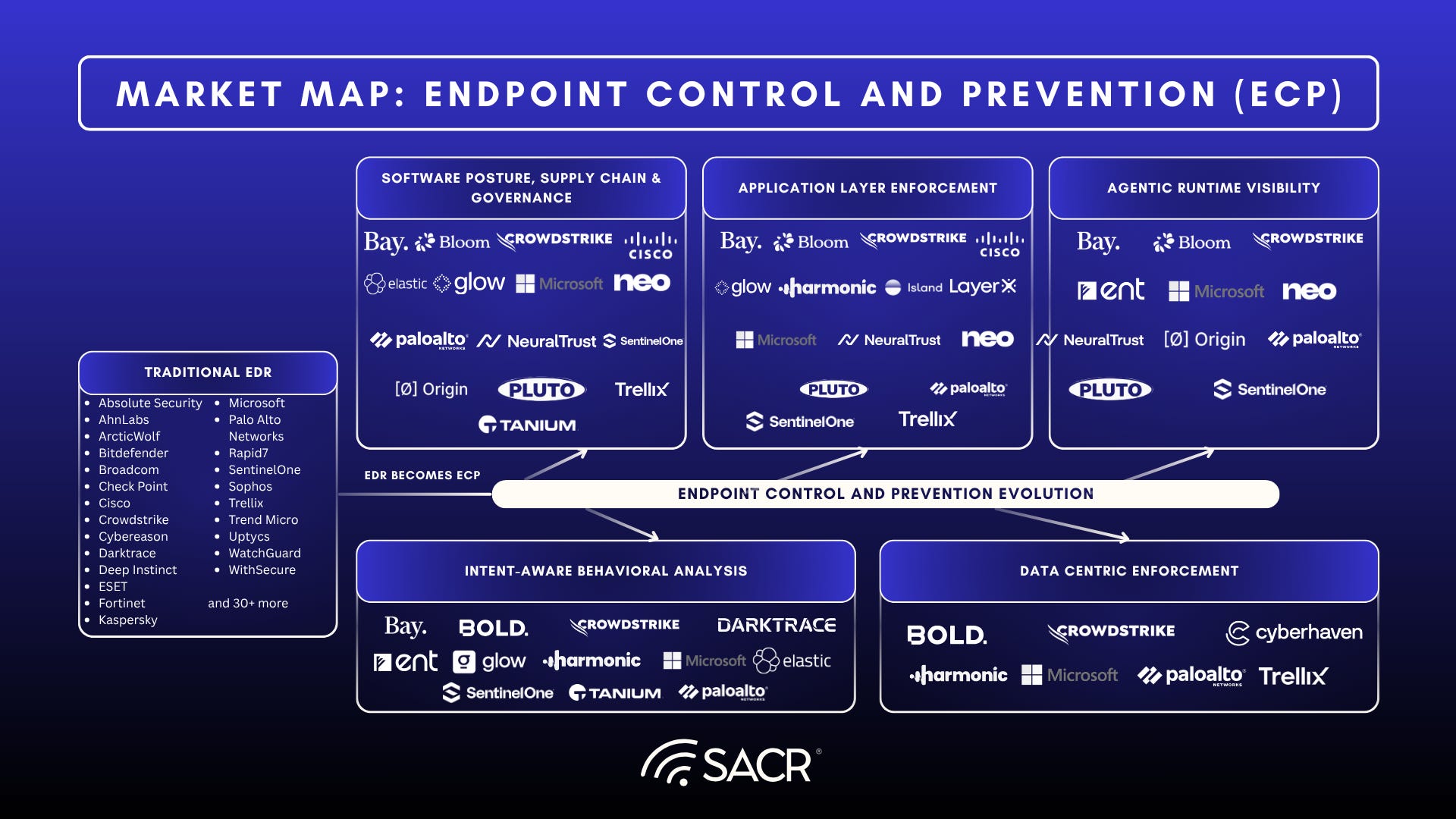
On the left is the EDR market as it stands today, competing on process and file telemetry that has largely commoditized. On the right, that same market fans out into the five zones where endpoint defence is now expanding, from software posture and supply chain governance at one end to data-centric enforcement at the other. The connective idea is that EDR becomes ECP: an extension of the endpoint, not a replacement of it.
The Report Summary: This report makes five observations.
The endpoint is becoming the primary enforcement point for AI. Security controls must move closer to where prompts, tool calls, browser actions, and agent decisions actually occur. In 2026, more of this activity is happening at the endpoint.
EDR is approaching an architectural ceiling. Process and file telemetry remain essential but no longer provide sufficient visibility into AI-driven workflows, browser sessions, SaaS applications, and non-binary software.
Context becomes the new detection engine. Modern security requires understanding who initiated an action, what prompted it, which tools were used, and whether the resulting behavior aligns with legitimate intent.
Prevention increasingly replaces response. Rather than terminating processes after compromise, next-generation platforms intervene earlier using software governance, workflow controls, behavioral guidance, and inline enforcement.
Endpoint Control and Prevention should not be viewed as the replacement for EDR. Instead, it represents the next stage of endpoint security, extending protection from the operating system into the interactions between users, AI agents, applications, identities, and data that increasingly define enterprise risk.
Endpoint Control and Prevention (ECP) Thesis
Our thesis is that the core failure in EDR is structural. Defenders lack actionable context within the execution workflow. Traditional endpoint tools secured basic machine hygiene and website access, but the next generation must secure the active interaction flow between users, autonomous agents, and SaaS platforms. Endpoint defense must transform from a passive detection sensor into a strategic control plane for the expanded use cases. EPP and EDR protected the machine and EDR protected the processes and some scripts; today, the defense perimeter must expand. The next-generation Endpoint Control and Prevention (ECP) endpoint protects the interaction of the critical flow between humans, AI systems, services, and data.
Market Definition: Endpoint Control and Prevention (ECP)
Endpoint Control and Prevention (ECP) is a pivot in endpoint security that reframes endpoint defense as a runtime visibility, operational workflow, and user contextual gap problem. ECP expands endpoint visibility beyond operating systems, files, and processes into developer environments, SaaS applications, AI tools, and agent frameworks. It secures these environments by monitoring the interactions and data flows between users, AI agents, applications, and command-line activities. Next-generation ECP focuses on prevention, enhancing context sharing and user-driven responses across emerging AI, SaaS, and data environments. It focuses on the governance of non-binary software, deeper application-layer execution context (especially for AI and data movement) for better user and agent behavioral characterization or judgement, and machine-speed intent recognition from AI to ameliorate precision action. All of which offers endpoints stronger attribution capabilities, allowing endpoints to transform from more passive detection and response-oriented sensors into more active control planes for the user, AI or agent for prevention, investigation or response actions.
Strategic Imperative: Transforming Telemetry into Decision Support
Application-layer discovery and posture control for non-binary software (extensions, plugins, models, MCP tooling, configuration risk)
Greater application user behavior visibility depth, governance and control by extending policies to the browser and its contextual telemetry.
AI Prompt-to-action attribution for agentic systems (what triggered an action, what tools were used, and what happened next)
Local semantic inference (often via small local language models SLMs and graph storage) to interpret intent and drive proportional controls and responses autonomously from back-end operations.
The outcome requirement is simple: Intercept risky flows and sessions before completion, reduce blast radius, and produce evidence that stands up in investigations and governance.
In scope
Threat detection evolution for AI and local agentics
Surgical intervention for lineage, evidence, and governance of users, data, and AI and agents
Local application context and extension to non-binary configurations and unmanaged dark matter identities (secrets, certificates and other artifacts)
User, Identity and agent telemetry, traceability and data lineage
Trusted, zero trust access and software postures above the OS (e.g. visibility and control over local DevOps integrated development environments, IDE plugins, AI agent harnesses/frameworks)
Identity and SaaS-mediated execution context (e.g endpoint and SaaS shared telemetry to shift more policy and threat detection from backend to frontend)
Out of scope
Standard EDR feature updates focused on legacy malware, traditional endpoint focused indicators of attack (IOA) or indicators of compromise (IOC) indicators
Standalone SIEM or SOAR platforms
Network-layer-only controls
General XDR bundles that primarily aggregate endpoint detection + response
Why is Endpoint Security being Re-Written?
Endpoint defense is being rewritten because decision points and context that can be derived and used are moving upwards in the stack. Context has taken precedence in a world of dispersed applications and interactions. In the near future, federated context from MCP will contribute significantly to both backend analytics and endpoint security as the threat landscape expands. Classic malware remains a threat, but many incidents now begin with a compromised session, a risky SaaS authentication (OAuth) grant, a compromised API secret, credentials, or a workflow executed legitimately with a stolen identity.
As adversaries bypass technical controls through credential attacks, session hijacking, and autonomous agent manipulation, the traditional telemetry stack encounters three terminal blind spots:
Invisibility of non-binary software: Browser extensions, plugins, and local models execute without traditional installations, leaving file-centric EDR blindsided.
Deficit in intent and attribution: EDR tools fail to distinguish between malicious injections and legitimate commands, lacking autonomous oversight and intent assessment.
Contextual blindness in execution paths: Encrypted connections, AI apps, and SaaS environments obscure user and application context from traditional tools.
Nefarious actors can now progress via autonomous AI agents and their delegated toolchains, where the file system becomes more secondary (or irrelevant) to the execution context or location of execution. This means shared context must come from new sources to make better, more localized decisions with enhanced visibility and context on the endpoint, giving security responders faster, real-time prevention, depth for incident response efficiency and enhanced precision. We depict the new evolution in the timeline graphic below.
Era Emergence: From EDR to Endpoint Control and Prevention (ECP)
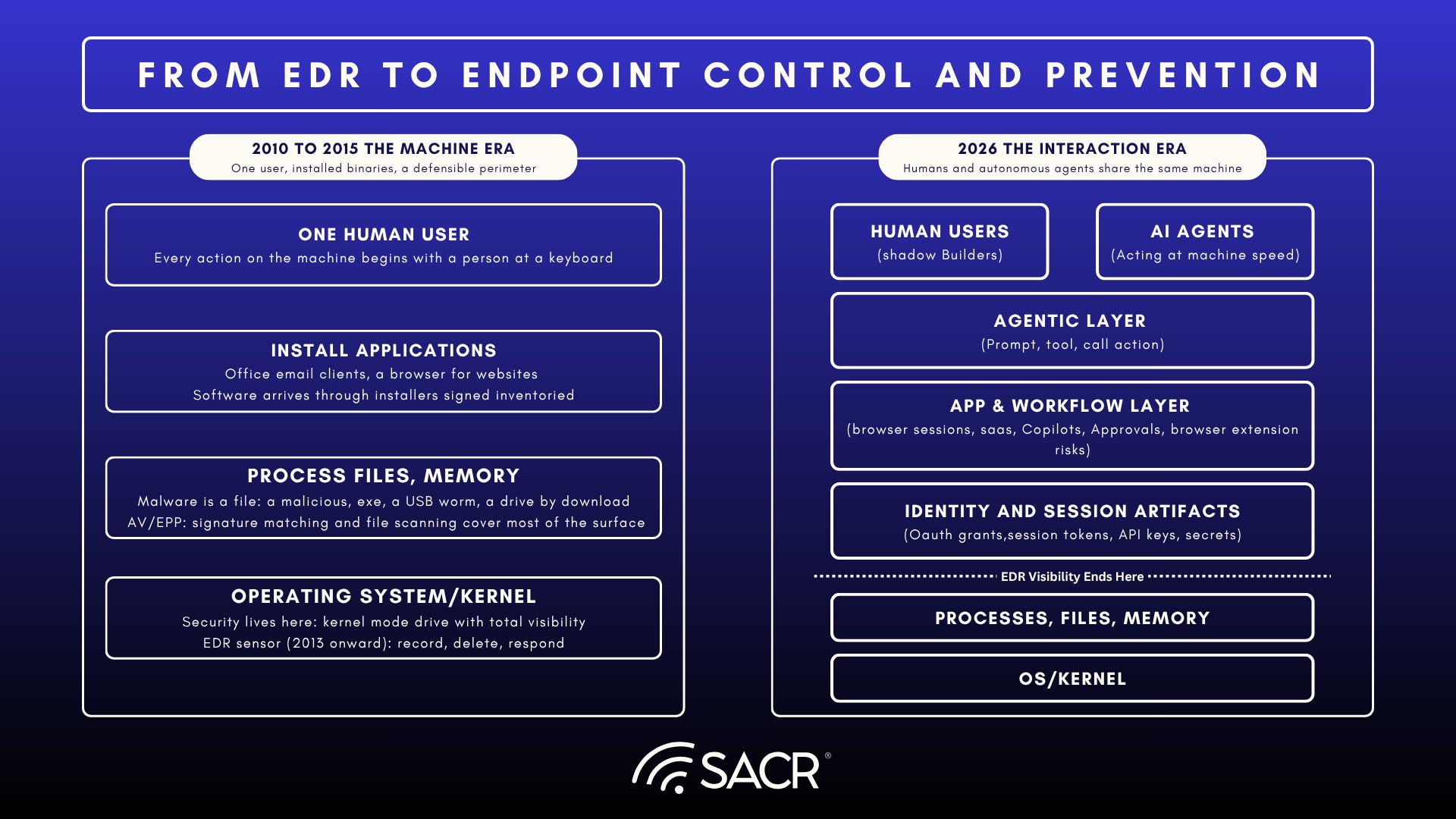
Legacy EDR is failing because it targets symptoms and conditions rather than the underlying structural issues or overall execution contexts. By focusing on file system telemetry and process trees, traditional security boundaries miss the strategic shift up-stack to non-binary software, sessions, autonomous workflows and SaaS. ECP resolves this structural blindness by transforming the endpoint into an active control plane that monitors, participates and governs the interaction layer between humans, agents, and data.
Conceptualizing the evolution of endpoint defense transformation requires transitioning to a framework focused on establishing new architectural layers or zones, leading directly to improvement of endpoint defensive and prevention posture. By integrating advanced visibility and control across these areas, organizations can re-align with contemporary threat landscapes and optimize the use of multi-model context, behavioral intent, and diverse data interactions to drive proactive defensive and prevention-focused decisions.
The Eras of Endpoint Security
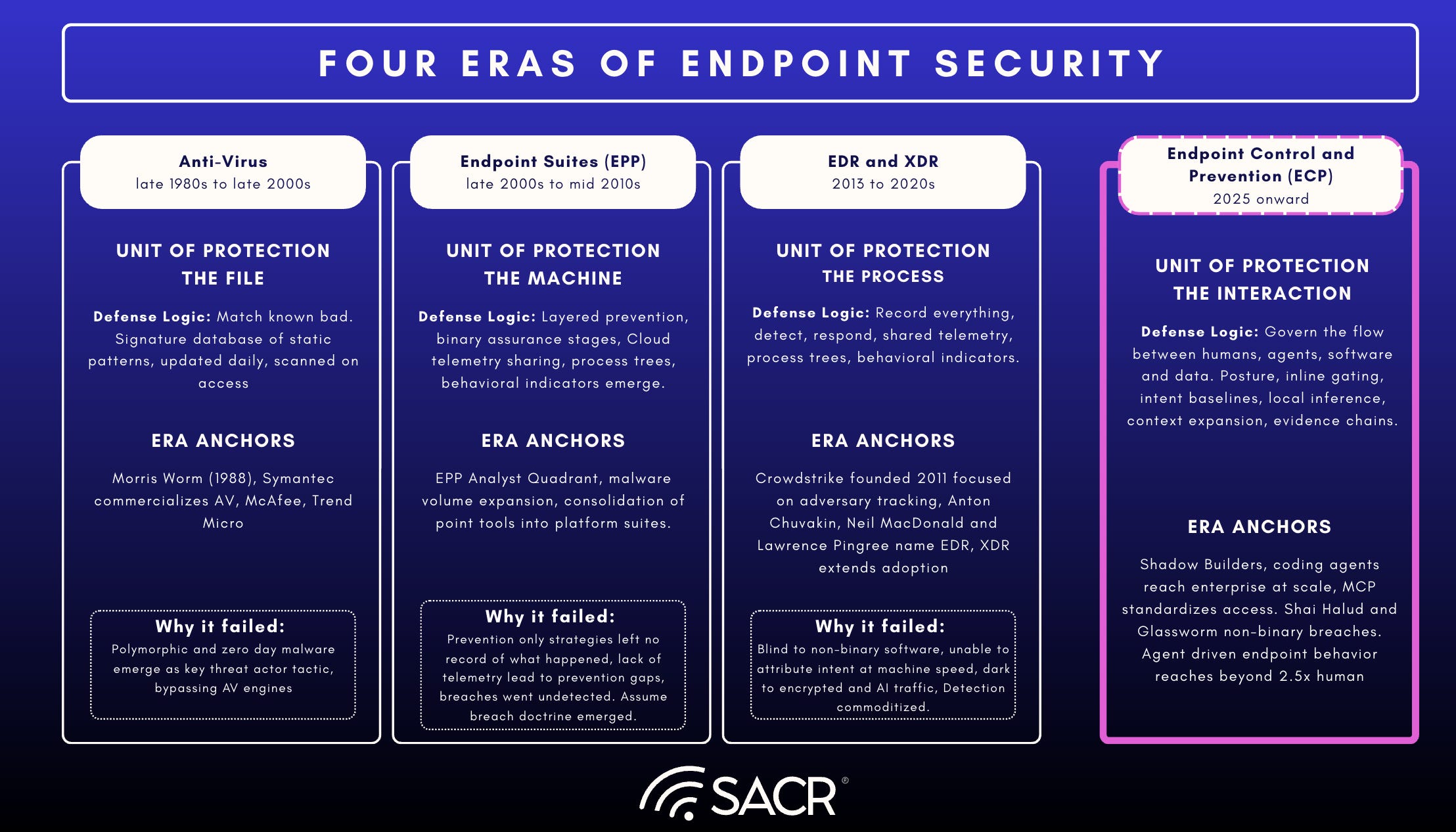
Endpoint security has evolved through three distinct eras, each triggered by the structural failure of the previous architecture.
The Antivirus Era (late 1980s to late 2000s): Protecting the File
The first commercial endpoint security products industrialized the idea of maintaining a database of signatures for known malicious files. This worked while malware was a static file, the industry was in a race between virus authors and signature distribution. The model collapsed under the pressure of polymorphic malware and targeted attacks like Operation Aurora (2010), which demonstrated that adversaries could bypass signatures entirely by using bespoke, never-before-seen implants.
The EPP Era (late 2000s to mid 2010s): Protecting the Machine
The industry’s first response was to bundle security tools, antivirus, firewalls, and device control into Endpoint Protection Platforms (EPP). While EPP improved prevention, it lacked visibility into what occurred when prevention failed. Breach investigations of the era consistently revealed that intruders remained resident for months, leading to an assume-breach doctrine and the realization that the decisive capability of the EPP era was not blocking malicious files, but rather observing endpoint activity.
The EDR Revolution (2011 to the mid 2020s): Protecting the Process
Endpoint Detection and Response (EDR) succeeded by recording everything, from process creation, file writes, and registry changes, into a cloud-hosted graph to identify adversary behavior. EDR’s dominance rested on one foundational architectural assumption: everything that matters on an endpoint executes as a process the kernel can see. As threats migrate up-stack to non-binary software, sessions, and AI agents, this reliance on kernel-level process visibility is reaching its limit, necessitating the shift to Endpoint Control and Prevention (ECP).
The ECP Redefinition (2026 through 2030): All we need is Context and Intent
The ECP redefinition phase marks a strategic pivot away from reactive process monitoring toward holistic, interaction-centric, SaaS and context-aware governance with user and agent intent awareness. This timeline emphasizes the necessity of newly emerging agentic workloads, managing high-speed autonomous execution, where the endpoint must evolve into an active control plane capable of verifying intent and securing non-binary and user execution contexts in real time.
Focused on Emergent areas such as:
The Human User (Shadow Builders)
AI Agents
Agentic Layer
Application and Workflow Layer
Identity, Session and Artifacts
The rapid proliferation of enterprise AI agents and automated supply chain vulnerabilities has intensified this crisis. Modern adversaries bypass OS-level signatures entirely by injecting malicious tools directly into shadow builder or developer ecosystems and agentic frameworks. These autonomous threats often operate with high-level permissions, independently navigating networks and executing custom, on-the-fly commands or building and executing their own code at machine speed. Recently, attackers have adapted part of their game; since so much net-new AI is being adopted on endpoints, threat actors are now targeting the new AI and agentic software supply chains to execute their nefarious acts.
Recent supply chain breaches highlight the urgency of securing this non-binary execution context:
PyTorch Lightning PyPI Compromise (April 2026): Hijacked credentials allowed malicious library versions to harvest and exfiltrate environment secrets via automated CI/CD pipelines.
Mercor-LiteLLM Upstream Breach (April 2026): A compromised routing dependency propagated downstream, exposing sensitive training pipelines and forcing immediate contractor suspensions.
NX NPM Breach & Agent Hijacking (August 2025): Poisoned packages executed locally to hijack active AI tools, systematically hunting and exfiltrating SSH keys and API tokens.
Hugging Face Weaponized Models (Ongoing): Malicious models embed reverse shells within unsafe serialization formats, instantly compromising the host endpoint upon model loading.
Assumption: AI agents and their arrival with Endpoint harnesses creates a cascade of new demands such as monitoring, assessment of risk, management and control, driving net-new technology adoption in endpoint security. These and the emergence of custom software generated on-demand by AI agents (even apps, scripts and services deployed locally on endpoints) become a new IT standard; legacy endpoint security metrics and even DevOps or DevSecOps metrics will also become obsolete on a standalone basis. One way to think of this is in the Builder Era (where all users become agentic shadow builders), federated development becomes the norm. This strongly shifts the value proposition of endpoint defense decisively from post-incident response to real-time execution control and proactive context governance.
To defend the modern enterprise, endpoint security must pivot from general user, software, and binary-driven monitoring and acquire higher-order contexts in the stack, helping unify disparate activities on the endpoint for enforcement pre prevention consideration. We need specialized oversight for autonomous agentic systems, integrated SaaS and the context created by users and agents, and visibility and control over the workflows connecting them. In older environments, investigators struggled to tie a user’s actions to automated agents they triggered. Today, as users increasingly become shadow builders spawning agents, writing and executing code via local chat interfaces and agentic harnesses, these new agents effectively become net-new bots on the internet. This is mandating evolution in adjacent areas (outside endpoint), for example, how we identify bots vs agents online. AI Agents often use similar tools to bot scraping services and other engagement tools that make them overlap with traditional malicious bots, representing the same dynamic and challenge to overcome on the endpoint. Even when operating under a user’s identity, actions taken by agents require a new forensic perspective and better context for decisions.
Effective defense now relies on our ability to provide user and agent context and enable rapid context sharing and enforcement mechanisms at machine speed. By adopting this approach, acceleration enables near-instantaneous security decisions, empowering both users and automated monitoring agents and other local sensory software to intervene and halt malicious behaviors the moment they arise. This shift opposes the traditional, slower-moving world of traditional breach-oriented detection and response focused on users or simple administrative functions or scripts (already representing a detection challenge). As enterprises weigh the benefits of control against the need for agility, the industry is moving decisively away from manual human-in-the-loop (HITL) processes and toward automated, proactive control and prevention.
In today’s environments, high-consequence actions rarely occur as simple file executions. They happen inside:
Browser Sessions: Where copilots handle approvals and data movement.
The Identity Plane: Where attackers leverage tokens, OAuth grants, and API keys.
Delegated Toolchains and Self-Developed Agent software: Where agents run scripts, build their own tools on the fly and move data directly.
Historically, Endpoint Detection and Response (EDR) has failed to extend into these specific areas on the device. However, technical shifts, such as machine-speed risks and AI-powered attacks using the advanced capabilities of Mythos, are forcing a faster transition to higher speed, greater context, and prevention prioritized over the EDR detection and response heritage. Organizations that continue to rely solely on traditional detection and response strategies will fail, the landscape is being redefined into one of real-time, active control and prevention-focused defense.
Emerging ECP Value Proposition
The Endpoint Control and Prevention (ECP) value proposition centers on transforming endpoint defense from a passive, binary-centric sensor into an active control plane capable of governing the modern interaction lifecycle, whether user or agent. By shifting visibility and enforcement up-stack, beyond kernel-level activity and file-based telemetry, ECP restores defender advantage in an era of AI-driven, machine-speed attacks. It bridges the gap between legacy detection and the reality of autonomous workflows, providing the contextual evidence and granular, real-time intervention primitives needed to secure the critical flow between humans, identities, agents, and SaaS applications.
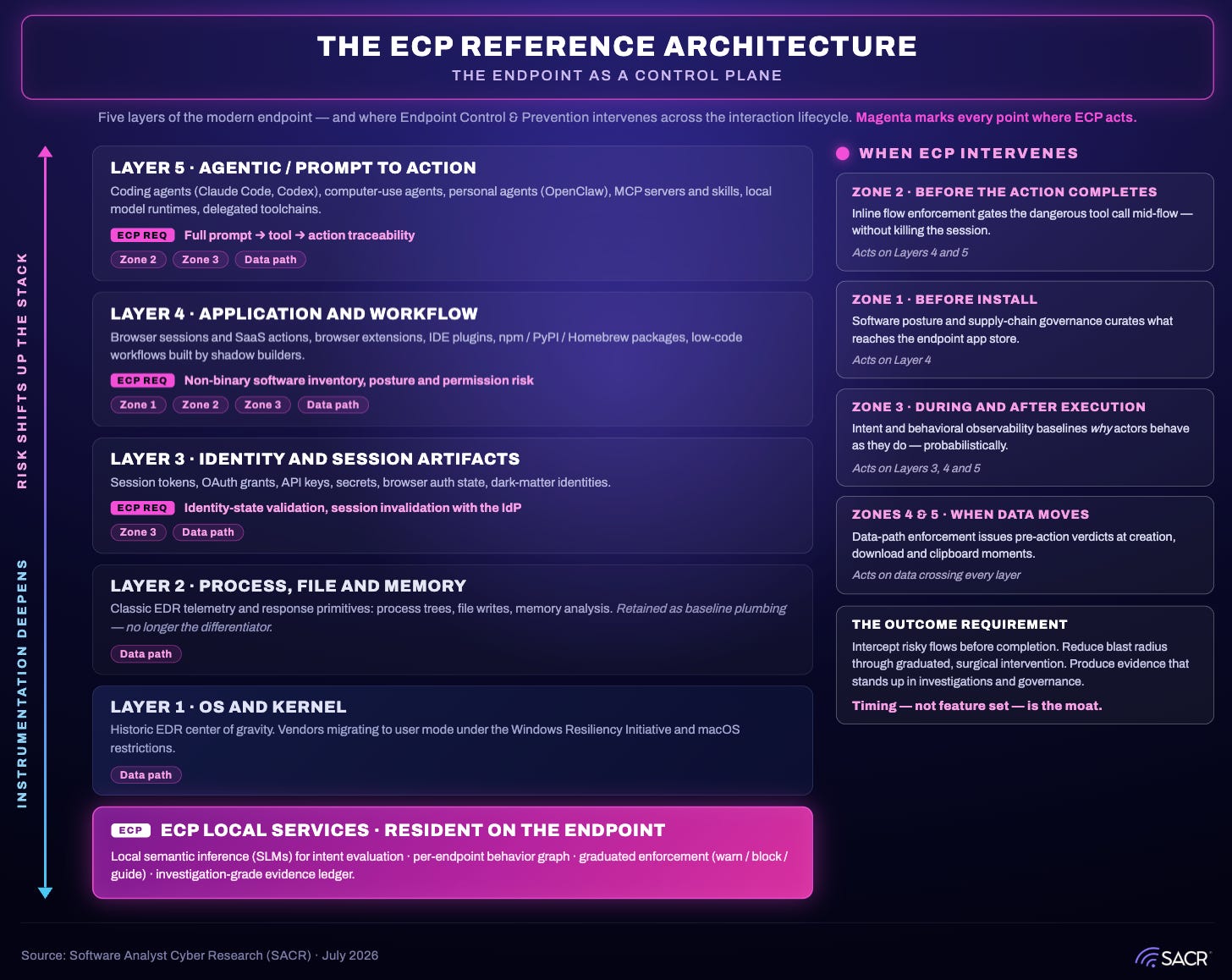
Critical Endpoint Control and Prevention Layers
OS and Kernel (classic EDR center of gravity): This layer represents the traditional foundation of endpoint security, focusing on low-level system activity and kernel-mode monitoring to identify malicious behavior at the hardware-software interface.
Process, file and memory (EDR telemetry & response primitives): These core primitives enable the detection of legacy file-based threats and post-incident reconstruction by analyzing how processes interact with the file system and system memory.
Identity and session artifacts (tokens, OAuth, browser auth, session abuse): In ECP, visibility and context extend to the identity plane to protect against session hijacking and the theft of cryptographic artifacts in real time, at runtime: for example, tokens and API keys used in SaaS-mediated workflows.
App & workflow layer (browser actions, SaaS actions, agent tool calls): Endpoint defense now necessitates runtime observability at the application layer, governing non-binary software such as browser extensions and IDE plugins where critical modern execution context resides, but is often not shared.
Agentic prompt-to-action layer (prompt, tool, action traceability): This critical new layer provides full attribution for autonomous systems, linking natural language prompts to specific tool invocations and downstream actions to ensure governability at machine speed.
Endpoint and End-User Organization Trends Enabling the Shift
Modern end-user organizations are driving the shift toward Endpoint Control and Prevention (ECP) as traditional security perimeters dissolve. With the rise of hybrid work and the proliferation of “shadow builders”, which are often non-technical staff deploying custom AI-driven application development, workflows and SaaS applications. The endpoint attack surface has expanded beyond legacy and more stable binary and process-centric threats. To address these complex risks, organizations are prioritizing comprehensive visibility into application-layer interactions and autonomous agentic behaviors, necessitating a move toward granular, real-time control.
Broad adoption of hybrid working and the rise of Shadow AI and Shadow Builders: The emergence of shadow builders and Shadow AI both represent a significant market driver for ECP, as non-technical staff increasingly use low-code and no-code AI agent frameworks tools and AI plugins to assemble automated tools and workflows. This decentralized development creates new third-party supply chain models directly on the endpoints or inside designated harness infrastructure for agents, necessitating visibility into non-binary software linked to browser sessions, extensions, and IDE plugins.
Instrumentation is shifting down-stack while risk shifts up-stack. Kernel and eBPF-era telemetry improves what happens, but the differentiator is increasingly interpreting and governing what runs above the OS (extensions, plugins, packages, models, MCP tools and shadow supply chains).
Shadow builder risks are now a first-class endpoint problem. Since non-developer users and teams can now assemble powerful workflows, build net new applications and deploy plugins and AI tools, security needs visibility into all of this new installable software, its permissions, composition risk, configuration and communications, which are no longer limited to just malware-style OS level indicators.
Deep Posture Assessment and Identity Awareness are emerging. As per-endpoint detection commoditizes, budget and evaluation energy move to application posture, attribution depth, and real-time intervention primitives (warn/block/guide) that reduce blast radius.
Operational Reality: Aligning Defense with Machine Speed
We have entered the age of Mythos, which is an era defined by the industrialization of vulnerability exploitation at machine speeds. Automated models are compressing the time required to weaponize software flaws from weeks to ~seconds. With the emergence of models like Mythos and open-source frameworks like GLM 5.2, the cybersecurity landscape has transitioned into a high-speed race to automate both AI vulnerability discovery and remediation via threat management processes. This evolution renders traditional, manual patch cycles obsolete, forcing a strategic pivot toward continuous, autonomous prevention engineering and retooling of the flows of data and context across security systems more generally.
The failure of legacy defense stems from a structural misalignment with how work actually occurs:
Execution has shifted from local binaries to SaaS-mediated workflows: Security telemetry cannot stop at the file system or process tree when the action and critical context occur in browser sessions, SaaS and API calls.
Identity is still a primary chokepoint: Tokens, OAuth grants, and session artifacts like cookies or authentication bits are the new crown jewels, and their abuse is a primary vector for modern compromise.
Non-binary attack surfaces are expanding: The real risk resides in extensions, IDE plugins, and agentic configurations that mutate daily; a compositional, use- driven attack surface can bypass legacy signature-based scanning.
Autonomy has changed the unit of risk: We have moved from a user running a process to an agentic toolchain executing a workflow. These actions occur at machine speed, rendering human-in-the-loop triage a strategic bottleneck.
MTTR requirements have collapsed: Cloud-backend analytics loops cannot keep pace with agentic misuse. Defensive logic must shift right to the endpoint runtime.
The Strategic Imperative: Securing the AI and Agentic Layer
Modern ECP architectures require deep visibility into the non-deterministic nature of local agentic infrastructures, including IDE copilots, local AI runtimes, and MCP-integrated toolchains. Governance must extend to the prompt-to-action trace to ensure full context, lineage, and verifiability for autonomous systems. Defenders must ensure that actions taken by local agents against remote APIs or SaaS platforms are properly contextualized, mediated, attributed, as well as mapping out what triggered an action, what tools were used, and what happened next. These are very important aspects of monitoring context to drive enhanced endpoint prevention and behavioral response decisions.
Small Language Models (SLMs) Arrive on the Endpoint
The transition toward AI PCs and Minis, along with an increase in shadow builders (unauthorized) or authorized users setting up local agent harnesses, is accelerating the need for deployment of local models, bringing agentic benefits to endpoint security. This development empowers local AI models and agents specialized in Endpoint Security to manage scaling agentic telemetry and localized or remote context, circumventing the cloud-pipeline expenses, latency, and contextual issues inherent in current setups.
Traditional, EDR-centric protection models are proving inadequate for modern defenders. In this report, SACR highlights a necessary paradigm shift: migrating full-stack context and security logic directly to the device. By leveraging local agents (Endpoint Defense Agents), Small Language Models (SLMs), and local graph databases, systems can achieve semantic and behavioral insight to improve threat prevention. This architecture facilitates instantaneous enforcement, circumventing the delayed, cloud-reliant detection pipelines characteristic of legacy EDR/XDR vendors that depend on central storage backends.
Endpoint Defense Agents Rise
Moving agentic inference onto the Endpoint hardware redefines the threat landscape, where local inference risks, data lineage and attribution emerge as the primary detection hurdles. Rather than simply evaluating if a process is malicious, defenders must identify the specific user, agent, workflow or tool and identify errant or malicious prompts that initiated an activity, confirming if it aligned with user intent. This establishes prompt, user and agent action lineage as the modern extension of threat detection from the traditional process tree.
Adaptive and Predictive Prevention Becomes the New Goal
Cloud-backend analytics and context enrichment loops can no longer keep pace with AI and agentic misuse, causing traditional MTTR requirements to collapse and forcing defensive logic to shift right to the endpoint runtime. Moving endpoint defense beyond traditional process and file centricity, this approach rejects standard signature or rules-based logic in favor of probabilistic, anomaly-based detection driven by local semantic inference. Endpoint security systems must evolve into proactive, predictive prevention engines and contextual sharing architectures. By leveraging expansions and preemptive modeling of advanced context, behavioral modeling and intent awareness of both user and agent, endpoints can enhance and anticipate agent-driven threats before they fully manifest, achieving millisecond-level mean time to response (MTTR). This proactive stance supports a self-healing zero-trust model, where the endpoint facilitates faithful action execution while continuously reducing the attack surface. By executing defensive logic directly at runtime via local SLMs, the endpoint can interpret user and agent intent to intercept risky or non-deterministic workflows at machine speed before any malicious intent can fully execute.
7 Critical Endpoint Control Moment Pillars Important for ECP
To effectively govern modern autonomous workflows and minimize the blast radius of agentic toolchains, security teams must embed defensive logic across the entire interaction lifecycle. Shifting to Endpoint Control and Prevention (ECP) requires moving beyond reactive, post-execution detection to establish high-fidelity visibility at each stage of the workflow.
The following pillars identify the critical control moments where ECP architectures must intervene to ensure policy adherence, verify intent, and mitigate risk before an action completes.
Endpoint Security Enforcement Control Moments
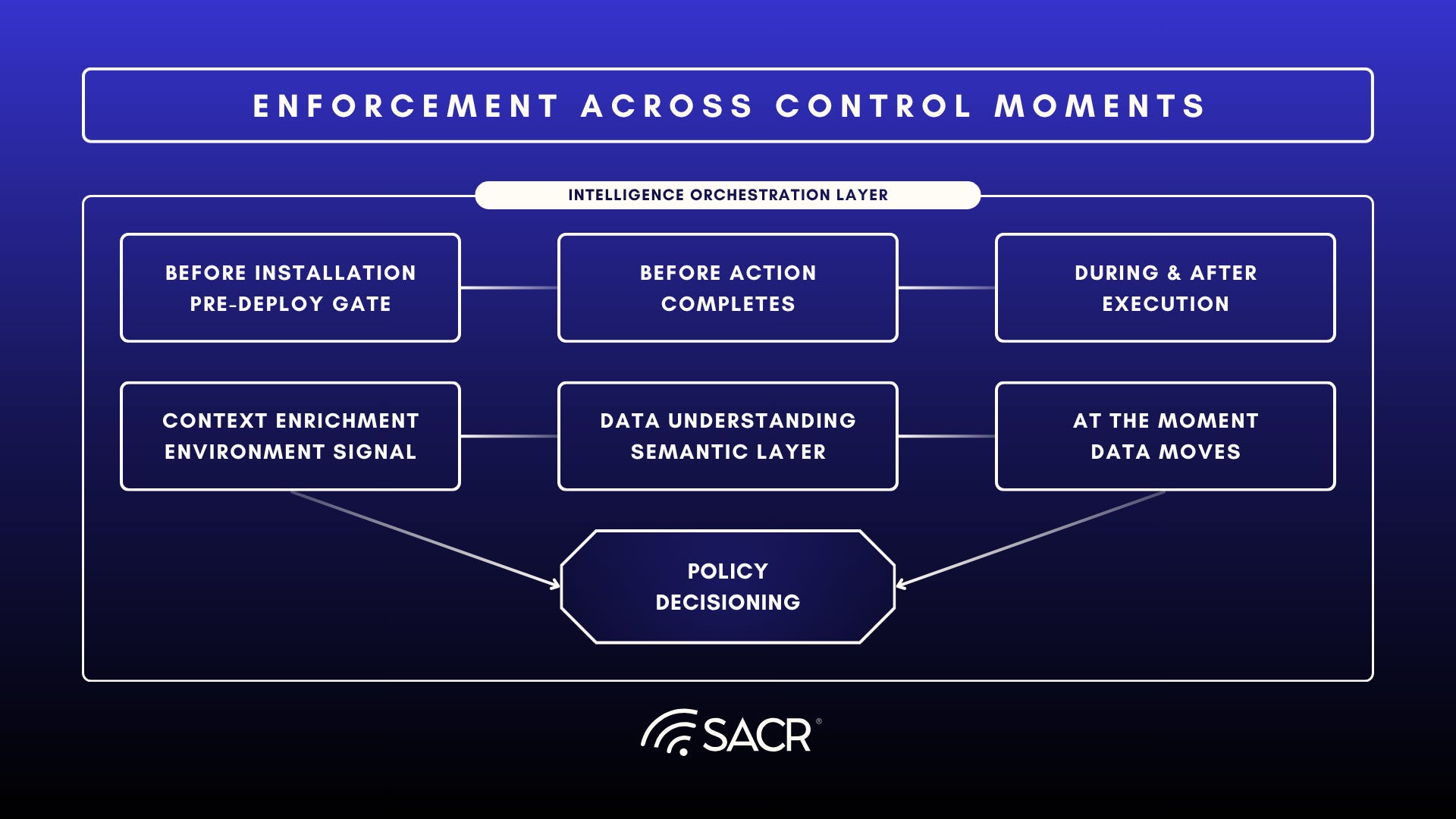
Before Installation (Pre-deploy gate): Focuses on proactive curation of the software supply chain to neutralize threats before they manifest on the device. By treating the endpoint similarly to an app store, this phase discovers and risk-ranks non-binary software components, such as browser extensions, IDE plugins, MCP servers, packages, and local models, ensuring configuration hygiene and preventing unauthorized dependencies from landing on the machine.
Before Action Completes: Involves gating risky behaviors, dangerous tool calls, or unauthorized data sharing mid-flow. Instead of relying on disruptive post-execution process termination, this control point uses inline, flow-level session evaluation to intercept actions at machine speed before they can fully complete.
During & After Execution: Builds runtime observability and behavioral baselines above the operating system layer. It continuously monitors active interactions, including natural language prompts, shell commands, tool execution, and network activity, using local semantic inference to detect intent-level anomalies and maintain complete forensic traceability.
Context Enrichment (Environmental Signal): Integrates deep identity plane and environmental telemetry, such as active session states, cryptographic tokens, OAuth grants, and API keys. This shared context connects endpoint activity directly to SaaS-mediated execution paths, providing the multi-layer visibility needed for continuous trust validation.
Data Understanding (Semantic Layer): Leverages on-device AI models and local small language models (SLMs) to interpret the natural language context of prompts and workflows. Shifting from rigid pattern-matching rules to probabilistic inference, this layer evaluates user and agent motivations to recognize risky prompt injection or unauthorized orchestration before execution.
At the Moment Data Moves: Monitors and intercepts sensitive data flows at critical interaction points, such as clipboard paste, file downloads, or model prompt submissions. By performing local AI classification directly at the endpoint edge, it successfully inspects cert-pinned or SASE-bypassed traffic that network proxies miss.
Final Policy Decisioning: Evaluates the combined signals of intent, posture, identity, and data behavior against organizational security rules to drive real-time, graduated interventions. Rather than defaulting to binary allow-or-block decisions, it enables proportional enforcement primitives such as surgical inline redaction, warnings, or context-aware user coaching.
SACR Security Zones for Endpoint Control and Prevention (ECP)
To evolve new use cases across the control moments pillars, we see emerging technology concepts and vendors evolving endpoint defense in several key emerging zones of technology and use case expansion, which requires transitioning from legacy, process-centric models to a robust architectural framework of ECP security zones. These zones serve as the blueprint for securing the modern, autonomous workflow by establishing high-fidelity visibility and control at the critical layers where risk now resides. By mapping defenses to these five distinct evolutionary focus areas, security teams can move beyond reactive detection, enabling proactive governance of user, agent, and data interactions at machine speed.
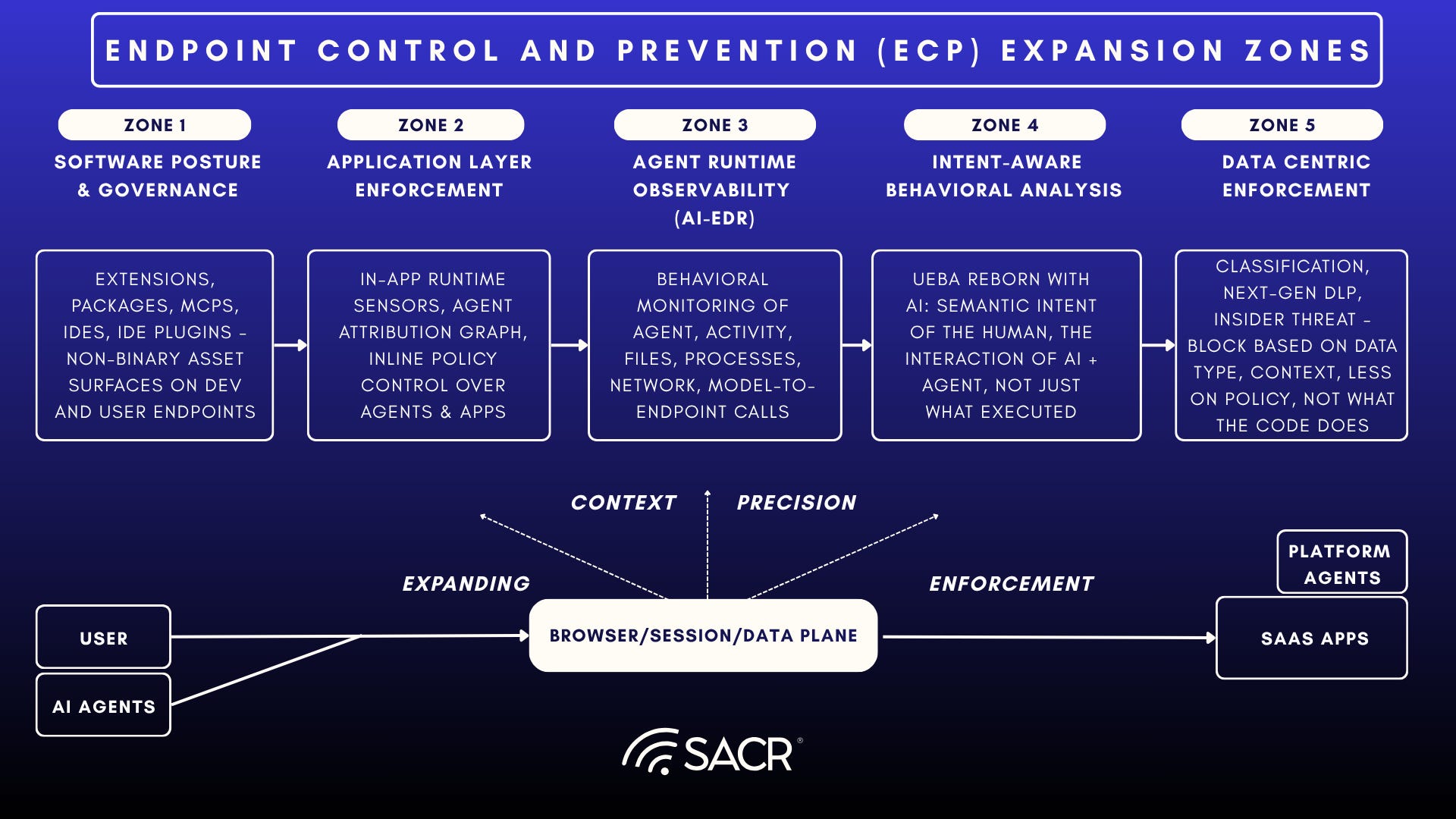
Zone 1: Software Posture & Governance
Concept: By treating the endpoint similarly to an app store, this layer controls the ingestion of various software components such as extensions, MCP servers, packages, models, and containers. Proactive curation of the software supply chain neutralizes incidents before they manifest by maintaining an active inventory and comprehensive posture assessment.
Operational Pillar
Shifts endpoint defense from reactive binary signature matching to proactive continuous governance of the non-binary software composition layer. This involves discovery and continuous risk-ranking of browser extensions, IDE plugins, and local model frameworks to establish an active inventory and continuous posture assessment above the operating system layer.
By treating the endpoint similarly to an app store, this layer controls the ingestion of various software components such as extensions, MCP servers, packages, models, and containers. The foundational premise is that because the vast majority of AI risk is acquired, proactive curation of the software supply chain can neutralize incidents before they ever manifest. Referenced as Endpoint Application Posture Management (EAPM) within SACR advisory frameworks and as a critical feature of ECP expansion, this paradigm and concept marks a strategic resurgence of classic OS oriented posture and control application control and configuration assessment with renewed focus on endpoint and agentic applications and supply chains.
While traditional allowlisting was historically constrained by operational overhead, intensive manual fine-tuning, and rapid policy challenges, AI completely redefines this resource-heavy dynamic. By deploying automated fleets of specialized agents, organizations can continuously analyze software behaviors and dynamically maintain allowlists at machine speed. Enforcement within this zone shifts the primary security discipline away from reactive detection engineering toward proactive policy engineering. It treats platforms as first-class citizens where configuration liabilities, such as a Claude instance, for example, with dangerous permissions enabled, are surfaced as high-severity posture anomalies rather than traditional malware events. The ultimate goal is to sustain an active inventory and comprehensive posture assessment of all non-binary dependencies functioning above the operating system layer, verifying configuration hygiene, access permissions, and the intricate workflows generated by shadow builders using AI agents before any malicious intent can execute.
Zone 2: Application Layer Enforcement
Concept: Sits at the interface between native apps and AI agents, governing layers like browser extensions, developer packages, MCP servers, and AI agent toolchains. It blocks dangerous tool-calls mid-flow or potentially risky data sharing without killing the session.
Operational Pillar
Enforce inline gating and session evaluation mid-flow to block dangerous tool calls or data sharing before completion, replacing disruptive process termination with surgical intervention embedded directly within the active workflow layer.
Sits at the interface between native apps and AI agents, governing layers like browser extensions, developer packages, MCP servers, and AI agent toolchains. It blocks the dangerous tool-call mid-flow or potentially risky data sharing without killing the session. The core bet is that at machine speed, where autonomous agents read natural language instructions, execute shell commands, edit files, and call APIs at a speed no human could perform or anticipate, traditional detection-and-response is operationally and structurally too late, and therefore must evolve to keep pace with emerging risks.
The rising prevention-first approach mandates that actions be gated using inline, flow-level, session evaluation, or data-layer enforcement before tool calls can fully complete. This strategy successfully replaces disruptive process termination with a more precise, surgical intervention embedded directly within the active workflow layer. Vendors in AI are hard at work continuously modeling both AI interactions to preemptively identify attacks while also expanding their ability to monitor deep workflows, and as DNS for Agents emerges in DNS land, most organizations still lack methods for executing more complex multi-layer agentic workflow recording and intercede. Traditional tools cannot block potentially harmful actions on both Application AI agents and their workflows together as a continuum, where the evaluation of intent and outcome behavioral analysis focuses on precision prevention.
Zone 3: Agent Runtime Visibility (AI-EDR)
Concept: This architectural layer builds its own above-OS telemetry and baselines of why actors behave as they do, rejecting standard signature or rules-based EDR logic in favor of probabilistic, anomaly-based detection driven by local semantic inference.
Operational Pillar
Provides full context and verifiability for autonomous systems by establishing absolute traceability from natural language prompts to downstream execution steps, tool calls, and system responses. It reframes the endpoint as an identity-centric control plane evaluating intent to mitigate credential theft and session hijacking through continuous identity-state validation and active blast-radius reduction.
This architectural layer builds its own above-OS telemetry and baselines of why actors behave as they do, shifting endpoint defense beyond traditional process and file centricity. It rejects standard signature or rules-based EDR logic in favor of probabilistic, anomaly-based detection driven by local semantic inference. The underlying bet is that novel AI-era attacks are anomalies of intent, making them invisible to both legacy signatures and passive posture scans. By executing defensive logic directly at the endpoint runtime using small language models (SLMs), it interprets user and agent intent to intercept risky or non-deterministic workflows at machine speed before a malicious action can fully manifest.
Zone 4: Intent-Aware Behavioral Analysis
Concept: Shifts endpoint control from passive file or process monitoring to active assessment of user and agent intent. This layer validates the behavioral risk profile of AI-driven interactions by correlating actions with their underlying intent. It ensures that autonomous agent activity and human-initiated commands are continuously evaluated against security policy in real-time, effectively neutralizing risks like malicious prompt hijacking, unauthorized agent orchestration, and anomalous workflow execution.
Operational Pillar: Deploys granular, intent-aware enforcement gates that provide real-time, behavioral guardrails rather than static blocking. By integrating surgical user coaching and inline friction directly into the interaction flow, this mechanism replaces binary, disruptive termination with adaptive, intent-aligned guidance that secures the workflow while maintaining productivity.
Anchors on intent and behavioral context, rather than just the file or software artifact. The core bet is that you cannot judge whether an AI-driven action is dangerous unless you understand the motivation behind it and the behavior it exhibits. This intent-anchored layer evaluates the risk of an action based entirely on its behavioral trajectory and alignment with authenticated user or agent intent, providing the control plane for mitigating autonomous misuse, shadow agent orchestration, and workflow manipulation. Rather than relying on rigid rules, next-generation architectures in this zone utilize local intent inference to issue pre-action verdicts at the point of interaction.
Zone 5: Data-Centric Enforcement
Concept: Sits at the data itself, classifying, tracing, and intercepting sensitive data movement at the moment of creation, use, or exfiltration across the endpoint, browser, and SaaS/API plane.
Operational Pillar
Anchors on the data object and its lineage to achieve convergence with DSPM and insider risk platforms, employing on-device AI classification at the endpoint edge to handle cert-pinned or SASE-bypassed traffic directly.
Sits at the data itself, classifying, tracing, and intercepting sensitive data movement at the moment of creation, use, or exfiltration across the endpoint, browser, and SaaS/API plane. The hypothesis: one cannot govern AI-era risk without understanding what data was touched, by whom, through what workflow, and whether that movement was authorized. Unlike Zones 1–4, which focus on software posture, attribution, behavior, or browser enforcement, Zone 5 anchors on the data object and its lineage, making it the natural control plane for insider risk, AI prompt leakage, shadow builder exfiltration, and supply chain data theft.
What distinguishes Zone 5 from legacy DLP: Classic DLP relied on static policy rules, perimeter chokepoints, and pattern matching, generating ~90% false-positive rates and high operational burden. Next-gen Zone 5 vendors replace policy brittleness with local AI classification, context-aware intent inference, and coaching-first enforcement that reduces noise and preserves workflow continuity.
Market Landscape
The Market Landscape: Decoupling ECP from Legacy EDR
The shift toward Endpoint Control and Prevention (ECP) signifies a fundamental decoupling of endpoint security from the constraints of legacy, process-tree-based detection models. As traditional security perimeters dissolve into dynamic, SaaS-mediated execution environments and autonomous agentic workflows, the market for defense is rapidly evolving. To address this complexity, the vendor landscape has begun to fragment, coalescing around three distinct strategic notable motions:
Software Posture & Supply-Chain Governance: Treating the endpoint as an app store. Vendors like Bloom Security and Palo Alto (Koi Security) prioritize the discovery and configuration risk-ranking of extensions, IDE plugins, and agentic toolchains rather than binary malware.
Intent-Aware Observation & Semantic Defense: Moving beyond what a process did to why a process occurred. Ent and Origin HQ provide high-fidelity telemetry that maps prompt-to-action, establishing the forensic evidence chains required for governance.
App-Layer Enforcement & Browser-Centric Control: Leveraging the browser as the primary control surface. Vendors like Neo Security and Cyberhaven move enforcement directly into the execution context (the browser or app), enabling surgical warn/block/guide interventions without the latency of kernel-level processing.
Emerging Players in Endpoint Control and Prevention (ECP)
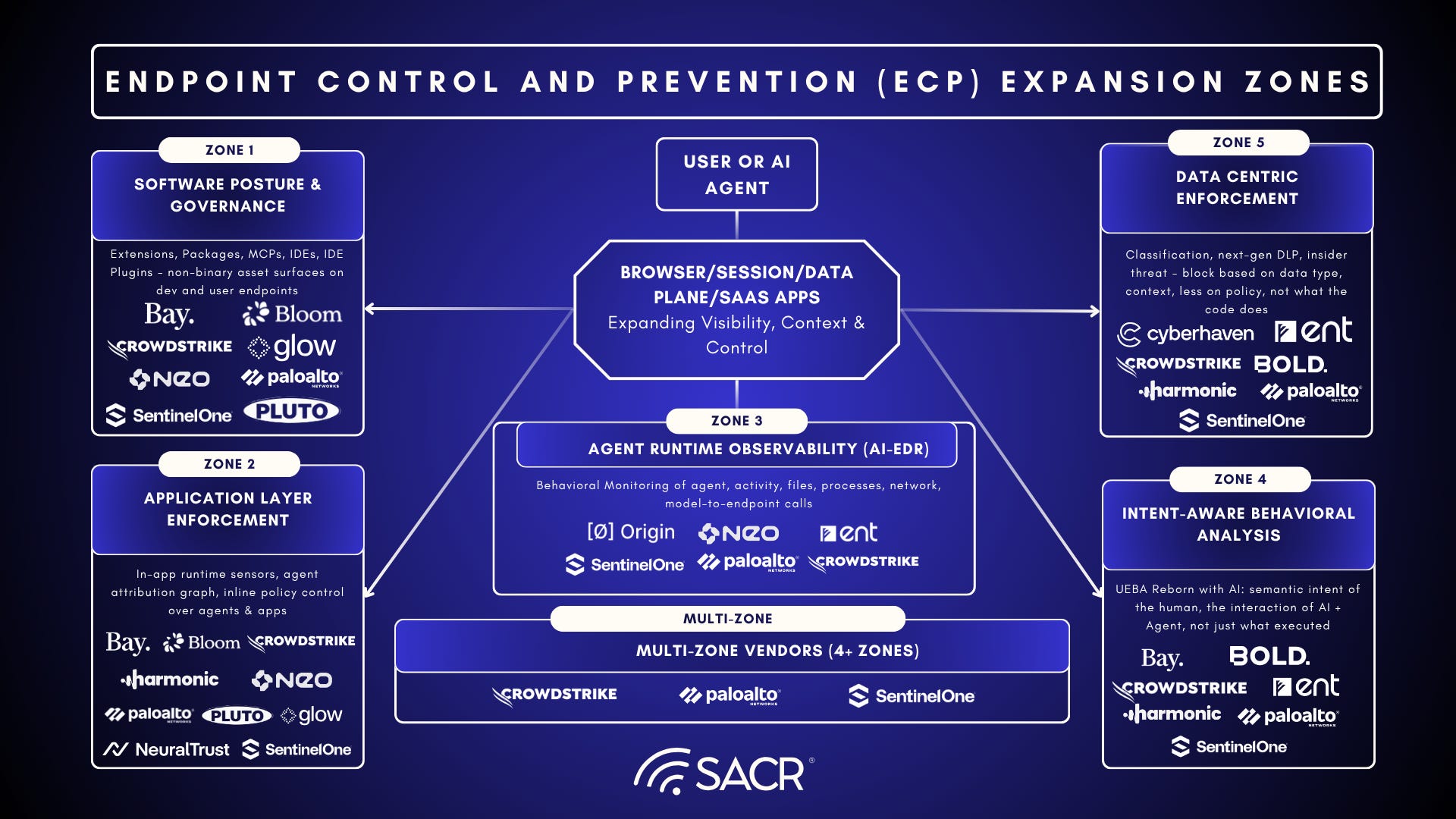
Source: SACR Briefings 2026 (Sampling of Notable Vendors)
Agentless vs. Agent-Based Trade-offs
The deployment debate has persisted for decades, with many buyers rightfully wary of the systemic stability risks inherent in legacy kernel-integrated drivers, most notably the catastrophic Blue Screen of Death (BSOD) events. While the adoption of Extended Berkeley Packet Filter (eBPF) technology has significantly neutralized these driver-conflict anxieties, a strategic appetite for agentless architectures remains. The primary driver for agentless adoption is the elimination of net-new software footprints, allowing organizations to achieve specialized outcomes, such as advanced forensic depth, novel data correlation, or unique AI-driven inference, without the operational friction of traditional sensor management. Whether delivered via API integration or cloud-mediated browser plugins, endpoint harnesses, or agentless solutions, they might provide the surgical, complementary telemetry required to bridge functional gaps without duplicating the existing endpoint protection stack.
Agentless Deployment Performance Claims May be Misleading
The value proposition of agentless deployment includes that they ensure zero performance degradation, which isn’t entirely true. If a vendor solution hits customer API rate limits, or maybe query maximums, the solution may have significant gaps in data freshness and quality, leading to potentially poor alignment to detections or lack of the latest functionality releases. But on the endpoint, in some cases agentless solutions can significantly augment the current endpoint software’s use cases, either delivering new telemetry, data science or machine learning approaches of their own to a complementary endpoint protection tool. The primary drivers for adoption of agentless is for a customer to avoid net-new software or processes deployed, thereby optimizing endpoint battery life, and in the eyes of many buyers, the overall user experience.
Rapid Deployment and Scaling
Agentless solutions facilitate instantaneous deployment, typically requiring only a service account, an application API key, or standard credentials. Scalability is achieved seamlessly without necessitating reboots or software installations. Centralized control mechanisms of agentless solutions can sometimes simplify management, particularly for platforms utilizing differentiated or advanced reporting or offering analytic graph interfaces that incumbents aren’t providing out of the box. By minimizing the local attack surface, agentless options, if used to unify datasets and operations, help somewhat strengthen an organization’s security posture while maintaining compatibility and lowering the total cost of ownership (TCO). This aligns with a broader cybersecurity trend where specialized vendors integrate synergistically with existing infrastructures to deliver enhanced capabilities, such as data enrichment, advanced workflows, and deep analytical graphing.
Vendor Use Case Limitations and Dependency Issues
Agentless architectures present clear operational constraints. Chief among these are reduced context and visibility stemming from a lack of their own, controlled local file system access, drivers, or parsing engines, which can hinder deeper forensic investigations, delivery of new functionality, use cases or performance while they also remain fundamentally dependent on the capabilities and rate limits of provided APIs. Reliance on network connectivity introduces latency risks and potentially restricts real-time response actions when local remediation alternatives are absent. Organizations should implement a hybrid defense model with preference towards agent-based solutions where possible for the lowest latency of endpoint defensive measures. In some situations, customers of endpoint software might want agentless monitoring for high-performance locations or IoT environments that have limited processing capacity, where agentless may be more ideal, while deploying agent-based ECP solutions across critical endpoints that demand comprehensive file inspection and immediate, machine-speed containment and prevention capabilities.
Vendor Profiles
(by Primary ECP Expansion Zone)
Zone 1: Software Posture & Governance
Bloom Security
Vendor Profile
Bloom Security is an endpoint security company with Zone 1 coverage of the ECP market, delivering visibility, context, and control across the AI-native endpoint. Bloom enables security teams to govern the modern workstation: what runs on it, how it’s configured, and whether it’s appropriate for the user and environment it operates in. Its approach is preventive, establishing governance at the workstation level before the conditions for incidents are created.
Bloom continuously discovers everything running across the fleet: AI agents, extensions, IDE plugins, MCP servers, packages, and CLI tools. It evaluates each asset and its configuration in context: who is running it, what data it can reach, and what else is installed alongside it. The same setup can be low-risk on one workstation and high-risk on another.
Bloom then acts on that context, enabling blocking of malicious or high-risk software before it installs, remediating dangerous configurations in place, setting runtime guardrails on what AI agents can access and execute, and enforcing policy continuously.
When enforcement happens, employees are told why, shown approved alternatives, and educated in the moment.
Applicable ECP Zones:
Zone 1
Zone 2
Zone 3
Products/Services Overview
Bloom Platform: AI-native endpoint security platform that gives security teams complete visibility and control over the AI-native endpoint: what runs on it, how it’s configured, and how policy is enforced, without manual workflows or employee disruption. Bloom covers the full security cycle, from continuous discovery and contextual risk evaluation through direct enforcement and remediation, in a single platform.
Core Functions
Discovery and Inventory: Continuously maps every AI agent, extension, plugin, MCP server, package, and CLI running across the fleet in real time
Software Risk Analysis: Evaluates each through marketplace intelligence, static code analysis, and behavioral sandboxing to determine what it can do, what it can reach, and how it behaves
Configuration and Context Analysis: Evaluates each against the workstation it runs on: the user’s role, their data access, and what else is installed alongside. The same setup can be low-risk on one workstation and high-risk on another.
Install Prevention: Intercepts compromised or malicious components upstream via the Supply Chain Firewall before they reach the endpoint, and enforces installation policy continuously across the fleet
Agentic Runtime Governance: Sets and enforces guardrails on what AI agents can access, execute, and connect to while running, scaling back over-permissioned configurations to safe defaults automatically
Use Cases and Pain Points Addressed
Endpoint Policy Enforcement: Bloom enforces precise, context-aware policy automatically, blocking risky installs and fixing configurations without manual review or employee friction.
AI Governance and Usage Control: Bloom enables security teams to govern how every AI tool, extension, and agent operates across the fleet: approved configurations, access boundaries, and usage policies per user and workstation
AI Supply Chain Security: Bloom’s Supply Chain Firewall monitors and intercepts marketplace traffic in real time, blocking compromised packages, malicious extensions, and backdoored MCP servers before they reach the endpoint. Bloom’s in-house research team surfaces findings before public disclosure, so customers are always protected first.
Key Takeaway / Recommendation
Bloom is the recommended first investment for enterprises securing the AI-native endpoint. Bloom’s preventive approach creates the foundation that detection and enforcement in higher zones depend on: establishing what runs across the fleet, how it’s configured, and whether it’s appropriate, before incidents occur. Bloom stands out by combining contextual risk evaluation, precise enforcement, and direct remediation in a single platform, with an approach to employee communication that addresses the productivity concern most security teams struggle to overcome. Bloom is a strong Zone 1 investment with immediate enforcement value and a roadmap that extends into Zones 2 and 3.
Zone 2: Application Layer Enforcement
Neo Security
Vendor Profile
Neo Security is a Zone 1+2+3 Application Layer Enforcement vendor delivering lightweight, user-mode endpoint and browser security for AI-era threats. Neo offers a 3-stage control flow: Discover all software and define what should be allowed to run, fix any configuration and posture issues of that software and enforce deterministic runtime guardrails on it. Neo’s architecture combines a fast (~30-second) initial scanner with a persistent user-mode in-application sensor that instruments browser, office and IDE extensions as well as conducts agentic harness-level monitoring. Neo feeds an agentic backend that reverse-engineers the software characteristics and produces the expected “good” posture and behavior at runtime. Unlike kernel-mode EDR, Neo’s user-mode sensor carries zero kernel stability risk while still capturing high-fidelity application-layer telemetry covering extensions, plugins, libraries, MCP servers, skills, and LLM. Every interaction is attributed to the agent, model, or human that caused it, giving SecOps teams full prompt-to-action traceability for every agentic interaction. The critical architectural differentiator is flow-level enforcement: Neo starts with static and posture gates and then also monitors for potentially dangerous tool calls before they execute, not after the fact. This inline enforcement model at the point of API call or tool invocation, rather than at process creation, is specifically designed for the agentic workflow threat model, where machine-speed execution renders post-hook detection operationally irrelevant. Enforcement happens on device, and doesn’t require any sensitive data to leave the machine, given the sensor-based architecture. Neo requires no MDM, kernel module, or proxy, and supports IdP integration to complete the endpoint + tool + identity picture, rather than requiring it. Neo’s enforcement scope spans extensions, binaries, plugins, MCPs, skills, and LLMs, making it broadly applicable across shadow builder, agentic workflow, and developer toolchain use cases.
Applicable ECP Zones:
Zone 1
Zone 2
Zone 3
Products/Services Overview
Neo Scanner: Lightweight ~30-second initial scan of endpoint software inventory covering extensions, plugins, MCP servers, and AI toolchains
User-Mode In-App Sensor: Persistent application-layer sensor for browser, IDE and office environments providing static monitoring and real-time telemetry and enforcement.
Agentic Backend: A continually updated repository of agentic app analysis intelligence
Flow-Level Enforcement: Inline enforcement layer that gates which extensions can be loaded, which binaries can be executed, and what tool calls, API invocations, and LLM interactions are allowed before execution.
Agentic Copilot: A designated SOC, GRC and IT personas that fully automate any activity, research and policy creation over the Neo Platform.
Core Functions
User-Mode Application Instrumentation: Instruments browser extensions, IDE plugins, and MCP servers at the user-mode application layer without kernel drivers or proxies, eliminating stability risk.
Monitoring: Monitors all AI activity, including network activity like MCP calls, LLM communications, authentication and other API calls from the application itself (the harness, the browser, the IDE, etc).
Flow-Level Pre-Completion Enforcement: Intercepts and evaluates tool calls, API invocations, and agentic actions before they complete, enabling inline block/warn/guide decisions at machine speed.
Agentic Software Reverse-Engineering: Backend behavioral analysis engine models the risk profile of newly encountered extensions, plugins, and AI tools by reverse-engineering their runtime behavior.
IdP-Only Deployment: Full enforcement capability requires only an IdP integration (no kernel module, MDM dependency, or proxy deployment), minimizing enterprise deployment friction. Other integrations are supported for enrichments but not required.
Use Cases and Pain Points Addressed
Agentic Conversation and Tool Call Interception: Full visibility into the agentic sessions. Neo blocks or gates dangerous tool invocations (e.g., a compromised MCP server calling a file exfiltration API) before the action is executed.
Browser, Office and IDE Extension Governance: Provides continuous monitoring and enforcement for extensions and plugins, surfacing over-permissioned or malicious components and blocking unauthorized actions.
Binary control: Control over which binaries should be able to run on the system, and which software should be installed to begin with (uninstall).
LLM and MCP Server Runtime Security: Monitors and gates interactions between enterprise users, AI models, and MCP-connected toolchains in real time.
Key Takeaway / Recommendation
Neo Security is the leading purpose-built Zone 1-3 enforcement-focused vendor, providing comprehensive control across the entire endpoint spanning binary and non-binary assets, as well as agentic and non-agentic software. It enables organizations to prioritize flow-level, pre-execution interception of tool calls and actions. Its IdP deployment model and user-mode architecture make it the lowest-friction path to genuine inline enforcement, not just posture visibility, for enterprises adopting AI agents and MCP-connected toolchains. CISOs should evaluate Neo as the primary enforcement layer in a Zone 1, Zone 2 and Zone 3 (enforcement-focused) stack. The key due diligence question is enforcement fidelity under high-volume agentic workloads: validate that Neo’s flow-level interception operates at the latency and throughput required for production agentic environments without introducing workflow-breaking delays.
Pluto Security
Vendor Profile
Pluto Security is a fully agentless AI workspace security platform occupying Zones 1-3 of the ECP market. Pluto delivers posture visibility into how employees actually use AI, contextual risk scoring that separates real danger from noise, and real-time enforcement that acts on those findings. Pluto governs three distinct layers spanning across AI tools employees use (ChatGPT, Claude, Copilot, etc.), the ecosystem surrounding those tools (npm packages, MCP servers, IDE plugins, browser extensions), and the artifacts employees build using those tools (custom apps, automated workflows, deployed agents). The platform deploys via API integrations and proprietary collectors that run through existing CrowdStrike, Defender, and MDM infrastructure, and claims to achieve approximately 30-minute deployment timelines even in large enterprises of 80,000+ employees. Pluto’s differentiation is structural. Most of the category secures one layer, the tool, the ecosystem, or the artifact, in isolation. Pluto not only connects context across all three layers but also delivers the visibility and governance to act on what that context reveals. A session that installs a package, calls an MCP server, ships an application, and runs a sequence of agent commands and prompts along the way is read as one event rather than three unrelated signals, with enforcement acting on the full picture rather than a single point. AI has turned employees into creators, wiring applications, agents, and workflows into production systems in an afternoon, often without a ticket, a review, or a security checkpoint. Pluto’s architectural bet is that the majority of AI-era endpoint risk is compositional: risk emerges from the combination of tools, permissions, and built artifacts, and that agentless monitoring of all three layers, paired with inline runtime hooks on coding agents, provides sufficient coverage to govern this risk without a local agent footprint.
Applicable ECP Zones:
Zone 1
Zone 2
Zone 3
Products/Services Overview
AI Tool Posture and Governance: Continuous discovery and policy enforcement for employee-facing AI applications (SaaS AI tools, local models, copilots);
Ecosystem Posture and Governance: Discovery, risk-ranking, and enforcement for packages, MCP servers, IDE plugins, and browser extensions associated with AI workflows;
Artifact Posture and Governance: Visibility, risk-ranking, and enforcement for apps, automated workflows, and AI agents built by employees using AI tools, the shadow builder output layer.
Agentless Collector Infrastructure: Proprietary collectors operating through existing CrowdStrike, Defender, and MDM APIs, with an inline hook configuration on coding agents for runtime observability and enforcement where API coverage alone isn’t sufficient.
Core Functions
Three-Layer Agentless Inventory: Simultaneously governs AI tools, their surrounding software ecosystems, and the artifacts (apps, agents, workflows) employees build with them.
Rapid Enterprise Deployment: Achieves full fleet coverage via API integration in approximately 30 minutes for organizations of 80,000+ employees, with no reboots or agent installations.
Shadow Builder Artifact Detection: Discovers and risk-ranks AI-assembled apps, scripts, and automated workflows deployed by non-IT employees, the artifact layer unique to Pluto’s scope.
Policy-Based Access Control: Enforces allow/ask/deny policies on AI tool usage and ecosystem components via integration with existing MDM and IdP infrastructure.
Continuous Risk-Ranking: Scores all three governance layers by permission scope, data access, behavioral signals, and upstream threat intelligence.
Agent Runtime Observability and Governance: Continuously observes and governs AI agent execution, including prompts, commands, MCP servers, skills, tools, package installations, and network access, enabling context-aware policy enforcement.
Use Cases and Pain Points Addressed
AI Tool and Ecosystem Governance at Scale: Rapidly inventories and governs the full AI toolchain, tools, packages, and plugins across a large enterprise fleet without a deployment project.
Shadow Builder Artifact Risk Management: Surfaces AI-assembled apps, workflows, and deployed agents created by non-technical employees that introduce supply chain and data leakage risk.
Federated AI Adoption Risk Reduction: Gives security and GRC teams an auditable record of AI tool adoption patterns across business units for compliance, procurement, and risk reporting.
Govern AI Agent Behavior: Reduces the risk of AI agents performing unauthorized or unintended actions by enforcing runtime policies on agent execution, such as blocking an agent from collecting credentials and exfiltrating them to a remote location mid-session, helping organizations safely deploy AI into enterprise workflows.
Key Takeaway / Recommendation
Pluto Security offers the broadest agentless governance scope in Zone 1, covering tools, ecosystem, and artifacts. This makes Pluto one of the strongest choices for enterprises whose primary concern is the shadow builder problem: employees assembling and deploying AI-powered workflows without security review. The 30-minute deployment claim is compelling for organizations facing board or regulatory pressure to inventory AI tool risk quickly. Enforcement runs today across EDR, MDM, and IdP policy rules, plus inline coding-agent hooks for runtime control, with granular blocking down to a specific tool, skill, or MCP action rather than an all-or-nothing cutoff. Pluto’s applicability extends into Zone 2 and Zone 3, so this coverage doesn’t require pairing with a separate enforcement vendor. Organizations building toward full-spectrum coverage, including Zone 5 data-centric enforcement such as classification-driven data loss prevention, may still want to evaluate that layer to complete the coverage stack.
Glow
Vendor Profile
Glow is a cybersecurity startup operating in Zone 1 and 2 of the ECP market, currently valued at over ~$1 billion with backing from Sequoia, Redpoint, Index, and Cyberstarts, among the most prominent venture investors in enterprise security. Glow is building an agentic solution that maps all the software and applications running on the endpoint, including local apps, AI agents, MCPs, browser extensions, packages, and developer plugins. The platform uses AI agents to analyze risk and enforce policies, proactively deciding which software is allowed and which AI tool configurations need to be hardened. The software governance and app enforcement framing aligns Glow with Zone 1 and Zone 2, where the primary threat models involve supply chain threats like compromised plugins and extensions and malicious packages as well as agentic app misconfigurations and unvetted software issues that increase endpoint exposure. Glow’s $1B+ valuation, achieved while the company was still in stealth, signals extreme investor conviction in the problem space and the founding team’s pedigree, drawn from top-tier prior security startups and enterprises. Buyers should monitor Glow’s emergence closely given its capitalization level, which will enable aggressive go-to-market, potential acquisitions, and rapid product development. Glow is expected to compete directly with Bay and Pluto in the Zone 2 enforcement and identity-governance space.
Applicable ECP Zones:
Zone 1
Zone 2
Products/Services Overview
Zone 1 Coverage: Software visibility, risk assessment and remediation of software plugins, packages, extensions, IDEs, and MCPs
Zone 2 Coverage: Application-layer enforcement with the ability to block and remove software, review and remediate app configurations
Core Functions
Inventory Reconciliation: Reconciles asset information across multiple data sources (EDR, MDM, IdP) and maps people to devices and software, enriched with information about vendor reputation, known issues, data privacy terms and other publicly available information
AI Configuration Management: Discovers, analyzes and remediates configuration risks in agentic apps
Supply Chain Exposure: Discovers, analyzes and remediates risks in the AI supply chain including MCPs, IDE plugins, browser extensions, and packages
Software Control: Provides inline enforcement at the application and workflow layer, consistent with Zone 2 positioning.
Use Cases and Pain Points Addressed
Asset Management: Consolidates endpoint, user, and application data from existing sources into a single reconciled inventory, addressing the persistent challenge of incomplete or conflicting asset records across tools.
Software Control: Applies allow, audit, and block policies to installed software, packages, developer plugins, and browser extensions, with per-item risk assessment to identify and prevent execution of unauthorized or vulnerable code.
Safe AI Adoption: Provides visibility into AI tools, plugins and MCP servers, and enforces configuration and usage policy to manage AI risk at the endpoint layer.
Key Takeaway / Recommendation
Glow is a high-signal watch-list vendor for CISOs and security architects evaluating the Zone 1 and Zone 2 enforcement space. Its $1B+ valuation and top-tier VC backing suggest a founding team and product thesis that sophisticated investors consider category-defining. With their impending launch, buyers should request briefings and demos to learn more about its current capabilities and roadmap.SACR will update this profile with full product details upon demo completion. In the interim, Glow should be treated as a strong potential competitor to Bay and Pluto, particularly given its software and application governance focus.
NeuralTrust
Vendor Profile
NeuralTrust is an EU-based agentic runtime security platform that raised a $20M seed round in June 2026, the largest EU cybersecurity seed to date, to build centralized discovery and governance of AI agents from reasoning and planning through to action execution. NeuralTrust occupies Zone 2 of the ECP market as an AI infrastructure control plane rather than a traditional OS-level endpoint agent, operating through TrustGate, its agent gateway, which serves as the connectivity and enforcement layer between software, agents, tools, and models (API gateway, MCP proxy, and SDK integration) to enforce security policy mid-flow. The platform comprises four products: TrustGate (agent gateway), TrustGuard (runtime security), TrustLens (agent discovery and posture), and TrustTest (red teaming), delivering capabilities such as prompt injection detection, data leakage prevention, and runtime policy enforcement, and has been recognized by analyst firms as an enterprise platform for securing AI agents. NeuralTrust’s architecture is fundamentally different from OS/browser-layer Zone 2 vendors like Neo: it is designed for organizations building and deploying AI agents in production, instrumenting the agent reasoning and planning layer rather than the endpoint execution layer. This makes NeuralTrust most relevant to engineering and platform security teams managing internal AI agent deployments, AI application developers, and enterprises requiring governance of AI agents that operate autonomously across cloud services and APIs. The EU origin is relevant for buyers with data residency and GDPR requirements, as NeuralTrust’s architecture is designed with European compliance standards in mind.
Applicable ECP Zones:
Zone 2
Zone 3
Products/Services Overview
TrustGate (Agent Gateway): Connectivity and enforcement layer between software, agents, tools, and models; manages API gateway, MCP proxy, and SDK integration.
TrustGuard (Runtime Security): Agent-to-agent flow governance, tool authorization, indirect prompt injection protection, and runtime DLP.
TrustLens (Agent Discovery and Posture): Centralized discovery, cataloging, and security posture management for agents across the enterprise.
TrustTest (Red Teaming): Security testing, validation, and red teaming for AI agents.
Core Functions
TrustGate Gateway Enforcement: Serves as the central connectivity and enforcement layer mid-flow, executing API gateway, MCP proxy, and SDK integration controls across software, tools, and models.
TrustGuard Agent Security Scope: Enforces advanced runtime policies that govern the entire agent reasoning layer, including tool authorization, autonomous agent-to-agent flow governance, and runtime data leakage prevention.
Indirect Prompt Injection Prevention: Leverages TrustGuard to deliver real-time detection and blocking of adversarial inputs and indirect prompt injections, preventing agent hijacking during execution.
TrustLens Centralized Discovery and Posture: Catalogues and inventories all AI agents across the enterprise, managing security posture from development through production deployment.
TrustTest Agent Red Teaming: Conducts specialized security validation, continuous testing, and adversarial red teaming focused specifically on autonomous agent action execution and planning paths.
Use Cases and Pain Points Addressed
Production AI Agent Runtime Security: Governs AI agents deployed in production, customer service bots, internal copilots, and autonomous workflow agents, enforcing security policy on every reasoning step and tool call.
Prompt Injection Attack Prevention: Detects and blocks adversarial prompt injection attacks targeting enterprise AI agents, preventing attackers from hijacking agent behavior via crafted inputs or via poisoned content and tool outputs the agent consumes (indirect prompt injection), blocked at enforcement points
GDPR-Compliant AI Governance: Provides EU-resident AI agent governance with data residency controls, audit logging, and compliance reporting aligned to GDPR and emerging EU AI Act requirements.
Key Takeaway / Recommendation
NeuralTrust is the leading purpose-built Zone 2 option for organizations managing production AI agent deployments and requiring governance at the reasoning and planning layer which is above and beyond what OS and browser-layer endpoint tools can reach. Its $20M seed backing signal offers a strong market validation for the platform thesis. CISOs should position NeuralTrust as the AI infrastructure security layer complementary to endpoint-focused Zone 2 vendors like Neo. Neo governs the human user and endpoint tool layer, while NeuralTrust governs the autonomous AI agent and API layer. For organizations with GDPR or EU AI Act compliance requirements, NeuralTrust’s EU-native architecture is a significant procurement advantage. CISO’s should evaluate NeuralTrust early in any production AI agent deployment programs; runtime security is significantly easier to instrument before agents go to production than after.
Zone 3: Agent Runtime Observability (AI-EDR)
Origin (OriginHQ)
Vendor Profile
Origin (operating as OriginHQ / Prelude) is a Zone 3 Agent Runtime Observability vendor delivering probabilistic endpoint defense through a proprietary user-mode agent, patented CPU branch and instruction telemetry, and a local graph database that stores per-endpoint behavioral baselines. Origin’s core architectural thesis is that novel AI-era attacks are anomalies of intent where they are invisible to legacy signatures and passive posture scans but detectable as statistical deviations from an established behavioral baseline built from prompt-to-action traces.
The Origin platform watches every AI-agent interaction, cloud-connected or local-only, on the endpoint, including prompts, tool calls, shell commands, file writes, and network activity, across laptops, build servers, and CI/CD runners. Origin’s local TLS-intercepting proxy and OTEL collector achieve hook coverage without kernel-mode instrumentation, and its local graph database ensures that behavioral inference operates on-device, eliminating cloud-pipeline latency and cost at agentic telemetry volumes. Origin positions as the next layer stacked on top of incumbent EDR platform add-ons in the user behavioral analysis and agentic endpoint observability space.
Applicable ECP Zones:
Zone 3
Products/Services Overview
User-Mode Endpoint Agent: Proprietary user-mode agent with patented CPU branch/instruction telemetry and local TLS-intercepting proxy; no kernel driver required. Also surfaces shadow AI locally, including agent hardnesses, IDEs, and browser-based AI, with no cloud connection or extra installation required.
Local Graph Database: Per-endpoint graph database storing behavioral baselines and prompt-to-action traces for on-device inference
Agentic Observability Platform: Real-time monitoring of AI agent interactions, prompts, tool calls, shell commands, file and network activity, across laptops, build servers, and CI runners
Probabilistic Behavioral Defense: An anomaly detection engine using local AI models and Bayesian behavioral baselines to detect intent-level deviations at machine speed
AI Observability Ontology: Built-in relational model of agent activity that correlates telemetry into the context graph and prompt-to-action trace, turning disconnected event logs into one connected investigation narrative.
Core Functions
Patented CPU-Level Telemetry: Captures CPU branch and instruction telemetry to build high-fidelity behavioral baselines without kernel-mode instrumentation, achieving coverage via a user-mode agent.
Local TLS Interception: Intercepts TLS-encrypted application traffic and OTEL locally on the endpoint to capture full AI model API call content including prompts, responses, and tool invocations.
Per-Endpoint Local Graph Database: Maintains a behavioral graph database on each endpoint, enabling on-device probabilistic inference without requiring cloud-backend latency.
Prompt-to-Action Lineage: Establishes absolute traceability from natural language prompts through tool invocations to downstream system actions, providing forensic evidence chains for governance and incident response.
On-Device Behavioral Inference: Executes anomaly detection locally using small language models and graph-based baselines, addressing agentic telemetry volume without cloud-pipeline cost.
Use Cases and Pain Points Addressed
Agentic Workflow Observability and Forensics: Provides complete prompt-to-action traceability for AI agent interactions across the enterprise, enabling post-incident reconstruction and governance.
Intent-Level Anomaly Detection: Detects AI-era attacks that bypass signature-based detection by identifying statistical deviations from established behavioral baselines at the intent layer.
CI/CD and Build Server Agentic Security: Extends behavioral monitoring and enforcement to build servers and CI/CD runners where AI agents operate outside traditional endpoint security perimeters.
Key Takeaway / Recommendation
Origin is the most technically differentiated Zone 3 vendor in the market, with its patented CPU telemetry, local graph database, and endpoint-centric architecture representing a genuine architectural moat against cloud-dependent incumbent EDR platforms. For CISOs managing large developer populations and AI agent deployments in production environments, particularly those running CI/CD pipelines and build infrastructure, Origin provides observability and forensic depth that no incumbent EDR platform currently matches. Buyers should evaluate Origin in environments where forensic evidence quality and agentic observability depth are primary buying criteria, rather than fast time-to-first-detection on commodity threats.
Zone 4: Intent-Aware Behavioral Analysis
Ent
Vendor Profile
Ent is a Zone 4 Intent-Aware Behavioral Analysis vendor that deploys a proprietary application-layer endpoint agent to build multimodal behavioral baselines of user and agent intent, then enforces policy through real-time pop-up interventions that block, warn, or redirect risky actions before completion. Unlike kernel-mode or network-layer EDR, Ent’s agent mints its own telemetry stream, capturing clicks, window focus, clipboard content, file activity, and screen context, and processes this multimodal data using on-device AI models (the “edge” inference architecture). Ent’s policy language, EntLang, enables security teams to express behavioral intent policies in structured natural language that the on-device model evaluates against the Bayesian behavioral baseline in real time. The Bayesian baseline uses a 90-day decay model, ensuring that behavioral norms adapt to legitimate changes in user workflows without requiring manual policy updates. Ent’s user-facing intervention model, real-time pop-ups that block, warn, redirect, alert, or block, where supported, is designed to replace the binary allow/block paradigm with a graduated, coaching-first enforcement experience that reduces friction for legitimate users while stopping risky behaviors at machine speed. Like Origin, Ent pushes inference to the device to handle agentic-volume telemetry without cloud-pipeline cost, which is the key architectural asymmetry against CrowdStrike’s AIDR network-dependent model.
Applicable ECP Zones:
Zone 3
Zone 4
Zone 5
Products/Services Overview
Application-Layer Endpoint Agent: Proprietary agent that captures multimodal telemetry (clicks, focus, clipboard, screenshots) for user and agent behavioral analysis
Edge AI Inference Engine: On-device multimodal AI model for real-time intent evaluation against behavioral baselines
EntLang Policy Engine: Structured natural language policy language enabling security teams to express intent-based behavioral and organizational rules
Bayesian Behavioral Baseline: Adaptive behavioral model with 90-day decay that baselines both user and agent behavior and detects anomalies
Real-Time Intervention System: Pop-up enforcement layer delivering block/warn/redirect/block interventions inline within the active workflow
Data Sovereignty: Data stays within the customer boundary where the Ent platform is self-hosted and managed by the customer, delivering privacy and trust by design
Core Functions
Multimodal Telemetry Capture: Mints proprietary telemetry including clicks, window focus, clipboard content, and screen context to build high-fidelity behavioral context for both users and AI agents operating on the endpoint.
On-Device Intent Inference: Executes behavioral intent analysis locally using edge AI models, eliminating cloud-pipeline latency and cost while maintaining privacy for sensitive telemetry streams.
Bayesian Behavioral Baselines: Maintains adaptive 90-day behavioral baselines for users and agents using Bayesian methods, automatically adjusting to legitimate workflow changes without manual tuning.
EntLang Policy Authoring: Enables security teams to express behavioral intent policies in structured natural language, reducing the operational expertise required to configure intent-aware enforcement rules.
Graduated Enforcement Interventions: Delivers real-time block/warn/redirect interventions via user-facing pop-ups, in addition to block and alert where supported, replacing binary allow/block with surgical, context-appropriate enforcement that coaches users rather than breaking workflows.
Use Cases and Pain Points Addressed
User and Agent Intent Verification: Distinguishes between legitimate user-directed AI actions and malicious or anomalous agent behaviors using multimodal behavioral context.
Insider Risk and Data Exfiltration Prevention: Detects and intercepts risky data movement and exfiltration behaviors by users and AI tools using clipboard, screen activity, and focus telemetry.
Shadow Builder and AI Tool Misuse Governance: Monitors and enforces policy on user and agent interactions with AI tools and applications, flagging and intercepting misuse patterns before data or credential exfiltration completes.
Key Takeaway / Recommendation
Ent is the strongest Zone 4 option for organizations prioritizing user-facing coaching enforcement and insider risk governance alongside agentic behavioral analysis. Its multimodal telemetry approach, capturing the full richness of user and agent interaction context, not just process and network signals, provides a behavioral depth that traditional EDR and network-layer tools cannot replicate. The EntLang policy language and Bayesian adaptive baselines significantly reduce the operational overhead of intent-aware enforcement compared to rule-based alternatives. CISOs should note that Ent overlaps with Bold Security on insider risk positioning; the differentiation is that Ent focuses on intent and behavior while Bold focuses on data payload and lineage, a complementary rather than competing stack in mature deployments. Origin provides the deepest forensic and developer pipeline observability, while Ent provides the strongest user-facing enforcement and insider risk governance.
Harmonic Security
Vendor Profile
Harmonic Security is a Zone 4 Intent-Aware Behavioral Analysis vendor delivering AI-native sensitive data classification and governance purpose-built for the era of enterprise AI tool adoption. Unlike legacy DLP platforms that rely on static pattern-matching rules, Harmonic uses AI-powered classification to identify sensitive data flowing into and out of AI applications, SaaS platforms, and collaboration tools in real time, at the point of user interaction, before data movement completes. Harmonic’s primary architectural bet is that the GenAI data leakage problem cannot be solved with rule-based DLP because the data types, destinations, and interaction patterns are too dynamic and context-dependent for static policies to govern. Its classification engine understands business context and not just PII and PCI patterns, enabling it to detect sensitive data submissions to AI tools that traditional DLP misclassifies as benign. Harmonic is designed to extend, rather than replace, existing endpoint and insider risk stacks, providing the AI tool governance layer that legacy DLP and Code42-style insider risk platforms were not built to address.
Applicable ECP Zones:
Zone 2
Zone 4
Zone 5
Products/Services Overview
AI-Native Data Classification Engine: Real-time classification of sensitive data flowing into AI applications, SaaS platforms, and collaboration tools using AI models tuned for business-context data types
AI Tool Data Flow Monitoring: Continuous monitoring and enforcement for data submitted to or extracted from GenAI tools (ChatGPT, Claude, Copilot, Gemini) via endpoint and browser interactions
Shadow AI Data Governance: Discovery and governance of unauthorized AI tool usage and the data flows they generate, providing visibility into unapproved GenAI adoption across the enterprise
Workflow-Integrated Enforcement: Inline coaching and policy enforcement delivered within the active user workflow rather than via disruptive hard blocks
Remote MCP Gateway: Governs MCP servers and agent tool calls inline, blocking dangerous tool-calls or risky data sharing mid-flow without killing the session.
Core Functions
Business-Context AI Classification: Classifies sensitive data submissions to AI tools using AI models that understand business-context categories (financial data, IP, HR records, source code) beyond standard PII/PCI/PHI pattern matching.
Real-Time AI Tool Interaction Governance: Monitors and enforces policy on data flowing into GenAI tools at the point of submission, prompt text, file uploads, clipboard paste, before the data reaches the model.
Shadow AI Discovery and Risk Ranking: Identifies unauthorized AI tool usage across the enterprise fleet, ranking data exposure risk by tool, user, and data type to prioritize governance interventions.
Inline User Coaching: Delivers contextual coaching and policy guidance to users at the moment of a risky AI tool interaction, reducing friction for legitimate use while intercepting genuine policy violations.
SIEM/SOAR Integration: Feeds AI tool data governance findings into existing SOC workflows via SIEM and SOAR integrations, enabling correlation of AI-era data movement events with identity and endpoint telemetry.
Use Cases and Pain Points Addressed
GenAI Prompt Leakage Prevention: Detects and intercepts sensitive business data submitted to AI tools in AI prompts, source code, financial reports, customer PII, HR data before it reaches the model and potentially leaves the organization’s control.
Shadow AI Data Exposure Governance: Provides security and GRC teams with visibility into which employees are using which AI tools and what categories of sensitive data are flowing through those interactions, enabling risk-based governance without blanket blocking.
AI Tool DLP Gap Coverage: Closes the data governance gap that legacy DLP platforms leave open when employees interact with AI tools via browser, which is a channel that network-layer DLP and proxy-based tools struggle to inspect with sufficient business context.
Key Takeaway / Recommendation
Harmonic Security spans Zones 2, 4, and 5 natively, anchored in Zone 4 as its primary zone, while also providing coverage for Zones 1 and 3 through shadow AI discovery and prompt-to-action visibility. This native multi-zone reach makes it the strongest option for organizations whose primary data governance gap is sensitive data flowing into GenAI tools and AI-assisted workflows, which represent a risk that legacy DLP platforms and traditional insider risk tools were not architected to address. Its AI-native classification engine provides the business-context awareness required to govern AI tool interactions without generating the false-positive rates that make legacy DLP operationally unsustainable. CISOs should position Harmonic as the AI tool data governance layer within an existing Zone 4 stack. The key evaluation question is classification accuracy for the organization’s specific sensitive data types in AI tool interaction contexts; request a proof-of-concept with representative prompt and file submission scenarios to validate detection fidelity before broad deployment.
Zone 5: Data-Centric Enforcement
Bold Security
Vendor Profile
Bold Security is a Zone 4/5 Intent-Aware Behavioral Analysis and Data-Centric Enforcement vendor that deploys a modular endpoint agent and an agent-deployed browser extension (no proxy required) to classify sensitive data locally on the device using small language AI models, delivering pre-action verdicts and inline coaching at creation, download, clipboard moments and other ingress and egress moments. Bold’s core architectural bet is that effective data protection in the AI era requires on-device AI classification, not network-layer proxies or cloud-backend DLP rules, because a growing proportion of sensitive data movement occurs within cert-pinned AI applications (ChatGPT, Claude, Copilot) that network proxies cannot inspect. Bold’s classification engine extends beyond traditional PII and PCI categories into business-context categories: financial reports, IT/security data, AI application outputs, and custom organizational data types. The platform provides stacked data lineage, human risk scoring, and AI risk scoring in a unified view, and has been validated at 100,000-endpoint enterprise scale. Bold’s on-device AI classification is the primary architectural differentiator, a distinction that becomes increasingly material as enterprise AI tool adoption grows and proxy-bypassed data movement becomes the norm.
Applicable ECP Zones:
Zone 4
Zone 5
Products/Services Overview
Modular Endpoint Agent: Lightweight endpoint agent providing on-device AI data classification and enforcement at creation, download, and clipboard interaction points
Agent-Deployed Browser Extension: Proxy-free browser extension for in-browser data movement monitoring and enforcement, deployed via the endpoint agent without proxy infrastructure
On-Device AI Classification Engine: Small AI models running locally that classify data beyond PII/PCI into business-context categories at enterprise scale
Data Lineage and Risk Scoring: Unified data lineage view with stacked human risk, AI risk, and data risk scoring for investigation and governance
Inline Coaching and Justification Prompts: User-facing enforcement delivering pre-action verdicts with coaching and exception justification workflows rather than hard blocks
Core Functions
On-Device AI Data Classification: Classifies sensitive data locally using small AI models at creation, download, and clipboard moments, covering business-context categories beyond standard PII/PCI/PHI.
Cert-Pinned AI App Traffic Inspection: Inspects data movement within cert-pinned AI applications (ChatGPT, Claude, Copilot) that network proxies cannot reach, closing a critical gap in legacy DLP architectures.
Pre-Action Data Verdict Enforcement: Delivers block/warn/coach verdicts before data movement completes, at the moment of clipboard paste, file download, or prompt submission rather than detecting exfiltration post-hoc.
Stacked Risk Scoring: Provides unified human risk, AI risk, and data lineage scoring in a single dashboard, enabling security teams to correlate data movement risk with user behavioral and AI tool usage context.
Inline User Coaching: Delivers contextual coaching and justification prompts to users at the point of risky data interaction, reducing false positives and building security-aware behavior rather than blocking workflows.
Use Cases and Pain Points Addressed
AI Application Data Leakage Prevention: Prevents sensitive data from being pasted into or extracted from cert-pinned AI applications (ChatGPT, Claude, Copilot) that bypass network-layer DLP.
Shadow Builder Data Exfiltration Prevention: Detects and intercepts sensitive data movement within AI-assembled workflows and shadow builder toolchains before exfiltration completes.
AI Risk and Human Risk Correlation for Investigations: Provides stacked data lineage with human risk and AI risk scoring to accelerate incident investigation and insider threat analysis.
Key Takeaway / Recommendation
Bold Security is a leading purpose-built Zone 4/5 option targeting cert-pinned AI application traffic missed by network-layer DLP. Operating at a validated 100,000-endpoint scale, its proxy-free architecture uses a modular agent and browser extension to classify data locally using small AI models. Classification goes beyond PII to business-context categories and user policies, providing stacked data lineage, human risk, and AI risk. Bold delivers pre-action verdicts at creation, download, and clipboard moments, utilizing inline coaching or justification prompts. CISOs should position Bold as an on-device enforcement layer complementary to network CASB/SWG tools, not a replacement.
Cyberhaven
Vendor Profile
Cyberhaven is a data lineage and browser-centric Zone 5 governance platform that tracks the origin, movement, and destination of sensitive data across endpoint, browser, SaaS, and cloud environments, providing high-fidelity evidence chains of user data interactions. Unlike traditional DLP tools that classify data by content pattern at a point in time, Cyberhaven builds a continuous lineage graph that follows data from its point of origin- a document created, a record copied from a database, a file downloaded from a cloud service- through every subsequent interaction, transformation, and transfer. This lineage model enables security teams to answer the forensic question that matters most in AI-era investigations. Cyberhaven’s browser-centric architecture captures SaaS and web application data interactions that endpoint-only agents miss, making it particularly relevant for organizations where the majority of sensitive data movement occurs within browsers interacting with cloud-based AI tools, SaaS platforms, and collaboration applications with on-device AI classification as the primary architectural differentiator.
Applicable ECP Zones:
Zone 5
Products/Services Overview
Data Lineage Platform: Continuous tracking of sensitive data origin, movement, and destination across endpoint, browser, SaaS, and cloud environments
Browser-Centric Governance: Browser extension-based data movement monitoring providing full visibility into SaaS application and web-based data interactions
Data Movement Evidence Chains: High-fidelity forensic evidence chains of user data interactions for incident investigation, governance, and compliance reporting
AI Tool Data Flow Monitoring: Visibility into data flows into and out of AI applications accessed via the browser
Core Functions
Continuous Data Lineage Tracking: Follows sensitive data from its origin through every subsequent interaction, transformation, and transfer across endpoint, browser, and cloud, building a persistent lineage graph.
Browser Data Movement Capture: Instruments the browser to capture the full richness of SaaS and web application data interactions, including copy-paste, upload, download, and AI tool prompt submissions.
Forensic Evidence Chain Generation: Produces investigation-grade evidence chains that answer the origin, path, and destination questions for any sensitive data movement event.
AI Tool Data Flow Visibility: Monitors data flowing into and out of browser-accessed AI tools (ChatGPT, Copilot, Gemini), providing governance coverage for AI-mediated data movement.
Cross-Environment Lineage Correlation: Correlates data movement events across endpoint, browser, SaaS, and cloud to provide a unified view of sensitive data flows across the enterprise.
Use Cases and Pain Points Addressed
Insider Threat and Exfiltration Forensics: Provides complete data lineage for forensic investigation of insider threat and exfiltration incidents, answering origin, path, and destination questions that traditional DLP cannot.
AI Tool Data Governance: Monitors and governs sensitive data flowing into browser-accessed AI tools, detecting prompt leakage and unauthorized AI-mediated data movement.
Departing Employee Data Exfiltration Detection: Detects and investigates data exfiltration by departing employees by tracking sensitive data movement patterns in the period leading up to departure.
Key Takeaway / Recommendation
Cyberhaven is a strong Zone 5 data lineage platform, offering the most mature and proven browser-centric data governance capability in the market. For organizations prioritizing forensic evidence quality, insider threat investigation depth, and AI tool data flow governance, Cyberhaven provides capabilities that legacy DLP and most next-gen alternatives do not match on lineage depth. CISOs should evaluate Cyberhaven as the data lineage and evidence chain foundation of their Zone 5 stack. The key consideration is that Cyberhaven’s primary strength is lineage and forensics rather than real-time prevention; organizations requiring pre-action enforcement should layer Cyberhaven with a prevention-first enforcement vendor rather than treating it as a standalone DLP replacement.
Multi-Zone: Converged Endpoint Control and Prevention Platforms (ECPP)
Note: Vendors must be in 4 or more zones
Bay
Vendor Profile
Bay is an agentless, prevention-first endpoint AI security platform operating in Zone 1 through 4 of the ECP market. Its capabilities span four layers: discovery and posture management, supply chain security and application control, visibility into agentic activity, and real-time, session-aware enforcement. At the discovery layer, Bay builds a contextual entity graph of the AI agents, browser extensions, IDE extensions, MCP servers, skills, plugins, connectors, models, and packages running across the fleet, mapping permissions, entitlements, personal versus corporate account use, and toxic tool combinations, and raising posture findings. At the supply chain layer, it extracts malicious indicators and vulnerabilities from the components agents load, with centralized approve, block, and uninstall controls and application allowlisting. At the activity layer, it records agent actions end to end, from prompt to tool call to system action, for investigation and audit. Then it analyzes the agentic activities to author out-of-the-box intent-aware policies that fit any workflows and departments within the organization.
A key differentiator for Bay relative to other Zone 1 agentless players (Bloom, Pluto) is that it does not stop at discovery or posture reporting: enforcement is endpoint-resident and executed locally as each agent action is invoked, evaluating that action in the context of the session rather than in isolation. Bay states that once a session touches sensitive data or credentials, it closes the outbound exfiltration routes for the remainder of that session, blocking the sequence rather than only flagging it, and that on-device enforcement runs at sub-4ms p95 latency with no cloud round trip. The platform is designed to ride existing EDR/MDM and orchestration rails such as Intune and CrowdStrike, deploying an ephemeral collector rather than a net-new persistent agent, and to run across Windows, Mac, and Linux endpoints, cloud endpoints and containers. Bay frames its value around stopping incidents before they occur across the agentic supply chain rather than generating a risk report for human review, and positions itself as distinct both from pure visibility players and from EDR, which observes processes and network connections but, in Bay’s account, cannot distinguish AI activity from human activity. This makes Bay relevant to organizations seeking discovery, application control, and active enforcement of agentic activity in a single agentless deployment.
Applicable ECP Zones:
Zone 1
Zone 2
Zone 3
Zone 4
Products/Services Overview
AI Tool and Extension Discovery: Agentless continuous discovery of AI agents, extensions, MCP servers, skills, plugins, models and packages across the enterprise fleet, mapped into a contextual entity graph with risk scoring, surfacing permission overreach, personal-account use, and toxic tool combinations as posture findings.
Supply Chain Security and Application Control: Malicious-indicator and vulnerability extraction across browser extensions, IDE extensions, MCP servers, packages, skills, and models, with centralized approve, block, and uninstall, and application allowlisting.
Credential Exposure Remediation: Active identification and remediation of exposed secrets, API keys, and credentials embedded in extension configurations and agentic toolchains
Real-Time and Session-Aware Enforcement: Endpoint-resident Allow/Ask/Deny policy enforcement via existing EDR/MDM sensors that evaluates each action locally and in session context, and closes exfiltration routes once a session touches sensitive data or credentials.
Agentic Workflow Visibility & Forensics: Record of agent actions with full context, human versus autonomous, prompt-to-action chain, and timestamps, used for investigation, audit, and policy tailoring.
Core Functions
Agentless Prevention-First Posture: Discovers and risk-ranks AI tools, extensions, and agentic workflows with a patent-pending ephemeral collector via EDR/MDM with a focus on preventing incidents rather than reporting them post-hoc.
Supply Chain and Application Control: Extracts malicious indicators and vulnerabilities from the components agents load, flags risky items, blocks or uninstalls them, and controls which applications and packages are permitted to run.
Session-Aware Policy: Evaluates each action against session state rather than in isolation, closing exfiltration routes for the remainder of a session once credentials or sensitive data are touched.
Credential and Secret Exposure Detection: Actively identifies secrets, API keys, OAuth tokens, and credentials exposed in extension configurations, agentic tool settings, and workflow artifacts.
Real-Time Policy Enforcement: Enforces Allow/Ask/Deny on the device as each AI tool action is invoked, evaluating the action across files, network destinations, credential access, MCP tool calls, and shell capabilities, and combining deterministic rules with behavioral context. Bay reports sub-4ms p95 latency for on-device decisions. Agentic Workflow Governance: Captures the prompt-to-tool-call-to-system-action chain for each agent, providing a single point for forensics and the behavioral basis for tailoring policy per identity-provider group.
Credential Remediation Workflows: Provides guided remediation workflows for exposed credentials, including rotation recommendations and integration with secrets management platforms.
Use Cases and Pain Points Addressed
Credential Exposure in Agentic Toolchains: Identifies API keys, tokens, and secrets embedded in agentic configurations and extension permissions before attackers can harvest them.
Prevention-First AI Tool Governance: Discovers unapproved AI tools and agentic workflows and enforces real-time allow/ask/deny policy on the device..
Shadow AI and Shadow Builder Risk Reduction: Surfaces unauthorized AI tool deployments and agentic workflow configurations created by non-IT employees, enabling governance without blocking legitimate productivity.
Agentic Supply Chain Exposure: Identifies malicious or vulnerable extensions, MCP servers, packages, and models, and blocks or removes them from a central point.
Key Takeaway / Recommendation
Bay is the strongest Zone 1 option for organizations whose primary concern is credential exposure within the non-binary software and agentic toolchain layer, a specific and underserved risk that pure posture scanners like Bloom address only partially. The prevention-first positioning and credential remediation capability make Bay a meaningful complement or alternative to Bloom/Pluto depending on whether credential hygiene or supply chain visibility is the primary buying criterion. CISOs should evaluate Bay alongside their existing secrets management and IdP posture (e.g., CyberArk, HashiCorp Vault integrations) to assess whether Bay’s remediation workflows integrate cleanly with incumbent tooling. As with all Zone 1 agentless players, enforcement depth for novel AI tool installations requires a complementary Zone 2 enforcement layer for complete prevention coverage.
Bay is a strong option for organizations that want more than posture reporting at the agentic endpoint layer. Its principal distinction from posture-only players such as Bloom and Pluto is an endpoint-resident, session-aware enforcement engine that acts on each AI tool action in real time, a layer those tools do not provide, and one that Bay argues EDR cannot deliver because EDR does not distinguish AI activity from human activity. That said, discovery and posture overlap materially with the incumbent scanners, so the enforcement layer is where Bay should be evaluated most closely. Two points bear on any assessment. First, prevention depends on Bay’s on-device enforcement component; a collector-only deployment runs in detection mode, so buyers should confirm which mode a given deployment is in. Second, several of the breadth claims, including scanning of skills, plugins, and models and the stated latency and cross-platform parity, are vendor-reported and would benefit from validation in a POV. CISOs evaluating Bay should scope a proof of value around the enforcement engine specifically, and confirm how its posture and activity findings integrate with existing identity, EDR, and secrets tooling.
CrowdStrike
Vendor Profile
CrowdStrike occupies a uniquely distinct position in the ECP market: platform convergence via acquisition and organic expansion, attempting to cover all five ECP zones simultaneously from its Falcon sensor base. Rather than a pure-play ECP startup, CrowdStrike is the incumbent EDR market leader extending its platform into the AI-era through Falcon AIDR and Falcon Secure Access (Seraphic Security acquisition of browser-layer enforcement). Falcon AIDR delivers prompt and LLM-response layer visibility, threat detection, data protection, and automated response across endpoints, SaaS, and cloud environments via Falcon Sensor integration, browser extensions, AI gateway integrations, SDK, and an MCP Proxy.
CrowdStrike’s two AIDR core use cases are workforce AI adoption governance (monitoring and controlling employee use of GenAI tools) and AI application runtime security (runtime guardrails for engineers building agents and agentic workloads). CrowdStrike’s strategic position is distribution and platform convergence: it can deliver ECP capabilities at attach rates no startup can match by embedding them into the Falcon platform already deployed across millions of endpoints. The structural vulnerability startups are exploiting is AIDR’s network-connection dependency; its prompt-layer telemetry requires network connectivity rather than operating at the local on-device inference layer.
Applicable ECP Zones:
All Zones
Products/Services Overview
Falcon Insight XDR: Unified endpoint detection and response (EDR) and extended detection and response (XDR) with enterprise-wide visibility to automatically detect adversary activity and respond across endpoints, identities, and cloud workloads.
Falcon AIDR: Prompt- and LLM response layer AI visibility, governance, detection and response module delivering visibility, threat detection, data protection, and response spanning endpoints, SaaS, and cloud environments via Falcon Sensor integration, browser extensions, AI gateway integrations, SDK, and an MCP Proxy.
Falcon Secure Access: Browser-layer enforcement capability acquired to extend Falcon into Zone 2 / App-Layer Enforcement
Falcon Next-Gen SIEM: Cloud-native security data platform that unifies third-party log ingestion and long-term storage with CrowdStrike’s native telemetry and AIDR findings for AI-powered detection, investigation and response.
Charlotte AI: CrowdStrike’s generative AI assistant embedded across the Falcon platform for analyst augmentation and accelerated investigation
Core Functions
Prompt-and LLM Response Layer Visibility and Governance: Captures full prompt content (including secrets) via Falcon Sensor integrations, browser extension and API/SDK/gateway integration; maps relationships between users, prompts, models, agents, and MCP servers in a unified visibility dashboard.
Access and Prompt Detection Rule Enforcement: Two rule types, Access rules which offer restrictions on attributes including user, application, LLM model, and version and Prompt detection rules (input/output checks for threats and policy violations), with response modes ranging from Report-only through Block to Replace (e.g., AWS tokens auto-redacted before prompt submission).
AI Agent and MCP Server Runtime Security: Extends Falcon telemetry to AI agent workloads, MCP server interactions, and AI/API gateway traffic, providing runtime guardrails for engineering teams building and deploying agentic applications.
Cross-Platform Telemetry Correlation: Feeds AIDR findings into Falcon Next-Gen SIEM for correlation with endpoint, cloud, and identity signals from across the full Falcon platform, enabling unified investigation across all telemetry sources.
Browser-Layer Enforcement (via Seraphic): Extends enforcement into the browser execution context through the Seraphic acquisition, covering browser-mediated AI tool interactions and web application data flows.
Use Cases and Pain Points Addressed
Enterprise GenAI Tool Governance at Scale: Monitors and controls employee use of ChatGPT, Claude, Copilot, and other GenAI tools across the fleet, enforcing access policies and prompt-content rules at enterprise scale.
AI Application and Agentic Workload Runtime Security: Provides runtime guardrails for engineering teams building AI agents, chatbots, and agentic pipelines, detecting prompt injection, secret leakage, and policy violations within the development and production workflow.
Unified SOC Triage Across Endpoint and AI Telemetry: Surfaces AI-layer threat detections (prompt injections, data leakage, policy violations) in Falcon Next-Gen SIEM alongside endpoint and identity alerts, enabling SOC analysts to correlate AI-era incidents with traditional threat telemetry in a single pane.
Key Takeaway / Recommendation
For CISOs running CrowdStrike as their primary EDR and SIEM platform, Falcon AIDR is the lowest-friction path to baseline AI governance coverage; it deploys through the existing Falcon management plane and surfaces findings in the existing SOC workflow, requiring no net-new vendor relationships. The platform convergence advantage is real: CrowdStrike’s distribution, attach rates, and cross-telemetry correlation are structural advantages no ECP startup can match in the near term. However, buyers should treat AIDR as a strong baseline rather than a best-of-breed solution across all ECP zones.
Palo Alto Networks (Koi Security)
Vendor Profile
Palo Alto Networks entered the ECP Zone 1 market through its acquisition of Koi Security, a startup focused on AI and software supply chain visibility at the network and endpoint boundary. The Koi acquisition gives Palo Alto Networks a wedge into the non-binary software governance category, extending the Cortex and Prisma platforms beyond traditional process-level telemetry into the discovery and risk-ranking of browser extensions, IDE plugins, MCP servers, and agentic toolchains. Rather than building agentless posture management organically, Palo Alto Networks is using M&A to accelerate its position in the category, integrating Koi’s supply-chain gateway capabilities with existing MDM and EDR integrations already present in the Cortex XDR stack for a more direct integration path. Additionally, Koi will remain available standalone, integrating with existing MDM and EDR tools regardless of vendor. The strategic bet is that Palo Alto Networks’s installed base and enterprise go-to-market can rapidly distribute a point solution into a platform-level posture capability.
Applicable ECP Zones:
Zone 1
Zone 2
Zone 3
Zone 4
Zone 5
Products/Services Overview
Koi Security (Standalone Today; Planned Integration into Cortex): Network supply-chain gateway providing discovery, risk-ranking and preemptive control of non-binary endpoint software, blocking installation of unauthorized MCP servers, AI models, AI agent toolchains, code packages, OS packages, IDE plugins, and browser extensions.
Cortex XDR: Palo Alto Networks’s extended detection and response platform, now extended with Koi-derived supply-chain telemetry
Prisma Browser / Talon (acquired): Browser-centric enforcement and visibility layer, relevant to Zone 3 Agent Runtime Observability (AI-EDR) as well.
Core Functions
Supply Chain Discovery: Continuously discovers and inventories non-binary software (extensions, plugins, packages, MCP tooling) installed across the enterprise endpoint fleet.
Risk Ranking and Posture Assessment: Scores discovered software against threat intelligence, permission scope, and behavioral signals to surface high-severity configuration liabilities before exploitation.
MDM/EDR Integration: Rides existing CrowdStrike, Defender, and MDM telemetry to deliver posture findings without requiring a net-new agent footprint on every endpoint.
Policy Enforcement via Network Gateway: Enforces allow/deny decisions at the network supply-chain layer, preventing installation of unauthorized toolchain components before they reach the endpoint.
Policy Enforcement via Endpoint Integration: Provides real-time control of AI agent behavior at runtime on the endpoint, governing approved software and what AI agents are permitted to do as they execute.
Platform Convergence: Feeds Koi-derived signals into Cortex XDR and Prisma AIRS for cross-correlation with process, identity, and cloud telemetry.
Use Cases and Pain Points Addressed
Shadow AI Toolchain Governance: Discovers and risk-ranks unapproved non-binary software including AI tools, MCP servers, and IDE copilot plugins, browser extension, code packages, AI models, and OS packages deployed by shadow builders.
Software Supply Chain Compromise Prevention: Detects compromised or malicious packages and browser extensions entering the enterprise via developer and agentic workflows.
AI Agent Runtime Behavior Control: Monitors and restricts approved AI agents’ actions during execution, including permission scope, access to sensitive data and credentials, deleting cloud infrastructure, or pushing code changes.
Compliance and Configuration Hygiene: Ensures non-binary software meets organizational security policy (permissions, provenance, version currency) for audit and governance purposes.
Key Takeaway / Recommendation
For CISOs with an existing Palo Alto Networks Cortex or Prisma investment, Koi Security’s integration represents the lowest-friction path to Zone 1 coverage; it leverages the incumbent agent and platform rather than adding a net-new vendor. However, buyers should scrutinize enforcement depth vs. visibility breadth as the Koi acquisition is early-stage integration, and real-time enforcement capabilities (block vs. report) may lag behind purpose-built agentless players like Bloom and Pluto in the near term. Palo Alto Networks’s strategic advantage is distribution and platform convergence.
SentinelOne (Singularity)
Vendor Profile
SentinelOne occupies a position in the ECP market as a platform convergence vendor for ECP which it achieved via organic expansion and acquisition, extending its Singularity Platform foundation across all five ECP zones simultaneously. SentinelOne’s expansion not only includes prompt-layer governance centers but also includes its Purple AI analyst layer, the Singularity Data Lake, and its growing AI Security Posture Management (AI-SPM) capabilities, extending the Singularity agent from classic endpoint telemetry into AI-era governance of workloads, agents, and data flows. SentinelOne’s strategic differentiation against CrowdStrike in the ECP context is its broad AI detection capabilities and open data architecture. Singularity Data Lake ingests native and third-party telemetry into a unified SOC triage surface, positioning SentinelOne as an integration hub for ECP point solutions rather than requiring exclusive use of SentinelOne-native capabilities. Purple AI extends the platform by surfacing AI-generated investigation narratives and autonomous response recommendations across all ingested telemetry, including AI tool governance events. SentinelOne’s AI-SPM and Prompt Security capability addresses the emerging need to discover and govern AI workloads, models, and agent pipelines deployed in cloud and endpoint environments, a Zone 1/3 adjacency that gives SentinelOne an entry point into the non-binary software governance and agent runtime observability space without a dedicated Zone 1 point solution acquisition.
Applicable ECP Zones:
All Zones
Products/Services Overview
Singularity Platform: Core kernel-level endpoint agent providing autonomous prevention, detection, and response in addition to process, file, network, and identity telemetry across the enterprise fleet; foundation for ECP zone expansion
Purple AI: Agentic AI analyst embedded across the Singularity platform; surfaces AI-generated investigation narratives, threat hunting queries, and autonomous response recommendations across all telemetry sources
Singularity Data Lake: Open, cloud-hosted telemetry lake ingesting SentinelOne-native and third-party data sources (including ECP point solutions) for unified SOC correlation and investigation
AI-SPM (AI Security Posture Management): Discovery and risk assessment of AI workloads, models, agent pipelines, and cloud-deployed AI infrastructure, posture governance for the AI development and deployment lifecycle
Unified Alert Management (UAM): Integration hub surfacing third-party security findings alongside SentinelOne-native detections for unified analyst triage
Core Functions
Platform-Wide AI Analyst (Purple AI): Generates natural language investigation narratives and hunting queries from endpoint, identity, cloud, and AI governance telemetry, reducing analyst time-to-triage across ECP-relevant events.
AI Workload and Model Posture Discovery (AI-SPM): Discovers AI models, agent frameworks, and AI-enabled applications deployed across cloud and endpoint environments, assessing configuration risk and permission exposure, a Zone 1 and 3 adjacent capability.
Open Telemetry Ingestion (Data Lake): Ingests third-party ECP telemetry (DLP findings, identity signals, network events, EDR data, cloud workloads) into Singularity Data Lake, enabling SentinelOne customers to use purpose-built ECP point solutions without losing SOC correlation.
UAM Third-Party Alert Integration: Surfaces ECP point solution findings directly in the SentinelOne analyst triage queue, eliminating the operational silo between data movement governance and endpoint detection.
Behavioral AI Detection (Singularity Agent): On-agent behavioral AI detecting anomalous process and application behavior at the endpoint, with expanding coverage into AI tool interaction patterns as the Singularity agent extends up-stack.
Use Cases and Pain Points Addressed
Unified SOC Triage Across ECP and EDR Telemetry: Ingests SentinelOne-native and ECP point solution findings into Singularity Data Lake and UAM, enabling SOC analysts to correlate AI governance events (data leakage, prompt injection, shadow AI activity) with endpoint and identity telemetry in a single investigation surface.
AI Workload and Agent Posture Governance (AI-SPM): Discovers and risk-ranks AI models, agent pipelines, and AI-enabled applications deployed in cloud and endpoint environments, providing CISOs with visibility into shadow AI infrastructure that traditional EDR telemetry does not surface.
Purple AI-Accelerated ECP Investigation: Applies Purple AI’s Agentic Investigation capability to ECP-sourced events, AI tool policy violations, and prompt injection detections, reducing mean time to investigate for complex multi-source AI-era incidents.
Automated Response via Hyperautomation: When Purple AI verdicts, AI-SPM findings, or UAM-ingested third-party alerts confirm a threat, Hyperautomation executes response automatically across the full stack. Automate endpoint containment, identity/session revocation, or any connected tool via pre-built SaaS connectors, a no-code custom connector, or Private Network Access for on-premises automation.
Key Takeaway / Recommendation
For CISOs running SentinelOne as their primary EDR and SIEM platform, the Singularity ecosystem provides a compelling integration hub for ECP point solutions: the open data lake architecture enables any Zone 1–5 vendor to feed SentinelOne without ripping out the incumbent. Purple AI’s agentic investigation capability is a meaningful analyst efficiency multiplier for ECP events, particularly for organizations that lack dedicated AI-era SOC expertise. Buyers should treat SentinelOne as the platform correlation and triage layer, augmented by purpose-built ECP vendors in Zones 1–4 for organizations with active agentic workloads. AI-SPM is the capability to watch for Zone 1/3 convergence as it matures.
Execution Strategy for the CISO and Security Team
SACR Five Strategic Zone Expansion Observations
SACR believes the zones converge into one architecture within ~3 years. Posture without enforcement is a report, enforcement without intent context is a false-positive machine and observability without prevention loses at machine speed. The winning stack is posture, inline gate, intent baseline and prevention enforcement in one user-mode agent.
Local AI on the endpoint becomes a defining moat. The cloud-pipeline cost structure of incumbent EDR becomes a liability at agentic telemetry volume. CrowdStrike’s network-dependent AIDR architecture is the specific vulnerability startups are targeting, as is Bold’s on-device classifier thesis. Agentics and small language models and generative AI-enabled behavioral defenses are emerging to help defend the endpoint (eventually leading to on-endpoint agentic defense).
Attribution becomes the new detection. The question shifts from “is this process malicious?” to “which prompt caused this action, and was it the user’s intent?”. Prompt and action lineage (Origin) and intent verification (like with Ent) are early versions of what becomes a required capability, the AI-era equivalent of the process tree.
The agentless wedge is real but time-boxed. Pluto and Bloom’s ride-the-EDR model wins the next 18 months on deployment friction. As enforcement (not visibility) becomes the buying criterion, API depth and real-time enforcement capabilities limits will be a deciding factor. Visibility is commoditizing, while enforcement, telemetry depth, federation and speed of context are where we see the margin settle over time.
Platforms win the category, startups define it. The most likely outcome mirrors CSPM and Wiz: one or two startups (Zone 2/Zone 3 architectural natives best positioned) escape to platform scale while the rest are acquired. CrowdStrike AIDR’s attach rates prove the demand; the Koi acquisition shows platforms will buy rather than build the new zones.
Emerging Goal Pillars of Endpoint Control and Prevention
The modern Endpoint Control and Prevention (ECP) framework is defined by four critical operational pillars:
App Posture & Discovery: Continuous governance of the non-binary software supply chain, including extensions and plugins.
AI/Agent Observability & Attribution: Full traceability from natural language prompts to downstream tool execution.
Intent, Identity, and Behavioral Inference: Shifting defense from binary monitoring to understanding the motivations behind user and agent actions.
Real-time Policy Intervention: Surgical, inline enforcement that interrupts risky workflows mid-stream without disrupting legitimate business activity.
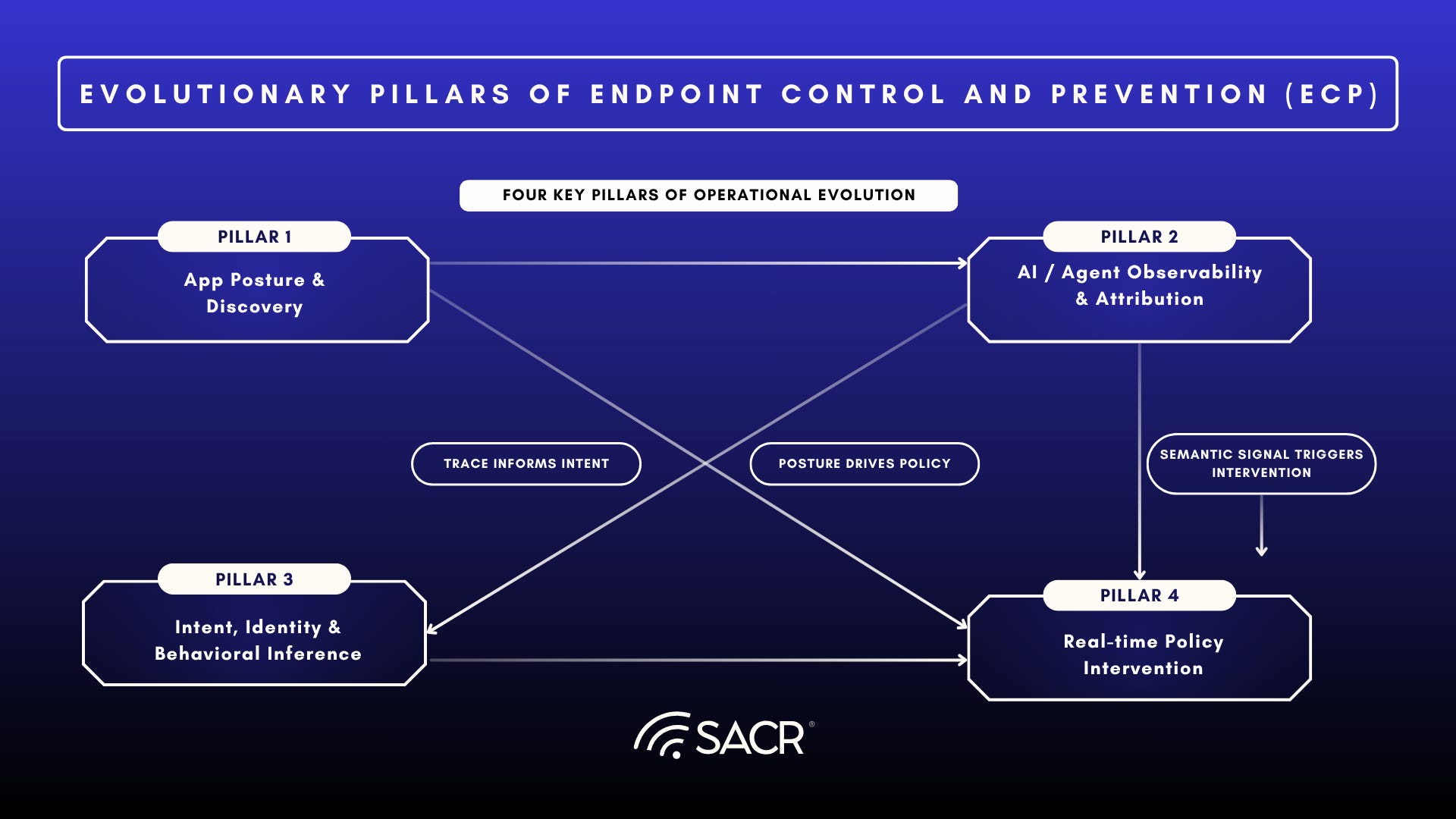
Investigation-Grade Evidence Required to Reconstruct Why, What and How
When an attack occurs, local telemetry is often the first and most detailed source of truth. However, raw endpoint logs (like standard Event IDs or process creation lines) lack the context required for sophisticated modern forensics. Endpoint agents must evolve into intelligent data collectors that correlate activities into a cohesive narrative. It isn’t enough to log that an administrative tool was run, a software or website was used; the endpoint must capture the prompt, tool, or automated workflow that triggered it. This allows SecOps to determine if a sequence of commands was executed by a human attacker, a benign developer, or an autonomous AI agent or toolchain.
Safer Enforcement: Moving Beyond Binary Decisions of Allow or Block through AI and Context Evaluation
Historically, endpoint detection and response (EDR) tools relied on binary enforcement where either a file was allowed to run, or the process was abruptly terminated and the machine isolated. This heavy-handed approach frequently breaks critical business workflows and alienates users. Modern endpoint defense requires graduated, human-centric controls integrated directly into the user interface. When a user attempts a risky but non-malicious action (e.g., running an unsigned IT tool or interacting with an unapproved API), the endpoint should inject real-time friction. This means warning the user, guiding them toward a safer alternative, or requiring a justified exception request that is immediately audited and passed to IT or GRC for review, rather than defaulting to a hard block. Contextual evaluation capabilities of LLMs have proven to reduce behavioral analysis of false positives by enabling cognitive evaluation by AI and agents, producing fewer false positives and more probabilistic-style responses.
Shifting from Posture Visibility to Proactive Posture Management and Control
The most disruptive change is the shift from endpoint security to posture security where the endpoint is no longer a boundary but a dynamic, self-optimizing component of the enterprise’s security ecosystem. The endpoint will be defined by identity, protected by identity, and continuously hardened by automated, intelligent systems. The technological building blocks are already in place: LLMs for reasoning, autonomous agents for self-healing, cloud-native and edge-native architectures for cross-platform security, and predictive posture for proactive defense. The next several years will see the convergence of these technologies into ECP, the next evolution of endpoint security. Endpoint defense must dynamically discover new micro-softwares and non-binary tools, rank their risk based on the permissions they hold (such as reading browser data, configurations, identities), evaluate source code repositories and supply chains for compromise, and apply proactive policy controls to prevent supply chain compromises arriving on endpoints.
SACR Future View: The Transition to Autonomous Endpoint Defense
By 2027, artificial intelligence and machine learning are fundamentally shifting Endpoint Detection and Response (EDR) from reactive, manual tools to proactive, autonomous, and self-healing systems conveying contextual information and telemetry in a semi-federated fashion.
The next horizon of endpoint defense is the migration of security intelligence from cloud-backend SIEM/SOAR clusters to the endpoint itself. As autonomous agents operate at machine speed, the traditional observe, export, analyze, respond cycle is becoming a structural failure point as the latency between detection and containment is now the primary attack vector.
The future of the endpoint is a self-governing runtime environment capable of endpoint and connected edge Inference. This requires a shift from passive telemetry collection to active, stateful full context defense, where endpoints utilize localized models (SLMs) and most likely include Edge services and integration with its telemetry to evaluate intent, govern non-binary software composition, and mediate agentic tool-chains in real-time, evolving from ECP to AECP over time.
ECP Zones as an Endpoint Control Plane
The architecture below presents The ECP Control Plane as a three-part architecture that moves from endpoint evidence to policy enforcement and verified outcomes. On the left, OS-layer signals, normalized endpoint context, and posture or behavioral state are consolidated into a validated endpoint evidence state. This evidence feeds a central, multi-zone enforcement model covering OS controls, software posture and supply chain governance, application-layer enforcement, agentic runtime visibility, intent and behavioral analysis, and data-centric enforcement. The model then applies zone-scoped write authority across endpoint agents, identity stores, browsers and SaaS applications, AI toolchains, and data egress layers, ultimately producing an enforced endpoint posture. A validation rail beneath the architecture logs each action, verifies the result against zone policy, preserves the evidence and authority record, and feeds the outcome back into the behavioral baseline.
ECP Zones as an ECP Control Plane
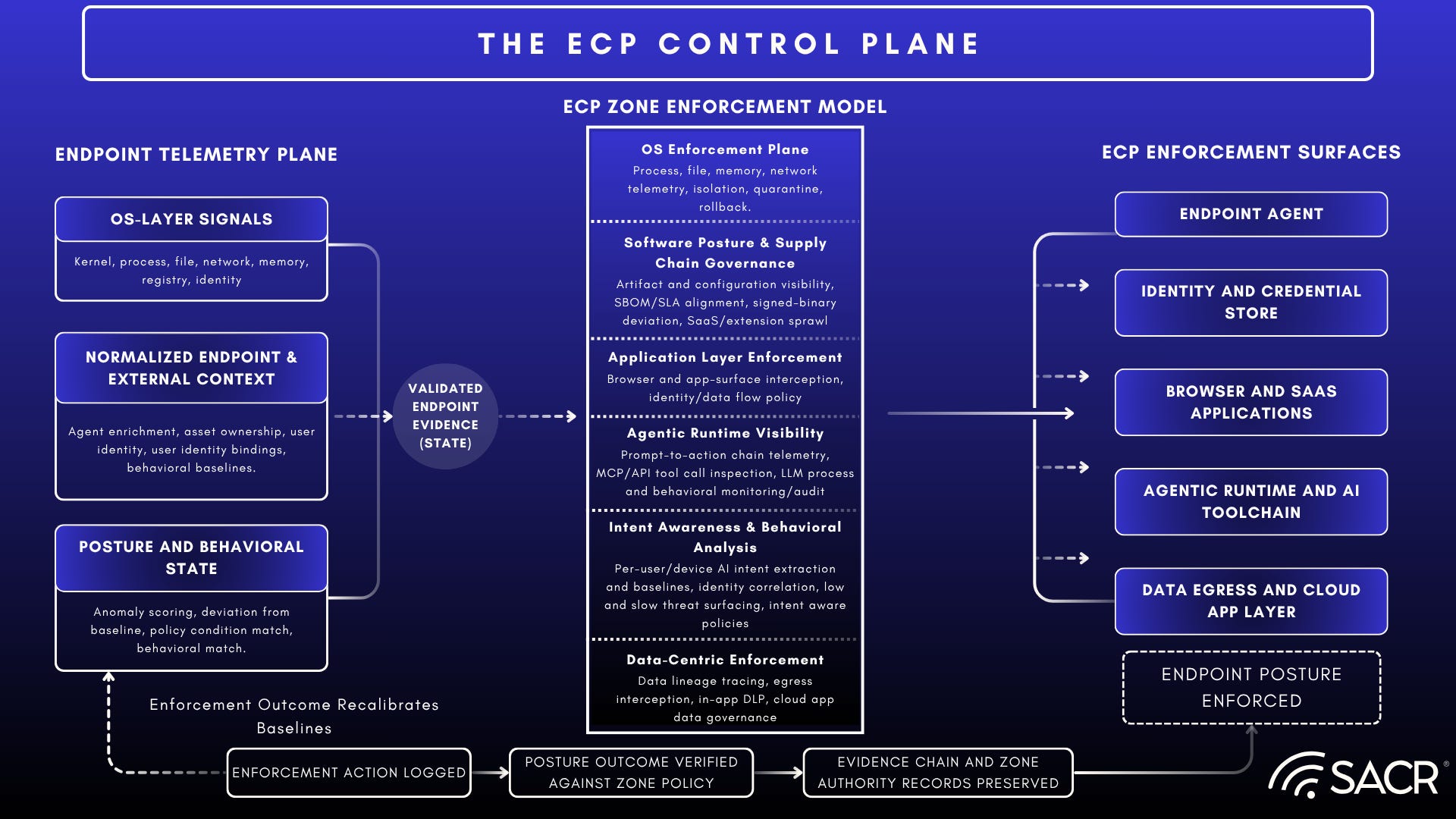
Key Requirements for Endpoint Control and Prevention
To enable autonomous Endpoint defense, security architectures must evolve to monitor these specific high-fidelity telemetry streams:
Prompt-to-Tool Lineage: Real-time tracking of input prompts, the specific tools invoked by the agent, and the associated data movement.
Non-Binary Composition State: Continuous monitoring of browser extensions, IDE plugins, and dependency packages (npm, PyPI) that alter the endpoint’s function post-deployment.
Local Intent Inference: Evaluation of natural language intent against security policies using lightweight, on-device models to detect semantic anomalies before execution.
Identity State Context: Localized tracking of active session tokens, OAuth grants, and API keys, ensuring that sensitive identity artifacts are only accessible to authorized workflows.
Dynamic Policy Enforcement: Monitoring and identification of shadow builder activity with automated, no-code and low-code workflows assembled by non-technical teams, to assess configuration and permission risks at the moment of creation.
Market Map: Endpoint Control and Prevention
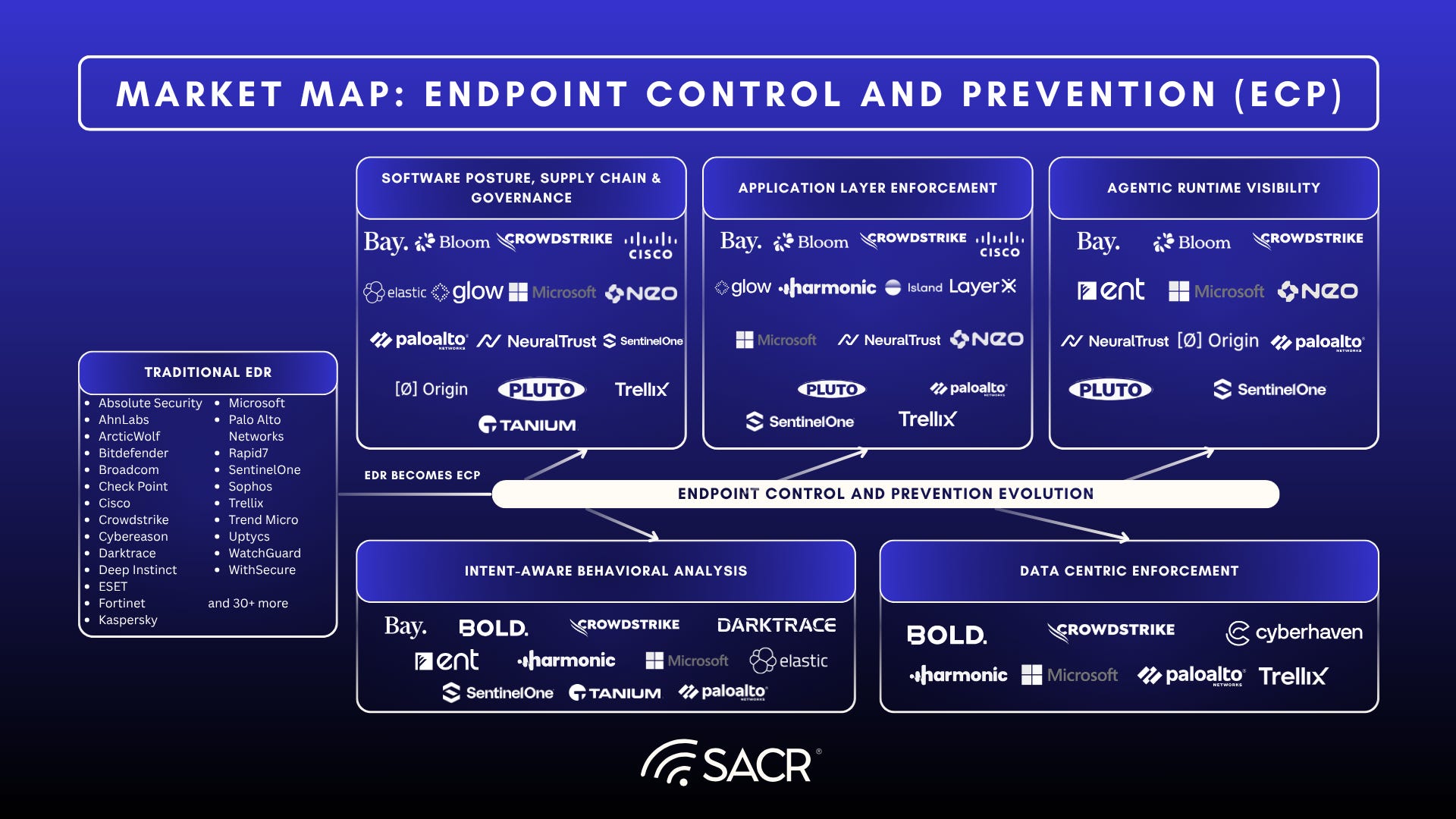
Future View: Endpoint Control and Prevention (ECP)
The integration of advanced AI and capabilities such as model context protocol driving the federation of agent-driven integrations are driving several major transformations in how EDR operates:
The Rise of Autonomous Agents
Endpoint security is entering its fifth generation, characterized by autonomous security agents. Instead of simply alerting human analysts, agentic AI is being deeply embedded into daily security operations, allowing systems to analyze massive volumes of heterogeneous data, make independent decisions about threat severity, and automatically trigger defensive reactions. This drastically reduces the mean time to respond (MTTR) from hours or days to just minutes, which is critical for containing fast-moving threats like ransomware.
New Attack Vectors Targeting AI
As AI becomes central to ECP, the AI models and agents themselves become high-value targets. Security teams must now defend against adversarial machine learning, where attackers manipulate input data to deceive AI detection algorithms. Because AI agents can crawl data and execute shell commands, they are vulnerable to indirect prompt injection attacks hidden within files or web pages. Modern ECP platforms are expanding to monitor AI usage, protect against data leakage, and secure the underlying AI infrastructure.
Advanced Behavioral Detection and LLM Integration
AI is replacing outdated signature-based detection with sophisticated behavioral analytics. EDR platforms are leveraging a combination of supervised learning, unsupervised learning, reinforcement learning (RL), and deep learning (DL) neural networks to recognize complex, novel attack patterns that traditional tools miss. Furthermore, Large Language Models (LLMs) are being deployed to parse massive amounts of unstructured data, such as chat logs, security logs, and emails to classify anomalies and conduct post-incident analysis by revealing an attacker’s motives and methods.
Self-Healing Endpoints and Automated Remediation
Perhaps the most significant advancement is the introduction of self-healing capabilities. When an endpoint is compromised, AI-driven ECP can automatically isolate the device, notify identity systems and backend telemetry via model context protocol (MCP), terminate malicious processes, remove persistence mechanisms, and roll back unauthorized system changes or encrypted files to a known-good, pre-infection state. This automated remediation and contextual sharing and response limits the blast radius of an attack and dramatically cuts down on the need to manually re-image devices.
Adaptive Security Policies
Rather than relying on rigid, static rules, AI empowers EDR and cloud security systems with continuous self-learning. These systems can dynamically adjust access controls, firewall settings, and anomaly thresholds in real time based on evolving attack patterns, ensuring resilience against zero-day exploits and environmental changes.
Human-Machine Collaboration
Despite the push for autonomy, a major theme for 2026 is balancing AI with human control so that algorithms do not go unchecked. The most effective SOCs utilize a collaborative model: autonomous systems handle routine threat containment and initial data correlation, while escalating the most sophisticated attacks to skilled human analysts. Human analysts then provide feedback that is used to continuously train and refine the machine learning models, improving future detection accuracy and reducing false positives.
Future View: Agentic Endpoint Control and Prevention (A-ECP)
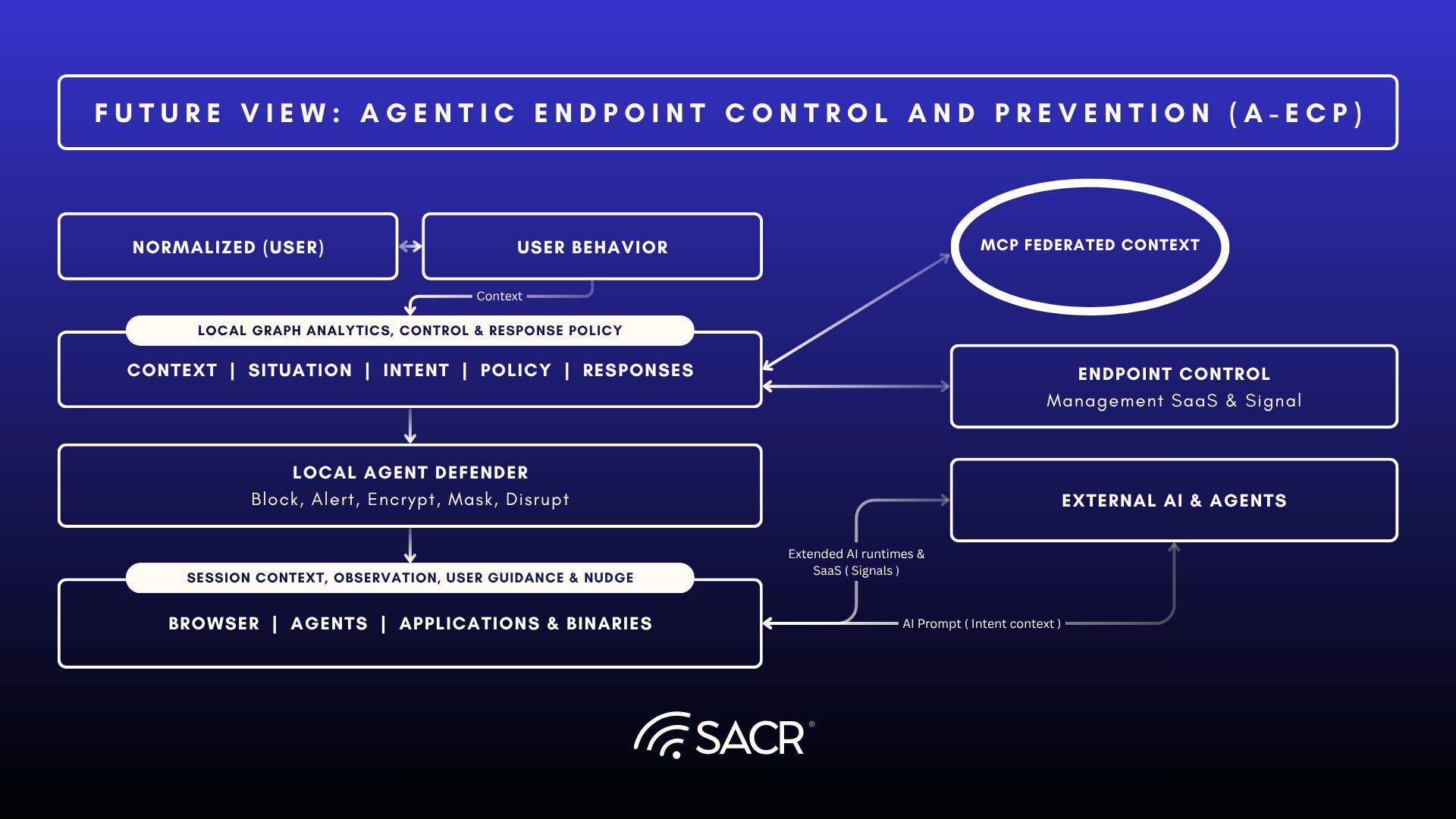
Implications for CISOs / Buyers: 30/90 Day Plan
Buyer strategy should assume rapid convergence: incumbent EDR will add more app-layer posture and identity context, while posture/agent-control vendors will add response and evidence features. CISOs should leverage the SACR 5 Zones framework as the primary architectural tool for identifying coverage gaps and mapping their infrastructure needs. The practical evaluation lens is: evidence quality, intervention safety, and measurable exposure reduction.
30 Days: Assess and Baseline
Audit existing security coverage against the SACR 5 Zones framework to identify specific architectural coverage gaps and avoid redundant tooling.
Treat classic EDR as baseline plumbing, not the strategic differentiator. Reallocate budget and evaluation energy toward application-layer posture, agent observability, and intervention safety.
Run privacy and governance diligence early. Recognize that intent layers require new, sensitive telemetry (e.g., interaction traces). Validate your organization’s standards for minimization, purpose limitation, and auditability.
Track pricing/model changes as a strategic signal. Monitor endpoint per-seat pricing compression, which signals detection commoditization. Look for consumption/usage models that better align with modern, bursty agentic workflows.
90 Days: Validate and Operationalize
Demand prompt-to-action attribution in any agentic tooling environment. Ensure any selected vendor can connect intent/prompt → action trace; without this, investigations will fail at machine speed.
Prioritize enforcement primitives that are surgical. Shift away from blanket block/allow strategies. Evaluate flow-level, policy-based interventions and exceptional UX that won’t break critical business workflows.
Evaluate autonomy. Evaluate autonomy as an operations capability, emphasizing the integration of new ECP signals into existing SOC workflows rather than mere validation. Ensure that these signals are actionable in your current incident response processes.
Prepare for category convergence. As EAPM/posture vendors add interventions and intent vendors add posture, focus your final evaluation criteria on the quality of control primitives and evidence.
SACR Key Takeaway:
For CISOs, the transition to Endpoint Control and Prevention (ECP) is not merely a tool upgrade but a strategic necessity to reclaim visibility in an era of AI-driven, machine-speed threats. As the center of gravity shifts from process-based detection to interaction-centric governance, the key takeaway is that your endpoint strategy must prioritize prompt-to-action attribution and granular, surgical enforcement over legacy, binary blocking.
By pivoting to an ECP-ready/AI oriented architecture, focused on software supply chain posture, identity-centric context, and autonomous behavioral inference, you can effectively reduce the blast radius of agentic workflows while ensuring your security posture remains resilient against industrialized, high-speed exploitation.
References
 | A guest post by
|