

Why CISOs Must Re-Think Identity Posture Management for AI Agents
How identity security is shifting from static reviews and dashboards to governed, verifiable remediation for human, non-human, and AI-agent identities


Executive Summary
Identity is the new perimeter. Every security leader has heard that phrase. Most have built programs around it. And yet identity-based attacks remain the most consistent, most documented, and most preventable category of enterprise breach. Not because the tools are inadequate. Because the governance model has not kept pace with the environment it is supposed to govern.
This report makes a direct argument: the identity security programs that most enterprises are running today are structurally mismatched with the identity environments they are trying to protect. The mismatch is not a product gap. It is an architectural one. And it is getting wider every quarter as AI agents enter enterprise workflows carrying identities, accumulating entitlements, and operating at speeds that no human-driven review cycle was ever designed to address.
SACR has been researching this market closely. What we found is not that organizations lack awareness of identity risk. It is that they have accepted a governance model built around detection and reporting at a moment when the threat environment demands detection, remediation, and verification as a single continuous loop. The organizations that close that loop will prevent breaches. The ones that do not will continue documenting them.
This report documents the evolution of ISPM across three distinct phases from periodic review to continuous visibility. Our goal is to make the case that the market has entered a third phase, which we call Agentic ISPM. The defining characteristic of this phase is not that AI is embedded in the interface. It is that posture findings can be translated into proposed, approved, executed, verified, and documented control changes without waiting for a human to open a ticket.
Introducing Agentic ISPM
We believe that Agentic ISPM is the next architectural evolution of identity security posture management. Where Continuous ISPM made risk visible in real time, Agentic ISPM makes risk actionable in real time. The defining capability is closed-loop remediation where the system does not merely surface a posture finding and wait, it can propose a corrective action, route it for human approval where policy requires, execute it, verify the outcome, and produce auditable evidence of every step, all within a governed, policy-bounded framework. Agentic ISPM represents a fundamental architectural shift from static, reactive identity governance to autonomous, continuous, and closed-loop control required to secure operations at machine speed.
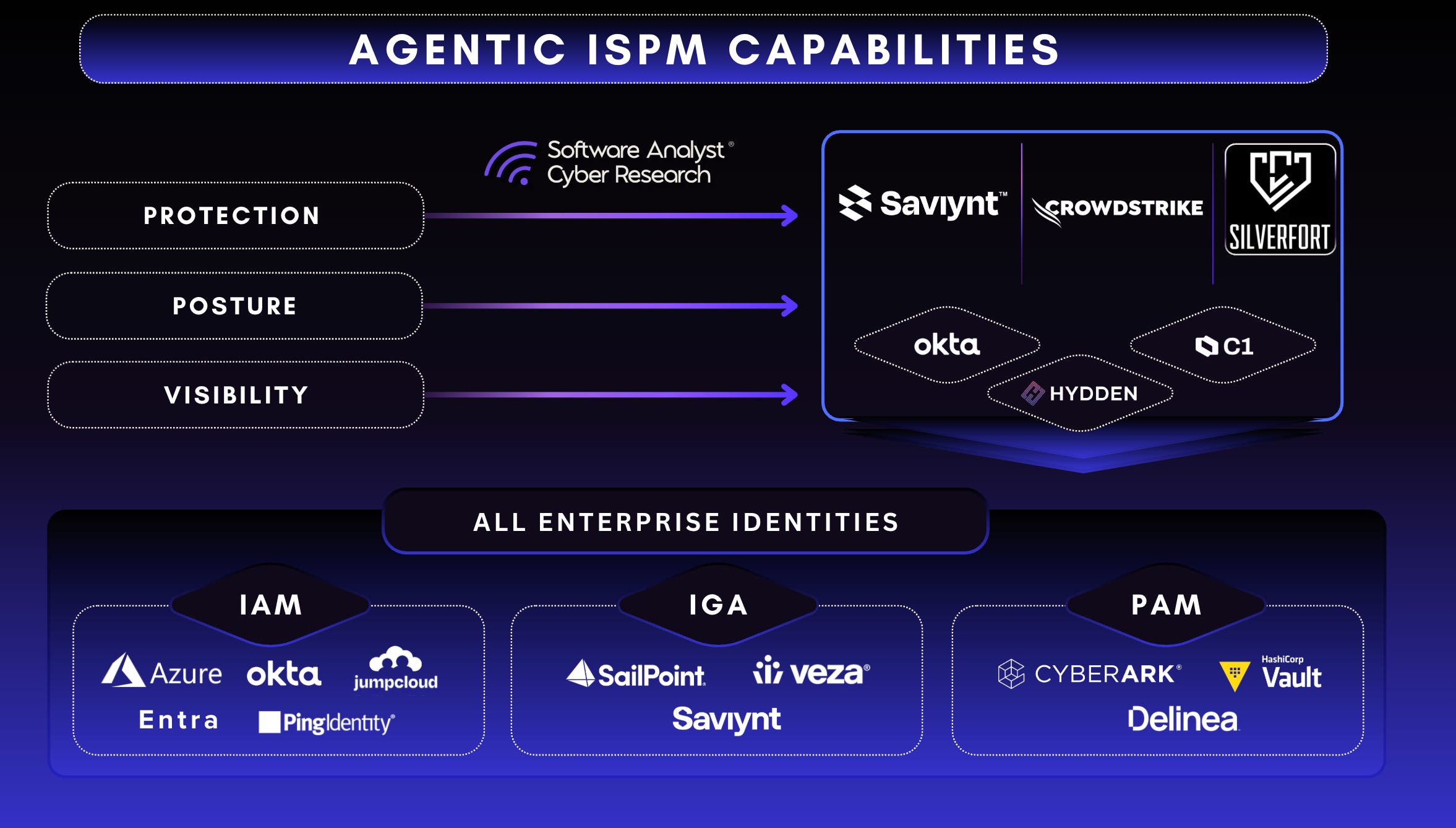
The distinction from earlier ISPM is not artificial. Continuous ISPM reduced the latency between a misconfiguration appearing and a human being notified. Agentic ISPM reduces the latency between notification and resolution, addressing a gap that most mature ISPM programs have been unable to close. It does this by aligning the non-deterministic behavioural signals generated by human users, machine identities, and AI agents with deterministic policy enforcement: the system reasons about context, but the controls it applies are bounded, verifiable, and reversible.
The result is a shift from posture management as a monitoring discipline to posture management as a control discipline. The question changes from what risks exist in our environment to what risks exist, what has been done about them, and how do we know it worked. Moving forward, we recommend IAM leaders and buyer evaluation to focus on verified remediation, which should focus on delivery of: write-back, change verification, instant rollback in the event of problems and clear lineage evidence for auditability.
What This Report Argues
Identity Security Posture Management emerged as the answer to a specific and urgent question: which identities, privileges, authentication policies, and access paths in our environment are unsafe right now? Not last quarter. Not at the last certification campaign. Right now.
For most enterprise programs, ISPM filled a real gap. It moved identity risk management from scheduled reviews to continuous visibility, from generic compliance findings to exploitability-mapped posture signals, from quarterly blind spots to ongoing assessment of the misconfigurations that attackers actually rely on. That was meaningful progress and it remains the foundation every mature identity program needs. The foundation is not the problem. The problem is that the environment has changed in a way that the foundation alone cannot address. AI agents are arriving in enterprise workflows as active participants: reasoning, calling tools, accessing sensitive systems, and chaining actions across services at machine speed. These agents require identities. They accumulate entitlements. They operate entirely outside the behavioral baselines that traditional identity programs were built to monitor. ISPM, as originally conceived, was not designed to govern them.
The market has reached a third phase. SACR calls it Agentic ISPM, and this report makes the case for why it represents the most significant architectural shift in identity security governance since the move from periodic access reviews to continuous visibility.
Identity Security Agentic Posture Remediation
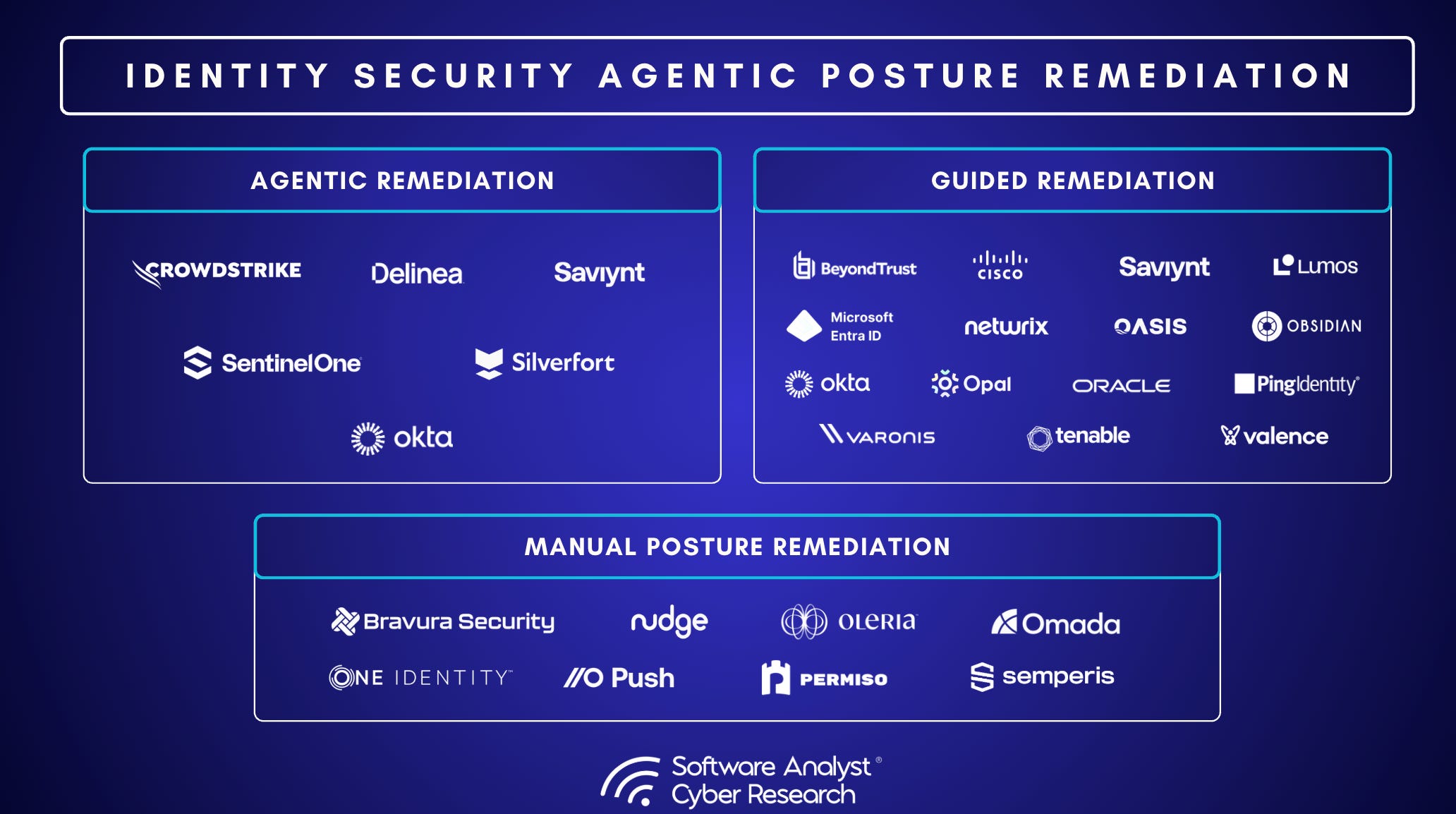
Market Map Rationale
This map organizes the identity security posture management vendor landscape according to remediation maturity. Specifically, the degree to which each platform can translate a posture finding into a governed, verified, and reversible control change without requiring a human to manually execute the fix.
Three tiers reflect three meaningful capability thresholds.
Agentic Remediation vendors have demonstrated closed-loop write-back: the platform makes changes directly to identity control planes, confirms outcomes, produces audit-grade evidence, and can restore prior states if a change creates operational risk. All five requirements- write-back, approval gating, verification, rollback, and evidence logging must be demonstrably met. When evidence was incomplete, vendors default to the Guided tier.
Guided Remediation vendors automate actions such as ticket creation, workflow triggers, and access review initiation, but cannot independently verify that a fix was applied or maintain rollback semantics across the full remediation cycle. This represents the current practical standard for most enterprise deployments.
Manual Posture Remediation vendors deliver continuous posture analysis and prescriptive remediation guidance, routing all execution to human administrators.
Tier placement measures remediation maturity only, not posture analysis depth, surface coverage, or overall product quality. The map answers one question: given a posture finding, how far can this platform take the response? That question matters because the bottleneck in mature ISPM programs is no longer detection. It is the gap between detection and verified remediation, and closing that gap is what the Agentic tier has been built to do.
Vendors are included if they provide continuous posture analysis across at least one major identity surface and offer a documented remediation workflow. Static dashboards and pure-play PAM or IGA solutions without ISPM use cases are excluded. Two known gaps require ongoing research: deep-tier NHI visibility across multi-cloud environments, and the long-term reliability of fully autonomous remediation agents at enterprise scale. Buyers should treat both as open questions in their own evaluations.
Evolution of Identity Security Posture
Identity security posture management evolved because traditional identity programs were not designed to continuously answer the most operationally important question in enterprise security: which identities, privileges, authentication policies, and access paths are unsafe right now?
Historically, identity and access management relied on periodic reviews, manual entitlement cleanups, access certification campaigns, and ticket-driven remediation. That model was adequate when the enterprise identity estate was primarily human-centric and relatively slow-moving. Administrators could review workforce access, validate role assignments, clean up stale privileges, and enforce authentication policies on a scheduled basis without losing significant ground between cycles.
The problem is that modern identity environments no longer move on a quarterly review cycle. Cloud infrastructure, SaaS applications, service accounts, API keys, workload identities, and now AI agents continuously create new access paths and new posture drift. The gap between the last review and the current risk state is where most identity-based attacks find their footing.
Phase One: Periodic IAM Reviews
The traditional model centered on scheduled access reviews, manual certification campaigns, and ticket-based remediation. Its strength was standardization. It forced organizations to periodically ask who had access, whether that access was still justified, and whether any privileges needed to be removed or adjusted.
Its weakness was latency. A quarterly access review creates a blind spot that spans months. In that window, users change roles, contractors leave without complete offboarding, service accounts accumulate stale privileges, applications are added without integration into governance workflows, and authentication policies drift as exceptions accumulate. Attackers do not wait for certification campaigns. The model also becomes structurally weaker as non-human identities and AI agents grow to outnumber human users, because their access patterns are more dynamic, harder to interpret, and entirely unsuited to manual review cycles.
Phase Two: Continuous ISPM
Continuous ISPM improved the model by making posture assessment ongoing rather than periodic. It continuously evaluates identity systems, directories, authentication policies, privileges, group memberships, application permissions, and identity configurations to identify risk before it becomes an incident path.
The core advance was that identity posture findings could now be mapped to exploitability, blast radius, and operational risk rather than treated as generic compliance gaps. A weak MFA policy, a stale privileged account, an exposed service principal, or a legacy authentication pathway could be understood as part of a specific attack path rather than an abstract policy deviation. Continuous ISPM became the preventative layer in the identity stack: it gave security and identity teams the ability to understand where their environment was weak and which misconfigurations created the most material risk, in real time.
The limitation that emerged was equally important. Most Continuous ISPM workflows still depend on human-speed remediation. The system identifies the posture issue continuously, but the fix still requires a ticket, an access review, a workflow approval, or an administrator making a manual change. In environments where the identity estate changes at cloud and automation speeds, continuous visibility without timely remediation produces a better-informed backlog rather than a more secure environment.
Phase Three: Agentic ISPM
Agentic ISPM represents the current frontier: a shift from continuous posture visibility to governed, closed-loop posture control. The defining difference is not that AI has been added to the interface. It is that posture findings can be translated into proposed, approved, executed, verified, and documented control changes without waiting for a human to process each one through a manual queue.
In an Agentic ISPM model, the system does not merely report that an account is overprivileged, that a legacy authentication protocol is exposed, or that a service account has accumulated stale privileges. It can recommend or execute a bounded remediation action, route high-impact changes for human approval, verify that the fix was applied correctly, produce audit-grade evidence of the change, and maintain rollback semantics if the action creates operational risk. This is the shift from ISPM as a reporting tool to ISPM as a control system.
The benefit is speed and precision. Agentic ISPM reduces time-to-remediation for identity risks that would otherwise accumulate in ticket queues or review campaigns. It can right-size privileged access, disable risky authentication paths, clean up stale accounts, assign ownership to unmanaged identities, and enforce guardrails around AI agents and non-human identities at a pace that matches the speed at which those risks appear.
The risk is equally important to state plainly. Autonomous remediation introduces real concerns around reliability, overcorrection, and operational breakage. That is why Agentic ISPM must be governed rather than blindly autonomous. High-impact controls require human-in-the-loop approval, deterministic policy boundaries, blast-radius analysis, verification loops, evidence logs, and rollback mechanisms. Remediation that cannot be verified and reversed is not mature Agentic ISPM. It is risky automation with better branding.
The practical takeaway for IAM leaders is direct. Periodic IAM reviews reduce governance gaps. Continuous ISPM reduces posture drift. Agentic ISPM reduces time-to-remediation under machine-speed identity change. Each phase addressed a real limitation of the one before it. The question for any program today is not which phase matters most. It is whether the current program reflects the pace at which the identity environment is actually changing.
Why Agentic ISPM Remains Central
As agentic capabilities have captured market attention, a quieter but more damaging narrative has taken hold: that foundational ISPM is a solved problem, a baseline capability that mature organizations have already addressed and moved beyond. The breach data does not support that narrative, and IAM leaders who accept it are accepting a material gap in their programs.
Identity posture drift remains the leading precondition for identity-based attacks. Not phishing. Not zero-day exploitation. Misconfiguration is the condition that attackers most consistently rely on to establish initial access, move laterally, and maintain persistence. The attack chain is well understood: legacy authentication enabled creates a credential exposure opportunity; an overprivileged account provides the blast radius needed for lateral movement; a stale privileged account provides persistence without active monitoring. Each element of that chain is a posture failure. Each is, in principle, preventable. Most organizations are still not preventing them continuously or at the speed their environments demand.
How MITRE ATT&CK Techniques Mapped to ISPM
The claim that misconfiguration drives identity breach more consistently than phishing or zero-day exploitation is not a theoretical position. It is what the adversary behavior data shows. The techniques in the MITRE ATT&CK framework that are most frequently used against enterprise identity infrastructure do not require novel attack chains. They require finding the configuration gaps that most identity programs have not yet closed. The mapping below connects specific ATT&CK techniques to the ISPM checks that address them, and to the documented frequency with which those techniques appear in real breach investigations. The occurrence rates are drawn from the 2025 Verizon DBIR, the NHIMG 2025 State of NHI Security report, DarkAnalytics 2025, Red Canary 2025, CrowdStrike GTR 2025, and SecurityToday 2026.
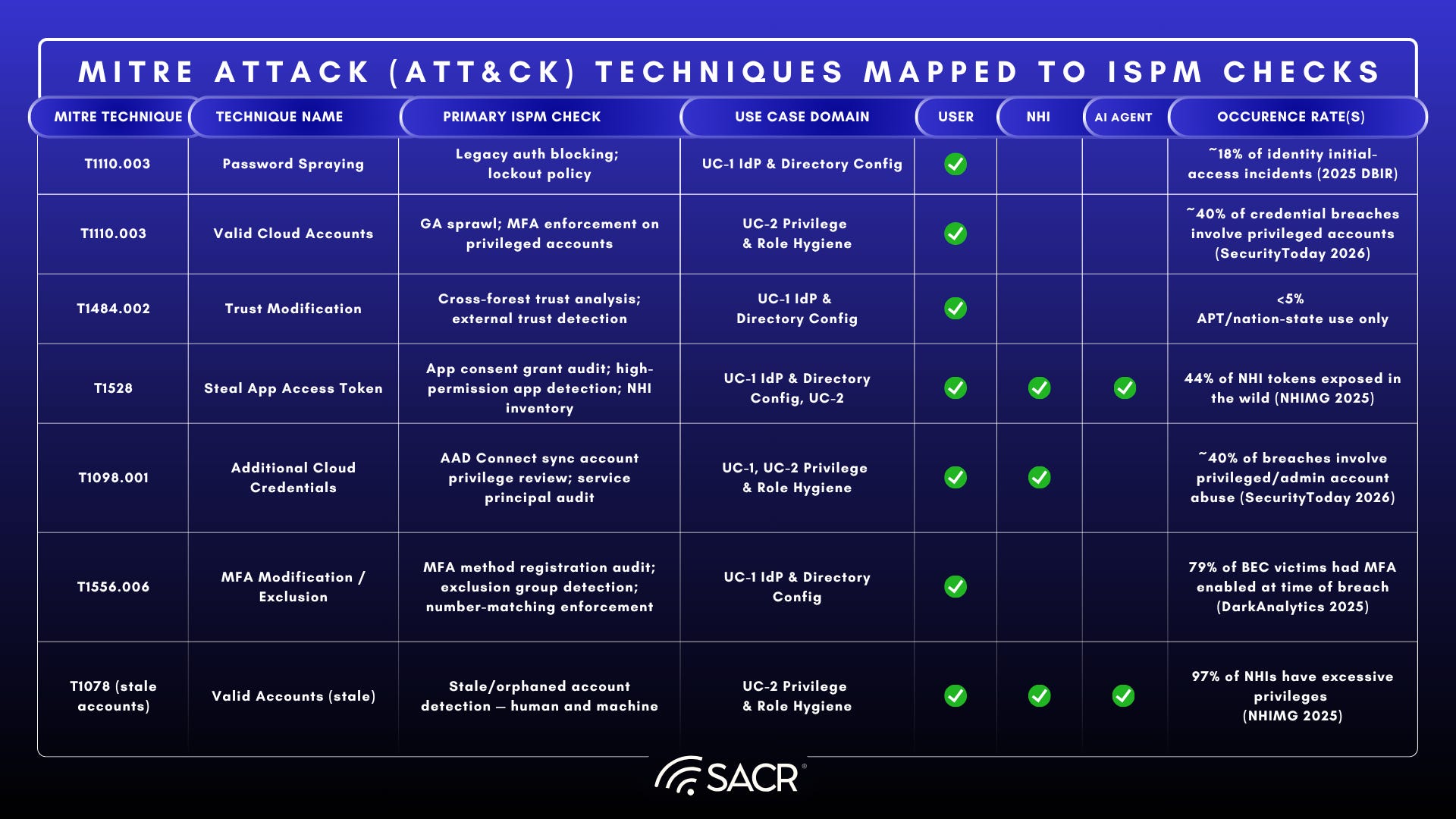
Three findings carry particular weight for IAM leaders reading this report.
Password spraying, mapped to T1110.003, appears in approximately 18% of identity initial-access incidents. The primary ISPM control is legacy authentication blocking and lockout policy enforcement. This is not a sophisticated defense. It is a configuration that most environments are capable of implementing and that continuous posture management surfaces as a finding when it drifts. The frequency of this technique in breach investigations reflects how often that configuration has not been maintained.
Stale and orphaned accounts, mapped to T1078, affect all three identity populations simultaneously: human users, non-human identities, and AI agents. According to NHIMG 2025, 97% of non-human identities carry excessive privileges. That figure does not reflect a sophisticated attack campaign. It reflects governance neglect at scale, and it represents the single largest unaddressed exposure in most enterprise identity programs today.
Supply chain and federated identity techniques, mapped to T1195 and T1550.001, appear in 92% of organizations that expose non-human identities to third parties without adequate governance controls. Golden SAML operates at less than 5% occurrence but carries catastrophic blast radius when it appears, as the SolarWinds investigation confirmed. Both techniques require ISPM coverage that spans on-premises directory configuration and cloud IdP synchronization simultaneously. Single-surface tools cannot identify the precondition.
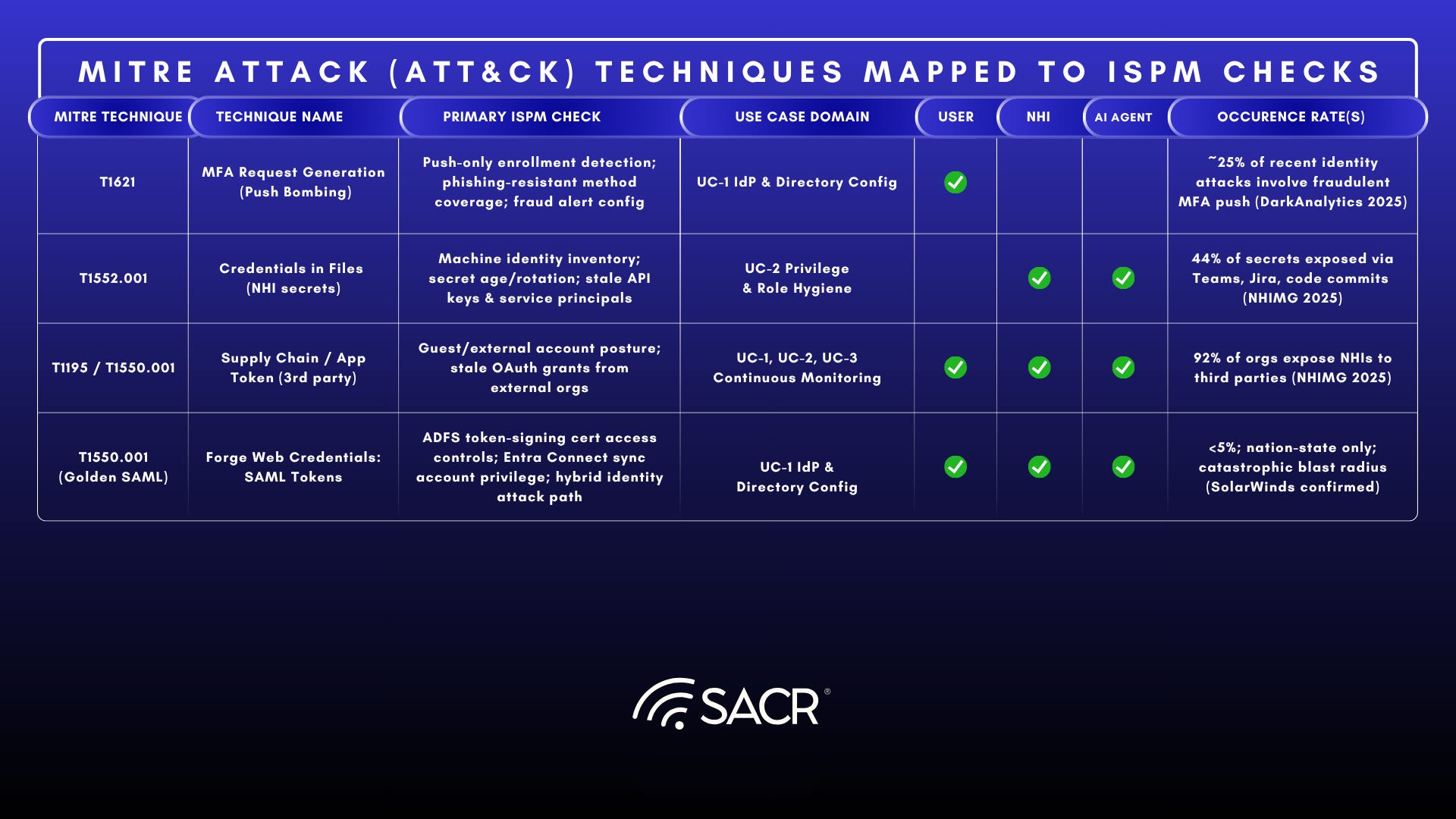
The MITRE mapping establishes what ISPM needs to address. The benchmark data that follows addresses a different question: whether agentic remediation has reached the reliability threshold where it can be trusted to address those conditions autonomously, and under what constraints that trust is currently warranted.
ISPM Benchmarks: Sola Results by Overall Performance by Domain (%)
The central question about Agentic ISPM is not conceptual. Most IAM leaders accept that autonomous, governed remediation would be valuable if it worked reliably. The question they are actually asking is whether it works reliably enough, across the identity surfaces that matter to their environments, to be trusted with real control changes rather than draft tickets.
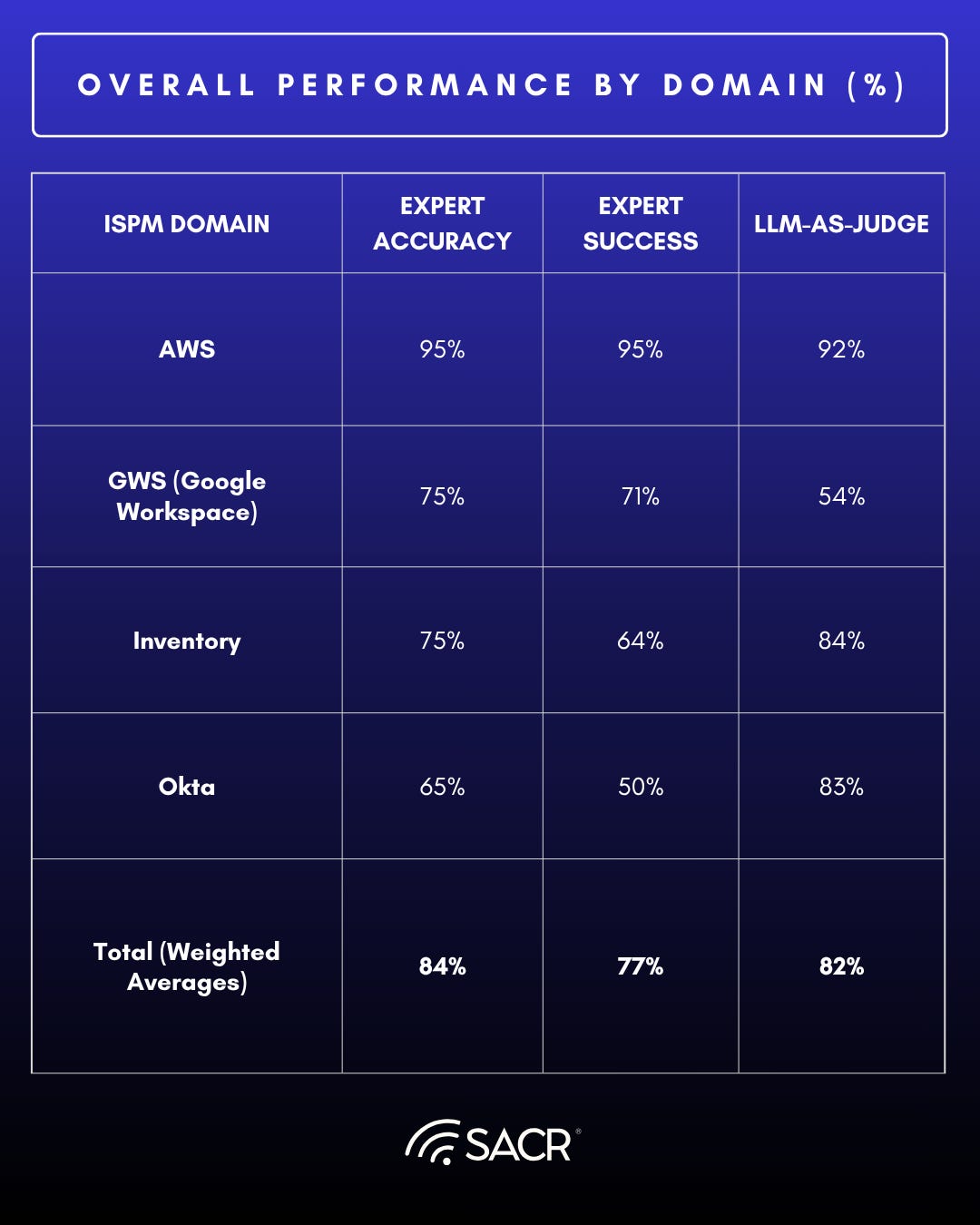
The Sola Visibility ISPM Benchmark, published in January 2026, provides the first systematic answer. It evaluated agentic AI performance against core ISPM tasks in real enterprise environments across AWS, Okta, and Google Workspace, measuring three dimensions: expert accuracy, the degree to which agentic responses matched what a human expert would produce; expert success, the rate at which agentic actions achieved the intended outcome; and LLM-as-judge, an independent model evaluation of response quality. The overall weighted results were 84% expert accuracy, 77% expert success, and 82% LLM-as-judge.
Those numbers mean different things depending on which surface and which task type a buyer is evaluating. Reading them as a single average obscures the most important signal in the data.
Where agentic ISPM is ready to act. AWS posture tasks achieved 95% expert accuracy and 95% expert success. These results reflect the relative maturity of cloud IAM signal quality. AWS permission models are precise and well-structured, and the posture questions ISPM needs to answer about AWS identity configurations are largely deterministic. At 95% accuracy and success, agentic remediation of AWS posture findings is mature enough to support autonomous execution for lower-impact changes, with human approval reserved for high-impact IAM policy modifications.
Where human oversight remains essential. Okta posture tasks achieved 65% expert accuracy and 50% expert success. This is the most operationally significant result in the benchmark for most enterprise buyers, because Okta is one of the two or three most common IdP environments in large-scale enterprise deployments. A 50% expert success rate means that in half of evaluated Okta posture tasks, the agentic system did not achieve the intended outcome. That result does not support autonomous remediation of Okta configurations without human oversight. It reflects a genuine difference in complexity: Okta posture analysis requires reasoning about conditional access policy logic, group membership inheritance, application assignment scope, and authentication policy exceptions in combination. These are context-dependent questions that require organizational knowledge beyond what technical signals alone supply.
What the benchmark means for buyers.
Three conclusions follow directly from the data. For AWS and comparable cloud IAM environments, agentic remediation is mature enough to support autonomous execution of lower-impact changes with governed approval for high-impact modifications. For Okta and other IdP environments requiring contextual organizational reasoning, agentic assistance with human-in-the-loop review is the appropriate starting point today. For inventory and non-human identity governance tasks, agentic discovery and prioritization are ready; agentic remediation of those findings benefits from human review where ownership attribution is ambiguous. The approval threshold across all three domains will shift as vendor fine-tuning on organization-specific identity data matures. Buyers who track the benchmark as it evolves will have the clearest signal of when that shift is warranted.
Why the Foundation Still Matters
As agentic capabilities have captured market attention, a quieter but more damaging narrative has taken hold: that foundational ISPM is a solved problem, a baseline capability that mature organizations have already addressed and moved beyond. The breach data does not support that narrative, and IAM leaders who accept it are accepting a material gap in their programs.
Identity posture drift remains the leading precondition for identity-based attacks. Not phishing. Not zero-day exploitation. Misconfiguration is the condition that attackers most consistently rely on to establish initial access, move laterally, and maintain persistence. The attack chain is well understood: legacy authentication enabled creates a credential exposure opportunity; an overprivileged account provides the blast radius needed for lateral movement; a stale privileged account provides persistence without active monitoring. Each element of that chain is a posture failure. Each is, in principle, preventable. Most organizations are still not preventing them continuously or at the speed their environments demand.
Agentic ISPM does not replace that foundation. It accelerates and governs the response to it. Two converging crises explain why that acceleration is now urgent.
The first crisis is the pace of drift itself. Configuration drift is not a single event. It is the compounding effect of small, individually unremarkable changes that accumulate over time into exploitable conditions. Cloud infrastructure, SaaS adoption, and DevOps automation have produced identity environments that change continuously. Access paths are created and modified by deployment pipelines, provisioning tools, and developers working faster than any quarterly review cycle can track. By the time a certification campaign runs, the access state being reviewed may bear little resemblance to the state that existed two weeks earlier. Continuous ISPM was built to close that gap. Agentic ISPM is built to close what remains: the distance between detecting a drift condition and resolving it before an attacker discovers it first.
The second crisis is the failure of human-scale governance at machine speed. Traditional identity governance was designed for a human-centric access environment. Its review cycles and manual remediation workflows are calibrated to human-speed change and human-legible access patterns. That design assumption no longer holds. Non-human identities, including service accounts, API keys, workload credentials, and autonomous AI agents, outnumber human users in most enterprise environments, in some cases by a factor of fifty to one. They accumulate privileges through automation rather than deliberate assignment. They are frequently created without ownership attribution, which means that when their risk state changes, there is no one to notify and no remediation workflow to trigger.
The introduction of AI agents intensifies this problem qualitatively, not just quantitatively. Unlike service accounts, which are relatively predictable in their behavior, AI agents can reason, plan, and take action across multiple systems simultaneously. They adapt based on context, chain operations together, and delegate access in ways that are difficult to anticipate and harder to audit after the fact. An AI agent holding standing access to a sensitive system, operating with a credential shared across tasks, represents a high-velocity incident path that traditional human-speed review processes are structurally unable to close. Some analyst projections suggest that by 2027, AI agents will reduce the time required to exploit account exposures by approximately 50 percent. At that speed, periodic governance is not a partial solution. It is no solution at all.
Regulatory Frameworks Are Enforcing What Good Practice On Identity Posture Recommends
Regulatory pressure is no longer a secondary driver of ISPM adoption. Several major frameworks have moved from recommending identity hygiene practices to mandating specific, auditable outcomes that continuous posture management is uniquely positioned to satisfy.
NIS2 requires organizations to demonstrate active access controls, including MFA enforcement and least-privilege access, and to produce evidence of continuous monitoring and incident readiness.
DORA requires evidence of privileged account inventory and regular access reviews, along with tracking and documentation of MFA exceptions across the organization.
SEC cybersecurity disclosure requirements demand audit-grade forensic evidence and governance documentation sufficient to support board-level reporting on material cybersecurity risk. Organizations without that capability must reconstruct the same evidence after the fact, under adverse conditions, with an incomplete record.
These frameworks establish a minimum operational standard that continuous, manual identity governance cannot meet at the pace regulatory expectations now demand. The organizations that will satisfy these requirements most cleanly are those that have built continuous posture management into the ongoing operation of their identity program.
The Practical Takeaway for IAM Leaders
The strategic argument for ISPM investment does not rest on any single driver. It rests on the convergence of three: the documented persistence of identity posture drift as the primary breach precondition, the structural inability of human-scale governance to address machine-speed identity change, and regulatory frameworks that are moving the compliance floor upward toward the operational standard that effective ISPM already represents.
For IAM leaders, the relevant question is not whether to invest in continuous identity posture management. It is whether the current program reflects the pace at which the identity environment is actually changing, covers the full population of identities that need to be governed including non-human identities and AI agents, and connects posture findings to remediation at a speed that closes the gap before it is exploited.
The organizations that treat ISPM as a compliance checkbox will extract compliance value from it. The organizations that treat it as operational infrastructure will extract security value from it. In an environment defined by identity posture drift, non-human identity sprawl, and autonomous agents operating outside existing governance frameworks, the difference between those two outcomes is the difference between an identity program that prevents breaches and one that documents them.
The Convergence Happening In Identity
ISPM has moved from a specialist capability to a strategic infrastructure layer. Its growth reflects a fundamental reorientation in how enterprises think about security architecture: the perimeter is no longer a network boundary. It is an identity. Every access decision, every authentication event, every entitlement granted or revoked is a point at which security is either enforced or compromised. In that environment, the platform that continuously governs identity posture and can act on what it finds sits at the center of the enterprise security stack, not at its edge.
That shift has exposed a structural problem that most identity programs have not yet resolved. The disciplines responsible for identity security- governance, privileged access management, and threat detection were built as separate functions, each with its own tooling, its own operational cadence, and its own blind spots. IGA governs who has access and whether that access is justified, but depends on review cycles that may already be stale by the time they run. PAM secures and monitors privileged accounts, but its scope typically ends where the definition of “privileged” ends leaving service accounts, API credentials, and AI agents in a governance gap. ITDR detects and responds to active attacks, but by the time it is engaged, a misconfiguration has already been exploited.
ISPM addresses this structural problem by operating as the shared intelligence layer across all three disciplines. As agentic capabilities mature, this loop is becoming faster, more autonomous, and more tightly integrated. ISPM is no longer a collection of siloed posture assessment tools that hand off to separate remediation systems. It is converging with the broader identity platform: IGA, PAM, ITDR, and increasingly the agentic execution layers described later in this report into a unified workflow that can take a posture finding from detection to verified remediation without requiring a human to manually coordinate the handoff between systems.
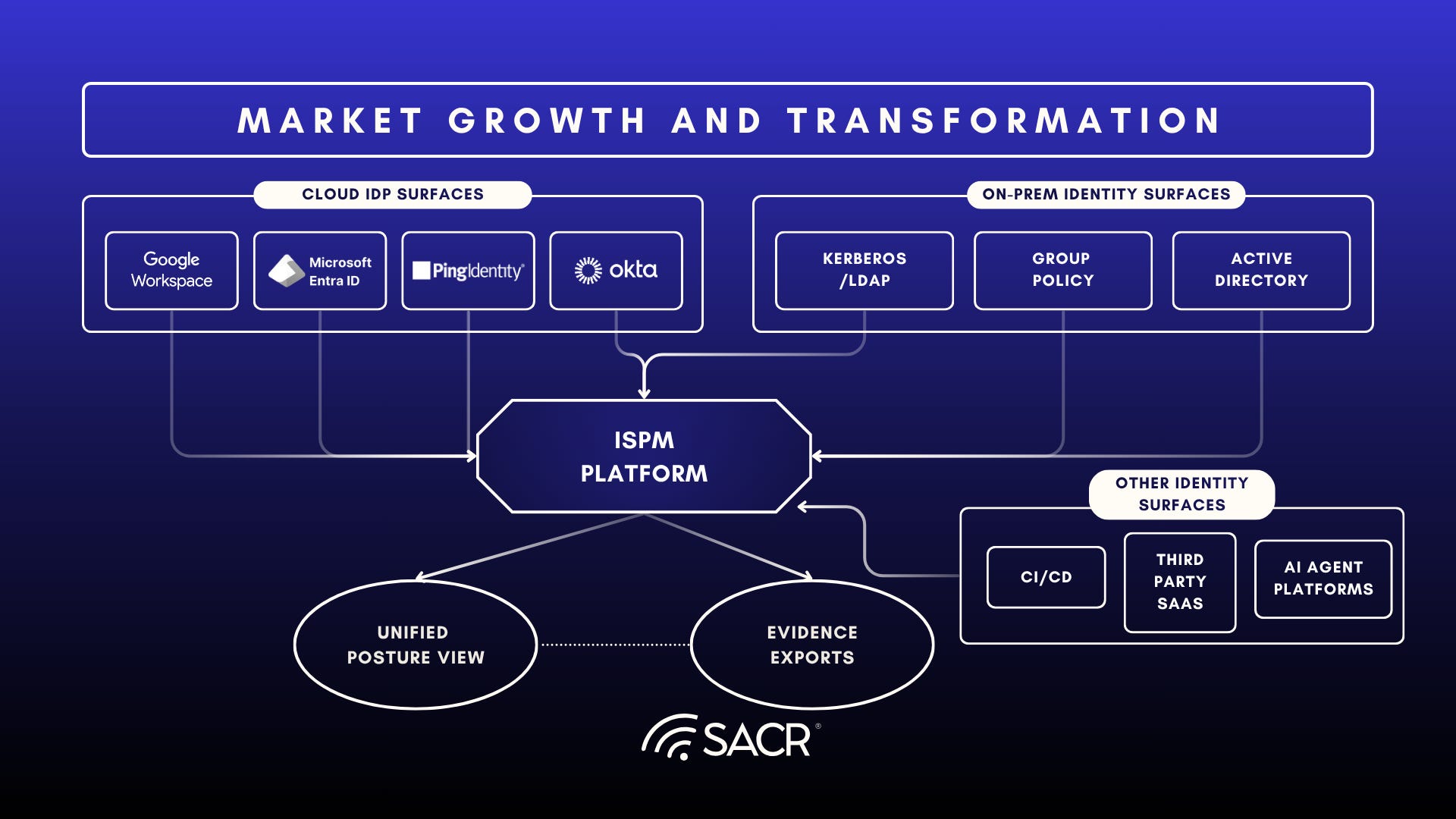
These areas are increasingly overlapping as ISPM transforms from a collection of siloed point tools into a unified workflow in wider IAM tools and how they might merge with Emerging Agentic Identity Access Platforms (AIAP). When ISPM identifies and prioritizes misconfigurations or posture drift, it routes remediations through IGA-style attestations, PAM-style privileged change controls, and ITDR and SIEM pipelines for correlation.
This integrated approach creates a single loop from discovery to remediation to audit trail. Modern identity platforms have been converging to meet buyer demands for unified visibility, compliant reporting, and safe automation, while ISPM serves as the connective tissue that translates identity settings into measurable, defensible risk reduction and is also evolving to accommodate agentics for various analysis, reporting, remediation and workflow activities.
The Future of Identity Security: Continuous Posture-to-Runtime Control
The convergence described above is not simply a product trend. It points toward an architectural model that represents the logical endpoint of the ISPM evolution: a unified, closed-loop control plane in which real-time risk posture directly informs access enforcement at the moment an identity- human, non-human, or agentic attempts to act.
SACR calls this model Continuous Posture-to-Runtime Control. Its defining property is the elimination of the gap between knowing that a risk exists and preventing it from being exploited. In current ISPM deployments, that gap is filled by human remediation workflows; a finding is generated, a ticket is created, an administrator makes a change. In the Continuous Posture-to-Runtime model, the posture signal feeds directly into the authorization decision. An agent flagged as high-risk does not wait for a human to review the finding and revoke its access. Its access is constrained or revoked at the moment the risk condition is detected, without human latency in the loop.
Prediction: Capability Matrix For the ISPM and AIAP Convergence
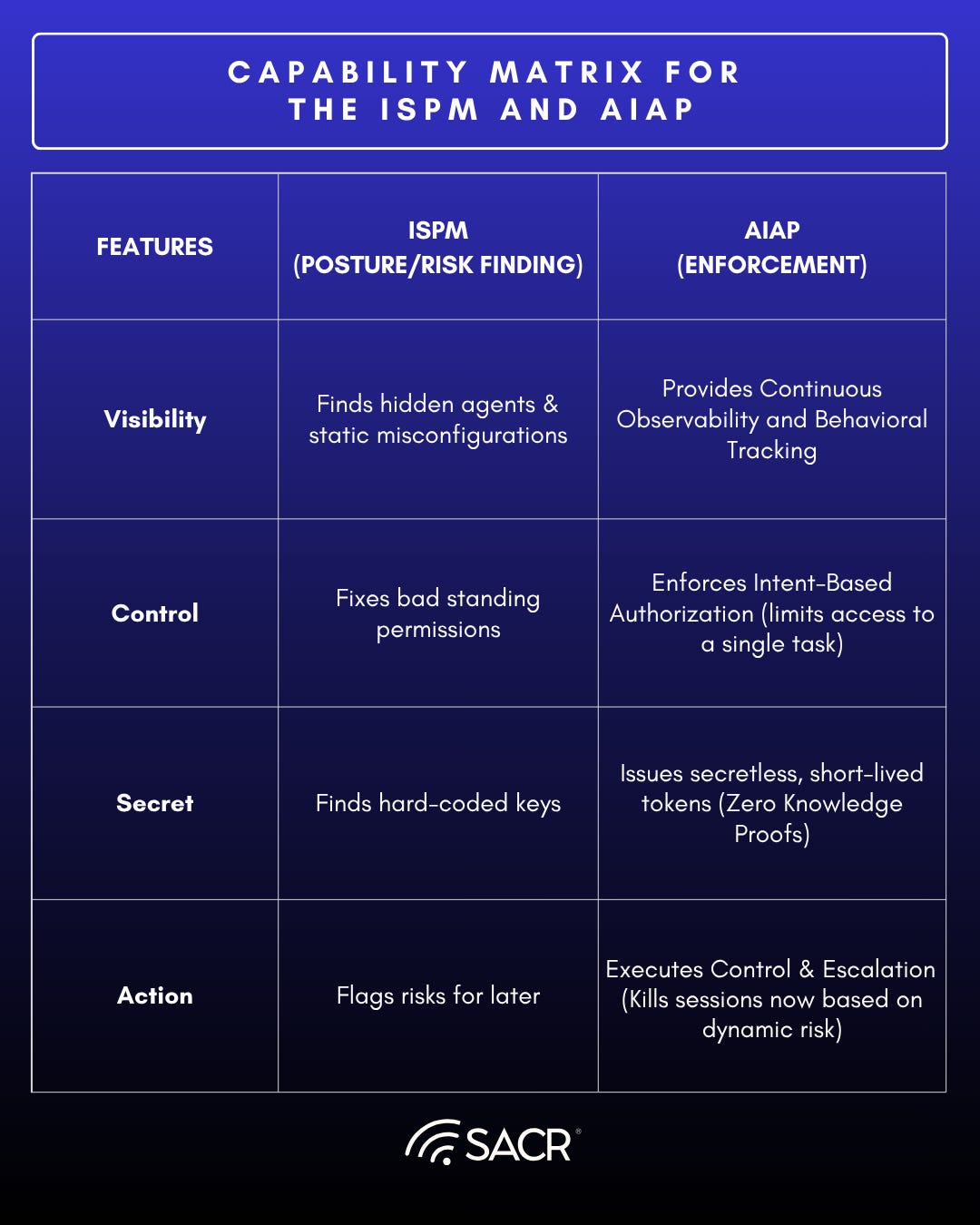
This model requires the convergence of two capabilities that have, until recently, evolved on separate tracks: Identity Security Posture Management and what are emerging as Agentic Identity Access Platforms: the runtime authorization and credential brokering layer that governs what identities can do at the moment of action, not just what they are permitted to do in principle.
For a deeper analysis of this transition, see the SACR report on AIAP. By 2029, SACR believes that identity for AI agents will no longer be static; it will be a transient state, granted, monitored, and revoked in real time (see also Runtime Security for AI Agents). Organizations that fail to adopt an agentic broker and runtime security risk leaving their infrastructure vulnerable to the exploitability of static, long-lived credentials. SACR will be exploring Runtime Identity Security Enforcement in future notes.
An Integrated Operational Model
The ISPM and AIAP convergence over time represents the architectural foundation of Continuous Posture-to-Runtime control, a unified, closed-loop control plane designed to govern machine-speed autonomy. This integrated model is structured around the four operational phases of Agentic Access Management (AAM), aligning the ISPM function (posture/risk-finding) with AIAP execution and the three layers of agent runtime security. Read more in our report above.
Agentic Remediation
The New Battleground for ISPM Capabilities
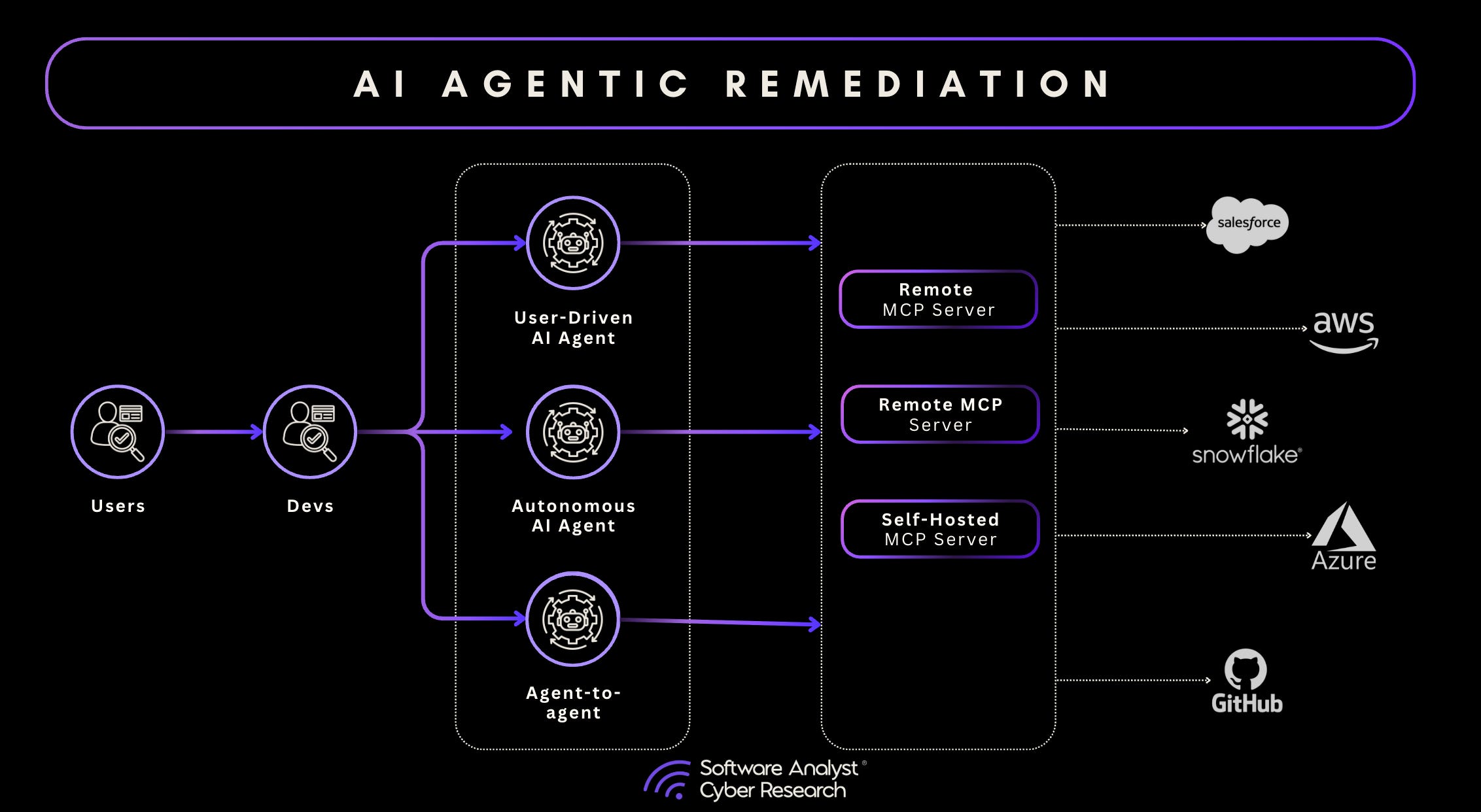
Agentic AI is not just a risk driver, it ultimately changes what good ISPM looks like as it becomes more and more capable of delivering reliability and efficiency for enterprises. The differentiator in the application of AI and agentics (at least today) is predominantly agentic remediation, which provides tools with the ability to turn posture findings into safe, reversible, evidence-producing changes at scale using various AI agents for various functions and domains. Use cases that are lightweight, or lower risk operations (for example, agentic review, prioritization, explanations for identity and access management team operators, or for audit sampling) are all lower risk activities that can be agentic-enabled without as much risk. Agentic adoption will still be reliant on enabling factors to gain adoption, the most important aspect being reliability and accuracy as called out by the Sola benchmark testing and vendor verification claims (See SOLA-VISIBILITY-ISPM).
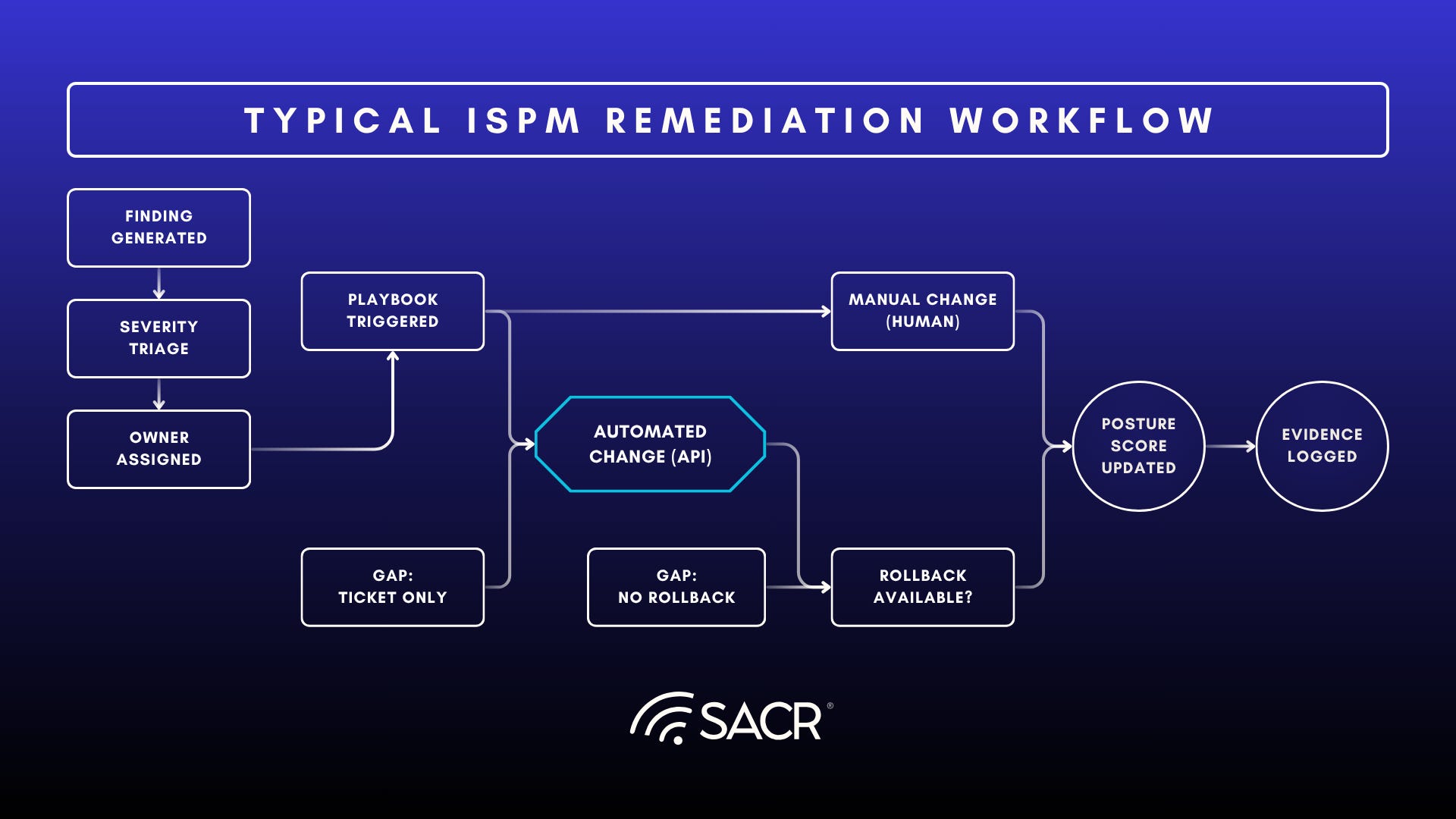
Typical ISPM Remediation Workflow
The typical ISPM remediation workflow operates as a closed-loop control system that moves through five critical stages: detect, decide, remediate, verify, and evidence. This automated cycle relies on several key enabling factors to ensure operational safety and reliability, including a change-control interface for human-in-the-loop approvals, rollback semantics to revert changes if necessary, a continuous verification loop to monitor for drift, and evidence-grade telemetry to provide a complete audit trail of every action taken.
Implication: ISPM must be evaluated as a closed-loop control system (detect → decide → remediate → verify → evidence), not as a posture dashboard.
Product Use Cases CISO Buyers Should Evaluate
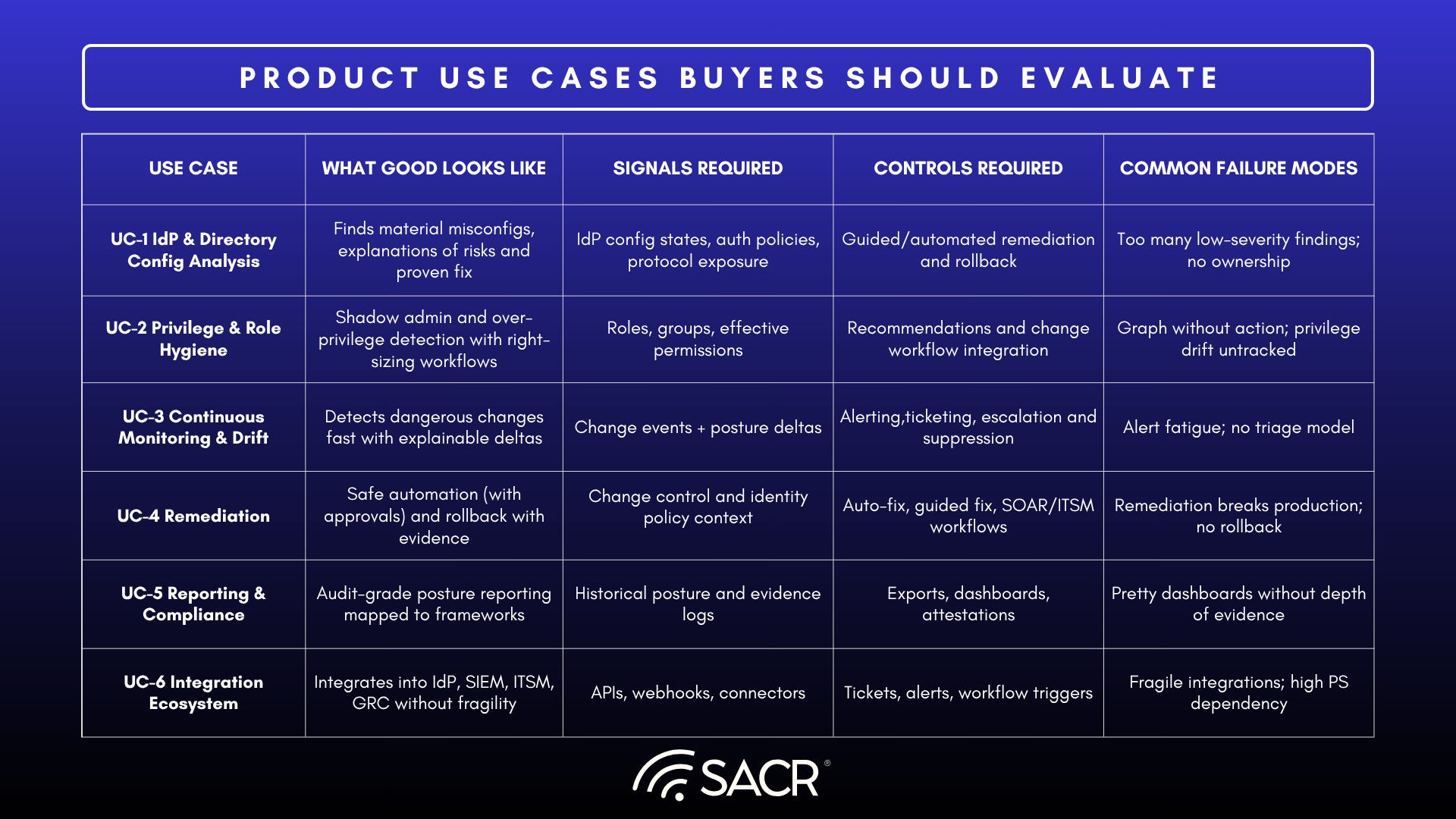
Agentic remediation capabilities (what to look out for)
The following capabilities delineate the fundamental transition from passive reporting toward a continuous, operationalized identity security control loop.
Evaluation framework: Qualitative Buyer Lenses
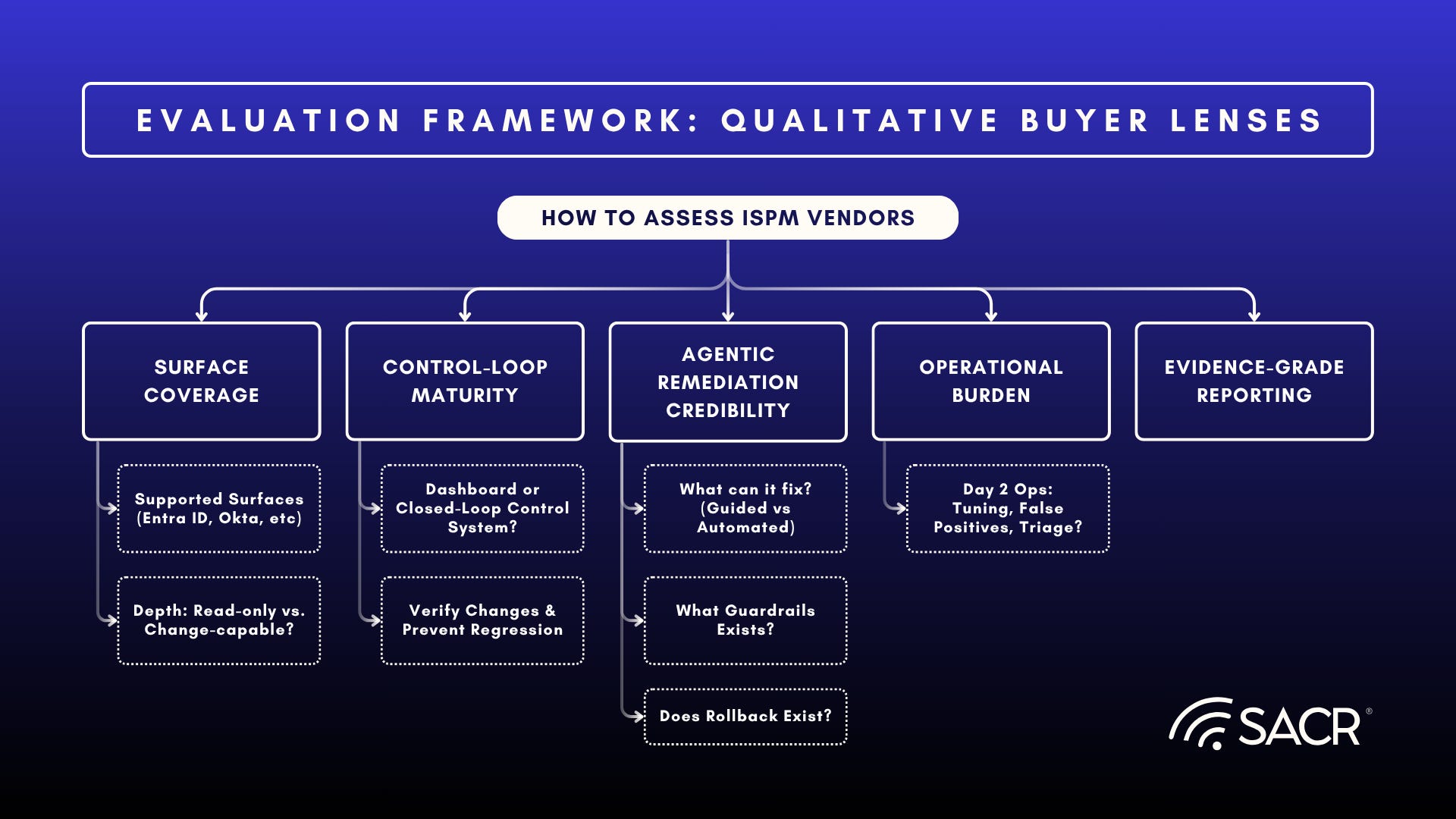
Remediation Intent Modelling: Sophisticated systems must articulate remediation as an intent-based outcome, such as the elimination of risky legacy authentication pathways or the precision right-sizing of privileged memberships, rather than relying on static, manual runbooks.
Autonomous Guardrails and Safe Automation: The platform must operationalize automation under strict constraints, incorporating definitive scope limits, blast-radius assessments, maintenance windows, and human-in-the-loop approval interfaces.
Dependency-Aware Remediation Graphing: A mature posture requires the ability to predict breakage risk and organizational impact prior to execution, distinguishing between effective permissions and mere configured states.
Audit-Grade Evidence and Rollback: To satisfy governance mandates, every action must produce evidence-grade artifacts, including before-and-after posture deltas, change actors, and verifiable rollback procedures.
Precision Human-in-the-Loop Workflows: Where manual intervention is required, the workflow must be accelerated through high-context delivery, providing pre-filled tickets and exact diff visualizations to ensure implementation accuracy.
Continuous Verification and Drift Prevention: Following remediation, the system must enter an autonomous re-check cycle to monitor for posture drift and prevent the reintroduction of known vulnerabilities.
Representative Vendor Profiles
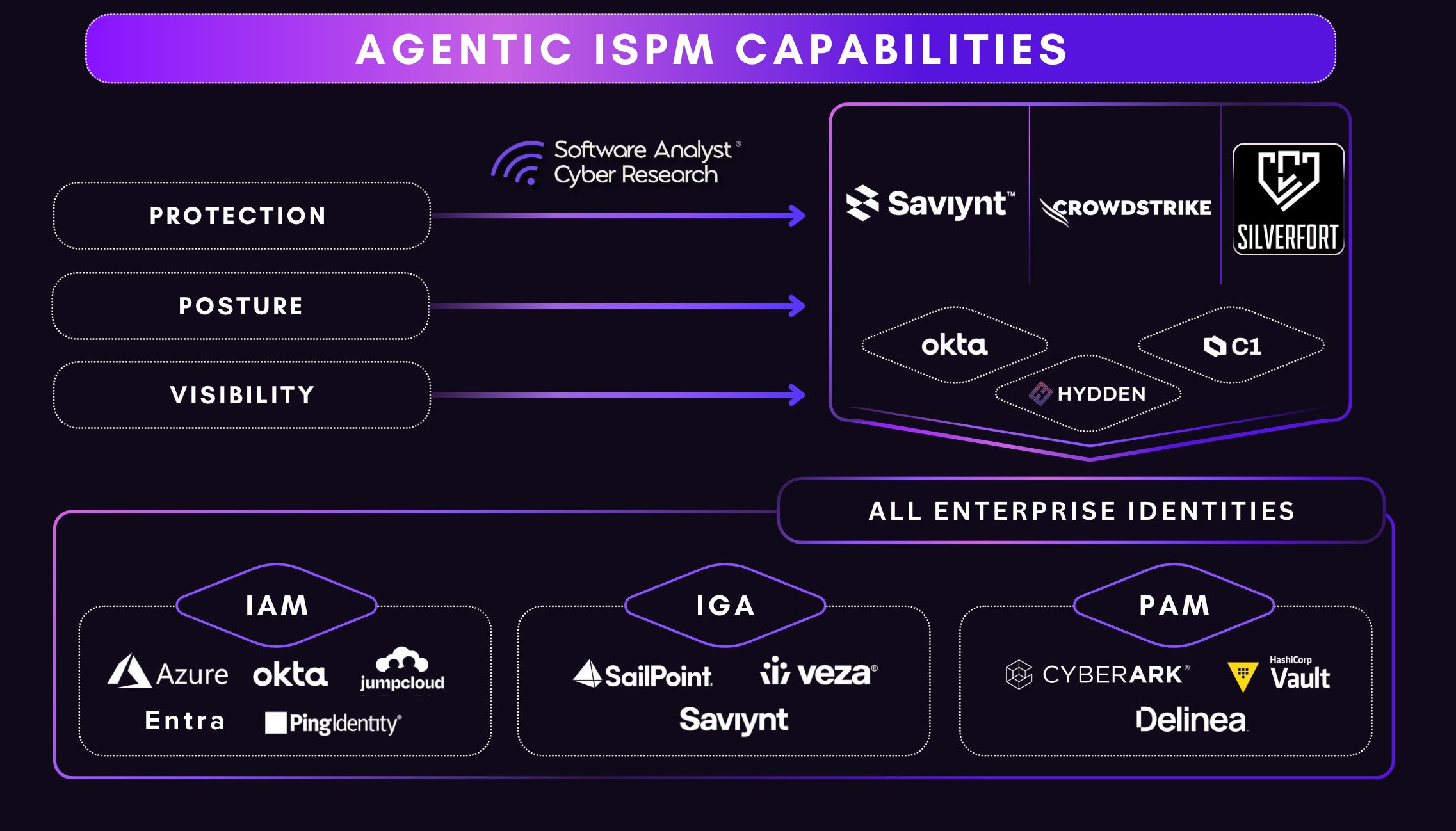
Inclusion Note: Profiles below are limited to vendors that have added agentic remediation capabilities to their ISPM functionality, enabling AI agent functions to drive actual remediation activities and workflows.
The vendors profiled in this section were selected on a single criterion: demonstrated capability to perform agentic remediation of identity-based risks, not claimed capability. Every vendor in the identity security market is currently describing its roadmap in agentic terms. The profiles below are not about roadmaps. They are about what each platform can demonstrably do today: whether it can write back to identity control planes, whether it can verify that a remediation action resolved the underlying finding, whether it can restore a prior state if a change creates operational risk, and whether it can produce audit-grade evidence of every step in that cycle.
Five vendors are profiled: Saviynt, Okta, CrowdStrike, Delinea, and Silverfort. Each approaches the Agentic ISPM problem from a different architectural starting point, IGA-native, endpoint and telemetry-native, PAM-native, and runtime enforcement-native respectively. That difference in starting point is not a ranking. It is the most important context for understanding which platform fits which environment and which buyer. A CISO standardized on the Falcon platform is evaluating a different set of tradeoffs than a CISO running a large IGA program with complex lifecycle governance requirements. The profiles are structured to surface those tradeoffs clearly rather than reduce every vendor to a feature checklist.
Saviynt
Vendor Profile
Saviynt is a recognized leader in agentic identity governance and the first to ship production-grade posture management for AI agents and MCP servers, delivering the critical infrastructure enterprises need to govern autonomous identities at scale. The milestone reflected a deliberate architectural vision: bringing agentic ISPM and identity governance together into a single, unified control plane. The result is the only IGA-native platform in this category that connects posture findings directly to the ownership, access, and compliance workflows that identity teams already operate.
Saviynt gives enterprises a unified view across human, non-human, and agentic identities spanning AWS, Google Cloud, and Microsoft Azure cloud platforms, so identity and security teams have a complete and governed picture of everything running in their environment.
Saviynt’s agent security story is easiest to understand as a closed-loop control system: you first establish what an agent is and what it’s allowed to do, then you continuously measure risk and context, and finally you enforce policy at the exact moment the agent takes action. That’s why their model is organized into three pillars: posture, governance, and runtime because each pillar supplies a distinct control layer, and the combined effect is what lets them claim end-to-end coverage “from registration to runtime enforcement.
Here’s how you incorporate the three parts into one coherent narrative:
Posture management (signal + risk context): They start by discovering agents, identities, apps, permissions, and activity and then correlate risk signals from the surrounding ecosystem. This pillar produces the risk and exposure context you need to make governance and runtime decisions credible (e.g., trust score, anomaly indicators, asset sensitivity).
Lifecycle governance (control plane): This capability puts agents into a governed lifecycle: registration, owner assignment, access boundaries, and just‑in‑time controls. This is where you define “who is accountable,” “what is permitted,” and “under what constraints,” so policies aren’t ad hoc, they’re administratively managed and auditable.
Runtime authorization (enforcement plane): Finally, you enforce those governance decisions in the transaction path through monitoring and intent assessment and token brokering/mediation. This is where policy becomes real: the system evaluates the runtime context and the governance state, then can block/flag/alert when the request violates policy or looks suspicious.
Agentic Identity Security Capabilities
Saviynt’s Agent Access Gateway is the control plane that defines and governs which agents exist, who owns them, what they’re allowed to do, and under what conditions they can act before you ever get to runtime. It operationalizes “agent identity” by treating agents as managed entities with lifecycle governance: registration, ownership assignment, scoped permissions, just-in-time access boundaries, and administrative guardrails (e.g., approval, certification, and recertification policies). This maps to Saviynt’s capability to bring traditional identity governance discipline (IGA) into the agent era: instead of letting agents sprawl as untracked automations, the gateway creates a governed inventory with explicit access boundaries and accountability, so that runtime enforcement has high-quality inputs (who/what the agent is, what it’s allowed to touch, and what policy must be true) and the organization can prove control through audit-ready governance artifacts.
Saviynt’s Runtime Gateway functions as a real-time policy enforcement layer that sits in the execution path between an AI agent (or agent-enabled workflow) and the enterprise systems it tries to reach. It integrates with core identity providers like Okta and Entra ID for authentication context, then performs multi-layer authorization at the moment of action, separately validating the human/operator’s entitlements, whether the agent is allowed to be invoked for that purpose, and whether the agent is permitted to access the specific target resources. It also mediates tokens (including on-behalf-of flows) to preserve provenance and reduce direct credential exposure, while continuously evaluating runtime signals such as agent registration status, ownership validation, trust score, anomalous access patterns, and certification/compliance state. Net: this maps to Saviynt’s capability to make “agentic access” enforceable like any other identity transaction: inspectable, auditable, and blockable with policy outcomes that can block/flag/alert in-line.
ISPM Alignment (Saviynt)
Saviynt ISPM delivers an end-to-end solution for AI identity security spanning discovery, governance, and runtime enforcement across human, non-human, and agentic identities. The platform continuously discovers AI agents, NHIs, and workforce identities, surfacing risks like orphaned accounts, missing guardrails, and excessive entitlements.
Every discovered identity is then governed with full accountability through ownership assignment, lifecycle management, and access approvals, with the Agentic Access Gateway enforcing entitlement boundaries at the moment an action is attempted. All findings and remediation actions are captured in an immutable audit trail mapped to NIST AI RMF, OWASP, MITRE, SOX, and HIPAA. Posture findings connect directly to the governance and runtime authorization workflows that identity teams already operate — turning visibility into action rather than leaving it as a standalone tool.
Saviynt Agentic ISPM’s core capabilities include:
Unified Visibility: Gain a centralized view of all AI agents and their underlying dependencies, including LLMs, tools, and data sources.
Actionable Risk Findings: Clear visibility into the highest-priority vulnerabilities, ranked for efficient triage and response.
Targeted Remediation: Take immediate action by assigning owners to orphaned identities, AI agents, registering shadow agents, or assigning missing guardrails while the overall platform has remediation across multiple types of identities and cloud platforms.
Audit-Ready Timelines: Accelerate investigations and simplify compliance checks with a chronological timeline of all access and configuration changes.
Dynamic Access Graphs: Visually map access pathways to identify what an agent can reach and limit its breach radius.
Use Cases and Pain Points Addressed
Improve speed, visibility and observability of NHI and AI identities
Enabling capability: Extend identity security posture management from humans to AI agents and NHIs without the need of a separate point solution. Improve application onboarding throughput (including disconnected apps).
Detail: Unifies posture and governance for human, non-human, and agent identities in one platform. CUA-style agentic onboarding is positioned to reduce manual effort and close the identity integration gap to disconnected and nonstandard applications.
Enable closed-loop governance
Enabling capability: Reduce remediation backlog by tying posture findings to agentic governance workflows.
Detail: Uses IGA-native ownership/certification mechanisms to operationalize closed-loop governance of NHI and AI identity ownership, succession management, and entitlement management..
Control what agents are permitted to do
Enabling capability: Runtime access management enforcement governed by identity, intent, context, and policy.
Detail: Runtime authorization ensures every action is verified at the moment of execution, preventing misuse, limiting unintended behavior, and enforcing least-privileged access as conditions change.
Saviynt’s Agentic tier placement rests on one architectural decision that separates it from most competitors in this category: posture findings execute remediation within the same IGA-native governance framework that manages every other identity change in the environment. When Saviynt identifies an overprivileged service account or a stale agent credential, the remediation action is not an out-of-band automation event. It is a governed identity transaction carrying the same audit trail, approval chain, and rollback semantics as any human access review decision. That is a meaningful distinction. Most agentic remediation tools operate outside the governance plane and produce a separate evidence record that identity teams must reconcile manually. Saviynt does not.
The platform is also the first in this category to ship production-grade posture management for AI agents and MCP servers, giving it early coverage of the NHI and agentic identity governance problem that is growing fastest in enterprise environments today.
The honest limitation is scope dependency. Saviynt’s core advantage is strongest in environments where IGA is already the operational center of the identity program. Organizations without a mature IGA foundation will get the remediation capability but not the governance integration that defines the platform’s differentiation. Buyers should know which of those two things they are actually purchasing before they shortlist.
Key Recommendation
Best fit for enterprises that want to extend posture management to NHI and AI agents without adding a separate tool. Saviynt provides a unique value proposition by connecting posture findings directly to existing governance and access workflows, facilitating proactive risk reduction through one-click remediation and agentic automation. It also offers easy discovery and onboarding of applications using agentics and AI to map various application capabilities to integrate rapidly, replacing manual human integration processes.
Okta
Vendor Profile
Okta ISPM is the posture management layer of the world’s largest independent identity platform, built on the foundation of the Spera Security acquisition and now positioned as a core capability within the broader Okta for AI Agents solution. Its architectural center of gravity is its position inside the identity control plane itself: where most ISPM vendors connect to identity providers as external observers, Okta operates the IdP for a significant share of the enterprise market and extends posture visibility outward from that position across third-party identity providers, SaaS applications, cloud infrastructure, and on-premises Active Directory. The platform provides a unified view of non-human identities across these surfaces and applies more than 25 prioritized risk detections mapped to the OWASP Top 10 for NHIs to surface gaps like over-privileged or unrotated credentials. Saviynt
The most significant recent development is Agent Discovery, announced in February 2026 to enable organizations to discover shadow AI, uncover hidden identity risks and misconfigurations of unknown and known agents, and map agents’ potential blast radius. The capability is architecturally distinctive: it is powered by Okta’s browser plugin and leverages OAuth consent events, the authorization prompts users see when an app requests access to their data, to identify AI agents operating inside an organization. By surfacing these connections at the point of origin, organizations gain visibility into AI tools entering their environment before they evolve into backend API integrations or complex app-to-app connections. This addresses a real and growing problem: research shows that 90 percent of enterprise AI usage occurs via unauthorized personal accounts, with organizations facing an average of 223 shadow AI incidents per month. Expert Insights + 3
ISPM Alignment (Okta)
Okta’s ISPM is aligned to discovery, prioritization, and guided remediation from inside the identity control plane, rather than autonomous closed-loop execution. The platform continuously assesses identity risk posture, uncovers misconfigurations such as SSO exceptions, MFA bypass conditions, orphaned accounts, and partially offboarded users, and routes findings through outbound integrations to the teams and systems that execute the fix. Recent releases have strengthened the operational layer around this model: role-based access control across the ISPM console with graduated permissions for issue responders and viewers, multiple outbound integration instances for routing findings to different teams, and expanding source coverage including Workday and Salesforce connected apps.
The key trade-off mirrors the inverse of Silverfort’s. Where Silverfort enforces at the authentication moment but is weaker on configuration baseline drift, Okta is strongest on configuration and entitlement posture across the identity fabric it already operates, but its remediation model remains primarily guided: findings generate actionable guidance, alerts, and workflow triggers rather than confirmed closed-loop write-back with independent verification and rollback semantics. This is why Okta sits in the Guided Remediation tier of the SACR market map. The placement is not a criticism of posture analysis depth, which is among the strongest in the market. It reflects the evidence threshold for the Agentic tier: demonstrated write-back, verification, rollback, and evidence logging as a complete cycle. Okta’s agent lifecycle vision, in which customers turn shadow agents into governed assets by assigning human owners and enforcing baseline security policies, points clearly in that direction, but the autonomous execution loop is not yet the demonstrated core of the offering. Expert Insights
Core Functions
Agent Discovery for shadow AI: Detects OAuth consents at the point of origin to identify sanctioned and unsanctioned AI agents, mapping the relationship between the client app and the resource app and exposing granted scopes and blast radius.
NHI posture across surfaces: Single view of non-human identity types across SaaS, identity providers, cloud infrastructure, and on-premises Active Directory, with prioritized risk detections mapped to the OWASP Top 10 for NHIs.
IdP-native configuration posture: Continuous detection of SSO exceptions, MFA bypass and exclusion conditions, inconsistent policy enforcement, and offboarding gaps across Okta and third-party identity providers.
Guided remediation routing: Outbound integrations, event hooks, and role-based workflows that route findings to the appropriate owner with actionable remediation context.
Key Recommendation
Okta represents the natural ISPM choice for enterprises already standardized on Okta as their workforce identity provider, and the strongest available option for organizations whose most urgent posture problem is shadow AI and ungoverned agent sprawl at the application layer. Its discovery position is structurally unique: because agents authenticate and request consent through the identity layer Okta already operates, the platform sees agent creation at the moment it happens rather than reconstructing it afterward from logs. Organizations should shortlist Okta when their strategic priority is comprehensive posture visibility across the identity fabric, NHI and AI agent discovery at scale, and tight integration between posture findings and the IdP configuration surface those findings describe. Buyers whose primary requirement is autonomous closed-loop remediation with demonstrated write-back and rollback should evaluate Okta’s roadmap timing carefully against the Agentic tier vendors, or plan to pair Okta’s discovery and prioritization strength with an execution layer that closes the loop.
CrowdStrike
Vendor Profile
CrowdStrike Falcon Next-Gen Identity is a real-time identity security platform that combines continuous identity posture management, modern privileged access with zero standing privileges (ZSP), threat detection and response, and dynamic enforcement across hybrid environments through its one platform, one console architecture. Its architectural center of gravity utilizes pre-deployed Falcon sensors and cloud telemetry to surface and correlate risks across endpoint, identity, cloud and SaaS environments, connecting posture management directly to real-time enforcement and automated remediation via Falcon Fusion SOAR. Recent acquisition of SGNL makes the Crowdstrike identity solution a continuous identity solution that comprises ITDR, Modernized Zero Standing Privileges, phishing-resistant MFA and extends to SaaS posture management with Falcon Shield.
CrowdStrike Falcon Identity is positioned as a strategic platform-incumbent play for organizations seeking to operationalize identity security within a converged EDR/XDR ecosystem. Its architectural center of gravity utilizes the pre-deployed Falcon sensor to surface risks across AD, Entra ID, and Okta, effectively converging ITDR and ISPM, and modern privileged access into a unified operational model. The primary value proposition lies in the telemetry correlation between identity, endpoint, and cloud, powered by Falcon Fusion SOAR for automated remediation. While the 2025 introduction of Entra Authentication Manager (EAM) provides inline auth control comparable to Silverfort, CrowdStrike uniquely connects identity posture, threat intelligence, and real-time enforcement across the Falcon platform.
Agentic ISPM Alignment (CrowdStrike)
SGNL materially strengthens CrowdStrike’s ISPM story because it moves Falcon Identity closer to continuous identity control rather than posture visibility alone. Before SGNL, CrowdStrike’s identity advantage was already strong in telemetry correlation: Falcon could combine endpoint, cloud, threat intelligence, and identity signals to detect risky identities, compromised accounts, lateral movement, and Active Directory or IdP misconfigurations. That made CrowdStrike credible in ITDR and identity posture assessment, especially for customers already standardized on Falcon. The gap was that posture insight still needed to connect more directly to real-time access decisions across SaaS, cloud, human users, non-human identities, and AI agents.
SGNL helps close that gap by adding a dynamic authorization layer. Instead of treating identity posture as a static finding or a ticket that someone must remediate later, SGNL enables access to be continuously evaluated based on identity, device, behavior, session context, and real-time risk. This is important for ISPM because the future of posture management is not just identifying that an account is overprivileged, stale, risky, or operating outside normal patterns. The more valuable capability is translating that posture signal into an enforceable control decision: grant, deny, revoke, step up authentication, shorten privilege duration, or route the change through approval.
This pushes CrowdStrike further into Agentic ISPM because it gives Falcon a clearer path from detection to posture-to-runtime control. Falcon can supply the risk intelligence and security context, while SGNL can help enforce access changes across SaaS and cloud environments where standing privileges, service accounts, and AI agents create fast-moving exposure. For CISOs, the strategic value is that identity posture becomes more operational: risky access can be constrained closer to the moment of use rather than discovered after the fact.
The key diligence question is whether CrowdStrike can prove full closed-loop remediation across customer environments: write-back, verification, rollback, audit evidence, and human-in-the-loop controls for high-impact changes. If those controls mature, SGNL makes CrowdStrike’s ISPM capabilities more than another posture dashboard; it strengthens the platform’s ability to govern identity risk continuously at runtime.
Broadly, CrowdStrike’s alignment is centered on the paradigm of Agentic Identity Posture Management (Agentic ISPM) as a core capability within the Falcon platform. By leveraging pre-deployed Falcon sensors, the architecture achieves a continuous Posture-to-Runtime Control model, correlating identity signals with endpoint and cloud telemetry in real-time. This integration transforms static posture into continuous, real-time identity protection and enforcement, utilizing Falcon Fusion SOAR to execute autonomous remediation across Active Directory and cloud environments. Furthermore, the 2025 introduction of Entra Authentication Manager (EAM) provides critical inline authentication enforcement, ensuring that agentic identities are governed by deterministic, intent-aware controls at the point of execution.
Use Cases and Pain Points Addressed
Unified identity posture within the Falcon console
Enabling capability: Co-location of ISPM data with endpoint and threat intelligence telemetry, requiring no additional vendor footprint for Falcon customers.
Real-time Entra ID auth enforcement (EAM)
Enabling capability: EAM intercepts cloud authentication events to apply deterministic grant/block/challenge policies inline.
Detail: Neutralizes credential-based risks in cloud IdP paths without necessitating a standalone authentication-interception tool.
Automated AD response via Falcon Fusion SOAR
Enabling capability: Deterministic playbooks that automatically disable accounts, revoke memberships, or trigger MFA upon threat detection.
Detail: Compresses the attacker’s window by reducing MTTR for identity-based tampering from hours to seconds.
Key Recommendation
CrowdStrike represents the optimal architectural choice for enterprises already standardized on the Falcon platform that require a unified control plane for identity and endpoint security. Organizations should prioritize this vendor when the strategic mandate focuses on consolidating identity posture, threat detection, and real-time enforcement within a unified Falcon platform architecture to achieve measurable risk reduction. ITDR and ISPM telemetry under a single SOAR execution engine to achieve measurable risk reduction. Shortlist CrowdStrike when the Falcon sensor is already deployed across the estate, multi-surface visibility (AD/Entra/Okta) must be co-located with threat intelligence, or deterministic, automated response workflows are a mandatory requirement for identity operational resilience.
Delinea
Vendor Profile
Delinea is positioned primarily as a PAM-led identity security platform pursuing the most ambitious mid-market Agentic ISPM play in the privileged access segment. Its architectural center of gravity is the convergence of enterprise PAM (Secret Server, Privilege Manager) with a real-time agentic AI layer (Iris AI, GA August 2025) and a newly unified runtime authorization capability via the StrongDM merger (announced January 2026). The primary value proposition lies in the platform’s ability to extend traditional vaulting and JIT privilege elevation into continuous, evidence-based access decisions across human, non-human, and AI agent identities without requiring manual identity cataloging. Unlike identity-native ISPM vendors that start from IdP configuration analysis and extend toward remediation, Delinea starts from the privileged execution layer and extends toward posture, creating a differentiated “fix-first” orientation where the remediation path (credential rotation, JIT assignment, session termination, automated response actions for Entra ID and Okta) is natively embedded. The ITP/PCCE (Identity Threat Protection / Privileged Cloud & Configuration Entitlement) module provides a structured checks library for identity posture with guided remediation and compliance mapping, while Iris AI promises to replace static rule-based access governance with real-time, context-aware decisioning. The acquisition of Authomize (2023) and Fastpath (2024) extends coverage into IGA-adjacent entitlement analysis and SaaS application access governance, though integration maturity across these acquisitions varies.
ISPM Alignment (Delinea)
Delinea’s alignment with the Agentic ISPM paradigm is anchored in the convergence of PAM-native execution capabilities with the Iris AI reasoning layer to establish a continuous Posture-to-Runtime Control model within the privileged access domain. The ITP/PCCE Identity Posture module provides the posture assessment and drift detection function (continuous monitoring of identity misconfiguration across Entra ID and Okta), while the automated response actions in the Cases workflow provide the remediation execution function, creating a partial closed-loop from detection through remediation. The StrongDM merger extends this control loop to runtime authorization for infrastructure and developer workflows, enabling just-in-time privilege at the point of execution rather than standing access. Iris AI is positioned as the intelligence layer that replaces static policy rules with real-time, context-aware access decisions, and represents one of the more complete agentic ISPM architectures in the PAM segment.
SACR Key Takeaway:
Delinea is the best fit for mid-market enterprises already running Delinea PAM, leveraging a unique fix-first remediation orientation by combining PAM-grade execution (JIT, session control) with ISPM assessment (ITP/PCCE) and emerging agentic decisioning (Iris AI) for privileged NHI and AI agent governance. However, organizations should note that its posture coverage for deep IdP configuration analysis is less proven than identity-native ISPM peers.
Silverfort
Vendor Profile
Silverfort is a leading runtime identity security company that recently deepened its focus on the agentic era through its April 28, 2026, acquisition of Fabrix Security. This acquisition integrates Fabrix’s AI-native identity knowledge graph and AI-driven decisioning engine with Silverfort’s Runtime Access Protection (RAP) technology, enabling the first autonomous Identity Security Platform. Silverfort’s architectural center of gravity is its unique authentication-interception architecture, which positions it as a runtime identity control plane for AI agents, human, and machine identities across hybrid ecosystems. Silverfort’s strategic alliance with SentinelOne aims to create a unified identity-endpoint control plane to deliver real-time enforcement and autonomous containment of all identity types including Non-Human Identities (NHIs), AI agents, and humans.
ISPM Alignment (Silverfort)
Silverfort’s ISPM is aligned to enforcement at runtime time, during the authentication, not remediation after the fact. Where most ISPM tools open a ticket when a misconfiguration is found, Silverfort can deny or challenge the at-risk authentication in real-time. The key trade-off is that auth-time enforcement addresses behavioral and access-time risk better than it addresses IdP configuration baseline drift (e.g., fixing a misconfigured CA policy). Silverfort best complements configuration-analysis-heavy IdPs, IGA and PAM solutions, it does not replace them.
Core Functions
Universal MFA for legacy/on-prem access paths: Enforce MFA where CA can’t reach (e.g., AD-authenticated admin protocols and legacy apps).
Authentication firewall containment: Deny/segment risky authentication attempts to contain lateral movement.
ISPM risk scoring and posture hardening: Prioritize identity weaknesses and map them to enforceable controls.
Entra EAM integration: Participate in Entra auth workflows where EAM is available.
Key Recommendation
Silverfort represents a critical architectural shift for hybrid Active Directory (AD) enterprises that require real-time, inline enforcement against identity-based threats. While traditional Identity Security Posture Management (ISPM) tools focus on discovery and long-term remediation, Silverfort operates at the authentication plane, sitting inline with Kerberos, NTLM, LDAP, and RADIUS requests. This positioning is vital for governing legacy protocol exposure that Microsoft Conditional Access (CA) structurally cannot reach, such as NTLMv1 or administrative command-line tools. Organizations should shortlist Silverfort when their strategic priority is stopping attacks in-flight, achieving near-zero latency between detection and enforcement as a necessary complement to misconfiguration remediation. By enforcing phishing-resistant MFA and virtual fencing for service accounts, Silverfort effectively neutralizes lateral movement and credential theft in milliseconds, filling the critical gap in the existing identity control plane for heterogeneous environments.
Buyer’s Lens / Practitioner Guidance
CISOs playbook & where ISPM belongs
ISPM should be treated as a control-plane and posture layer that sits between identity infrastructure (IdP/IGA/PAM/endpoint/cloud identity) and operational security workflows (SecOps / IAM ops/platform engineering). The key question is ownership: who will operate posture findings and remediation day-to-day?
30/60/90 Day Implementation Strategy
Implementing an effective Agentic Identity Security Posture Management (ISPM) program requires a structured approach that evolves from initial discovery and baseline establishment to full autonomous maturity. The following strategy provides a phased framework for organizations to operationalize continuous identity risk reduction, ensuring security evolves at machine speed while maintaining governance and control.
The pilot design framework focuses on defining measurable success criteria, identifying necessary telemetry sources, and ensuring robust change control and rollback planning. Additionally, practitioners are encouraged to vet vendors on their inclusion criteria for identity posture signals, their specific write-back remediation capabilities, and their ability to provide evidence-grade validation for non-human identity posture.
The strategy follows a phased approach to transition from discovery to autonomous maturity:
30 Days (Discovery & Baseline): Establish a defensible inventory of the identity estate by mapping human, non-human (NHI), and AI agent identities across all hybrid surfaces.
60 Days (Remediation & Drift): Execute remediation for the top 10 material misconfigurations and operationalize real-time drift monitoring with reversible workflows.
90 Days (Autonomous Maturity): Deploy autonomous remediation for low-risk vulnerabilities to reduce MTTR and formalize audit-grade reporting for compliance.
CISOs Call to Action: The Pivot to Posture-to-Runtime Control
The transition to agentic systems requires moving beyond detection-only dashboards to an integrated Continuous Posture-to-Runtime Control model. CISOs must prioritize an Identity Control Plane that establishes a unified, closed-loop system where real-time posture risk directly informs deterministic, intent-aware authorization and ephemeral access enforcement. By eliminating Zero Standing Privilege and enforcing a watch and terminate runtime layer, organizations can ensure that trust is withdrawn the moment an identity, whether human or agent, drifts from its approved baseline. This shift is not just a security upgrade, it is a mandate to ensure that identity remains the primary control plane in an era of machine-speed autonomy.
Key Conclusion
Identity Security Posture Management must fundamentally evolve from a reactive, manual discipline into Agentic ISPM. Identity Security Posture Management (ISPM) must fundamentally evolve from a reactive, manual discipline into Agentic ISPM, a continuous, autonomous, closed-loop control system that translates static misconfiguration findings into active, measurable risk reduction. This report emphasizes that CISOs must shift from detection-only postures to Agentic ISPM to manage the massive scale of non-human identities (NHIs) and AI Agents.
Evidence & Methodology
The findings and claims presented in this report are rigorously derived from a synthesis of vendor briefings, practitioner inputs, direct customer signals, and deep-dive technical documentation to ensure adherence to SACR evidence quality requirements.
Citations
Sola-Visibility-ISPM: Benchmarking Agentic AI for Identity Security Posture Management Visibility
Sola-Visibility-ISPM: Benchmarking Agentic AI for Identity Security Posture Management Visibility (https://arxiv.org/abs/2601.07880)
SACR Independence & Vendor Review
This report reflects SACR analyst judgment. Participating vendors were invited to review for factual accuracy (e.g., feature availability, integration support, terminology). Vendors did not control conclusions, comparative framing, or market definitions. Vendor disagreements are documented where relevant; factual inaccuracies are corrected upon validation.
SACR maintains independent research objectivity. All vendor feedback is reviewed for factual accuracy, but vendor dissatisfaction regarding placement or methodology will not influence analyst conclusions, which remain strictly evidence-based and SACR-owned.