

AI SOC Technoscope Series: The AI SOC Market, 2026 (Part 2)
How Trusted SOC Rankings Vary by Different SOC Operating Environment


This is SACR’s third consecutive year of original research on the AI SOC market, following previous episodes: The Path Toward AI-Augmented SOCs (2024) and SACR AI SOC Market Landscape for 2025. This year’s research inaugurates a new franchise, the AI SOC Technoscope Series, which opened with Part 1, Building the Trusted SOC.
Part 1 established that a Trusted SOC is not purchased as a platform or achieved through autonomous actions by AI agents. Security teams/leaders build it by granting AI agents authority for specific response actions only when the evidence, governance, reliability, and verified outcomes support that authority.
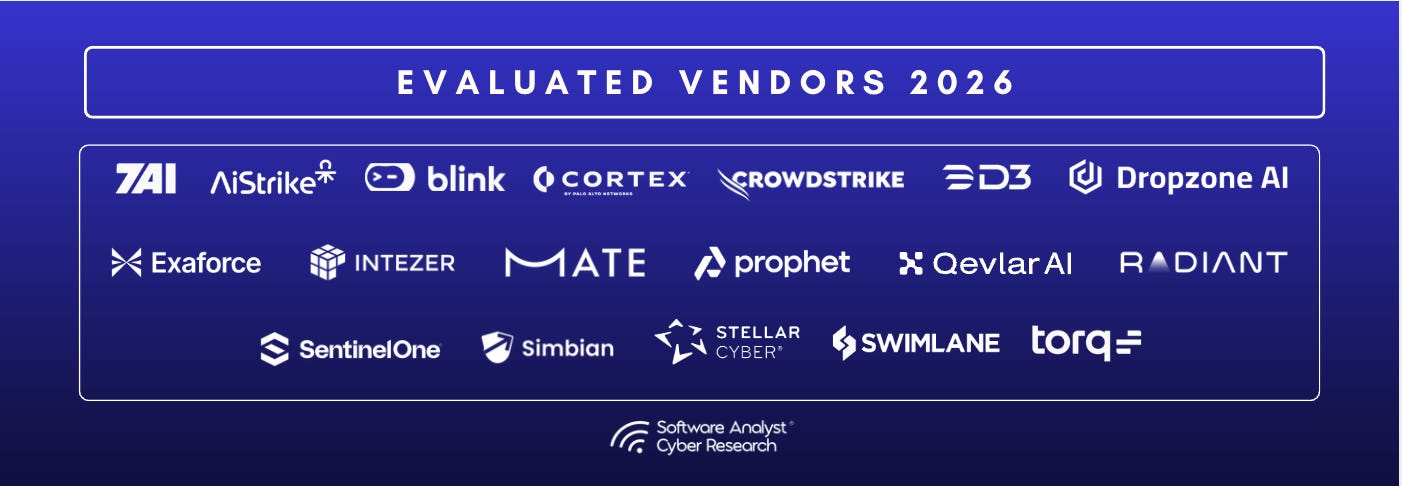
This Part 2 applies that model to the market itself. We evaluated 18 vendors across three operating environments and testing scenarios.
The regulated SIEM-centric enterprise SOC
Hybrid mid-market SOC
Cloud native data-lake SOC
The result shows which products are positioned to support which authority portfolios, and where.
Caveats:
The AI SOC category is broad and still consolidating. Peer trackers count close to 140 vendors that use, market, or support AI within security operations, and SACR treats more than 60 of those as pure-play AI SOC platforms worth direct comparison. This report evaluates 18 of them in depth. This report is purely independent, with no vendor relationship influencing any rankings. Everything was weighted
That narrower set was not a matter of convenience. To qualify for ranking, a product had to materially shape the path from case understanding to response, through decisioning, action recommendation, governed execution, or verification, backed by enough generally available capability and production evidence to support a defensible comparison rather than a restated pitch deck. Inclusion in the ranked 18 is a statement about evaluability, not a statement about quality. A vendor’s absence from the ranked set is not a judgment against it. It typically means the evidence available to us during the research period did not yet support a comparison at the same depth as the vendors we ranked.
This analysis builds on the same primary research described in Part 1: structured interviews with [20] security leaders and practitioners, and briefings or live demonstrations across the broader vendor landscape.
Key Actionable Summary
The first report identified the action gap between incident understanding and trusted response. Our market analysis finds that this gap remains the dividing line between broad capability and category leadership. Investigation, summarization, and enrichment have become common across the market. The systems that carry evidence into decisioning, governed action, execution, verification, and proof remain far less consistent. Products that appear similar in a demonstration can create substantially different operating models in production.
Evaluation model: We evaluated 18 vendors across Architectural Alignment and Production Delivery. Architectural Alignment measures how completely a product connects the lifecycle from evidence through verified outcome. Production Delivery measures how reliably it provides that capability in real operating environments today.
Market finding: Leadership is architecture-neutral. AI-native, SOAR-derived, and platform-consolidated products can all support the Trusted SOC. Their strengths differ according to lifecycle ownership, governance, production maturity, integration requirements, and operational burden.
Top-line results: No single vendor can be considered a universal AI SOC leader. Suitability materially changes based on evidence architecture, control-plane ownership, governance intensity, operating capacity, and the response actions organizations intend to delegate in their own environments.
Environmental finding: Vendor fit changes across the regulated SIEM-centric enterprise SOC, hybrid mid-market SOC, and cloud native data-lake SOC. Each environment places different demands on governance, integration, data access, execution, and operational overhead.
Buyer takeaway: Use the Trusted SOC as the destination and these rankings as a guide to the most credible path for your environment. Evaluate how much of the lifecycle the product can own today, what authority it can safely exercise, how it proves the outcome, and what your organization must supply around it.
What Buyers Are Purchasing
AI SOC purchases today take one of three primary forms. Each places control of evidence, case state, decisioning, and response in a different part of the security stack. The practical choice is where the buyer wants this operating layer to reside, which systems should remain authoritative, and how much integration, maintenance, and governance burden the organization is prepared to own.
Path 1: Add an AI-Native Layer Over the Existing Stack
Organizations choosing an independent AI-native platform generally want to preserve their current SIEM, EDR, identity, cloud, and workflow tools while adding a system that can assemble evidence, investigate incidents, develop cases, and coordinate response across them. This path offers cross-stack flexibility, modern reasoning, and faster deployment without requiring broad platform consolidation. Its effectiveness depends on integration depth, API access, credential design, customer context, and the platform’s ability to verify actions executed through external control systems.
This path is a natural fit for hybrid mid-market and cloud native teams that operate fragmented environments, need greater analyst leverage, or want to improve investigation and response without replacing the surrounding stack. Buyers assume responsibility for deciding which systems remain authoritative and how the AI-native layer receives enough context and permission to act safely.
Path 2: Modernize SOAR and Automation with AI
Organizations with established orchestration, case management, and response workflows may extend those systems with AI-assisted investigation and decisioning. This path builds on existing strengths in connector breadth, approvals, deterministic execution, auditability, retry logic, and failure handling. AI can improve prioritization, evidence gathering, case development, playbook selection, and the handling of incidents that require interpretation rather than a fixed sequence of steps.
This path is well suited to regulated enterprises and operationally mature SOCs that already rely on formal workflows and controlled execution. Buyers gain a familiar governance foundation and may face greater workflow administration, integration maintenance, and process complexity. They should determine how deeply AI reasoning is connected to the execution layer and whether the system can preserve evidence continuity from investigation through verified closure.
Path 3: Consolidate Into a Broader Security Platform
Organizations already standardized on a major security platform may extend that platform across telemetry, detection, investigation, case management, and response. Native access to endpoint, network, identity, cloud, and threat-intelligence data can reduce integration friction and connect decisions directly to enforcement. This path can provide strong production scale, established governance, and a more unified operating experience across the platform’s installed ecosystem.
This path is most natural for large or regulated enterprises that prioritize consolidation, native control, and operational consistency. Buyers should evaluate the breadth of third-party support, the amount of additional platform adoption required, and the degree to which the system can maintain case and evidence continuity outside its native ecosystem.
Choosing the Operating Model
Each path can support progress toward a Trusted SOC. The purchasing decision should begin with the authority portfolio the organization wants the product to assume: which evidence it can access, which investigations it can conduct, which actions it can recommend or execute, where approval is required, which credentials it can use, and how outcomes will be independently verified.
Sourcing and delivery choices cut across all three paths. Organizations may operate the product directly, deploy it with vendor assistance, use it through a co-managed or managed service, or combine vendor capabilities with internally built agents and automation. These choices shift the staffing, maintenance, accountability, and proof burden between the customer, the software provider, and the service operator.
This makes environment-specific evaluation essential. The buyer is selecting a product to assume defined responsibilities inside a particular security operating model, with evidence that it can perform those responsibilities safely, reliably, and at the maturity required by the organization.
Research Methodology
We developed this report through primary and secondary research conducted across the AI SOC market. We collected evidence through security-practitioner interviews, vendor briefings, live product demonstrations, targeted surveys, product documentation, and supporting market research. Practitioner research established the operating problems, architectural constraints, adoption requirements, and purchasing considerations shaping real deployments. Vendor research provided evidence on product architecture, integrations, investigation workflow, decision systems, response capability, governance, deployment maturity, and customer use.
We assessed capabilities according to what vendors could demonstrate or support with available evidence. Greater weight was given to generally available product functionality, live workflow, documented integrations, production use, and customer evidence. Beta, private-preview, and roadmap capabilities were separated from mature functionality and did not receive equivalent credit. Product positioning and general statements about automation were not treated as evidence of response authority or production maturity.
The market is developing quickly, and the available evidence remains uneven. Vendor participation, access to live deployments, customer references, and measurable production outcomes varied across the evaluated companies. The findings represent SACR’s assessment of the best evidence available during the research period and should be understood as a current view of a rapidly changing market.
Evaluated Vendors
The AI SOC market now includes over 100 companies that use, market, or support AI in security operations. The ranked cohort was limited to products whose relevant AI SOC offering was publicly identifiable by December 31, 2025, which materially addressed the path from case-level understanding to governed response, which fit one of the three customer-operated product paths evaluated, and had sufficient verifiable evidence of current capability and production maturity to support a defensible comparison. This report is not meant to serve as a census of every vendor in the market, it is a comparative analysis of platforms that buyers can reasonably evaluate as a path to operating a Trusted SOC.
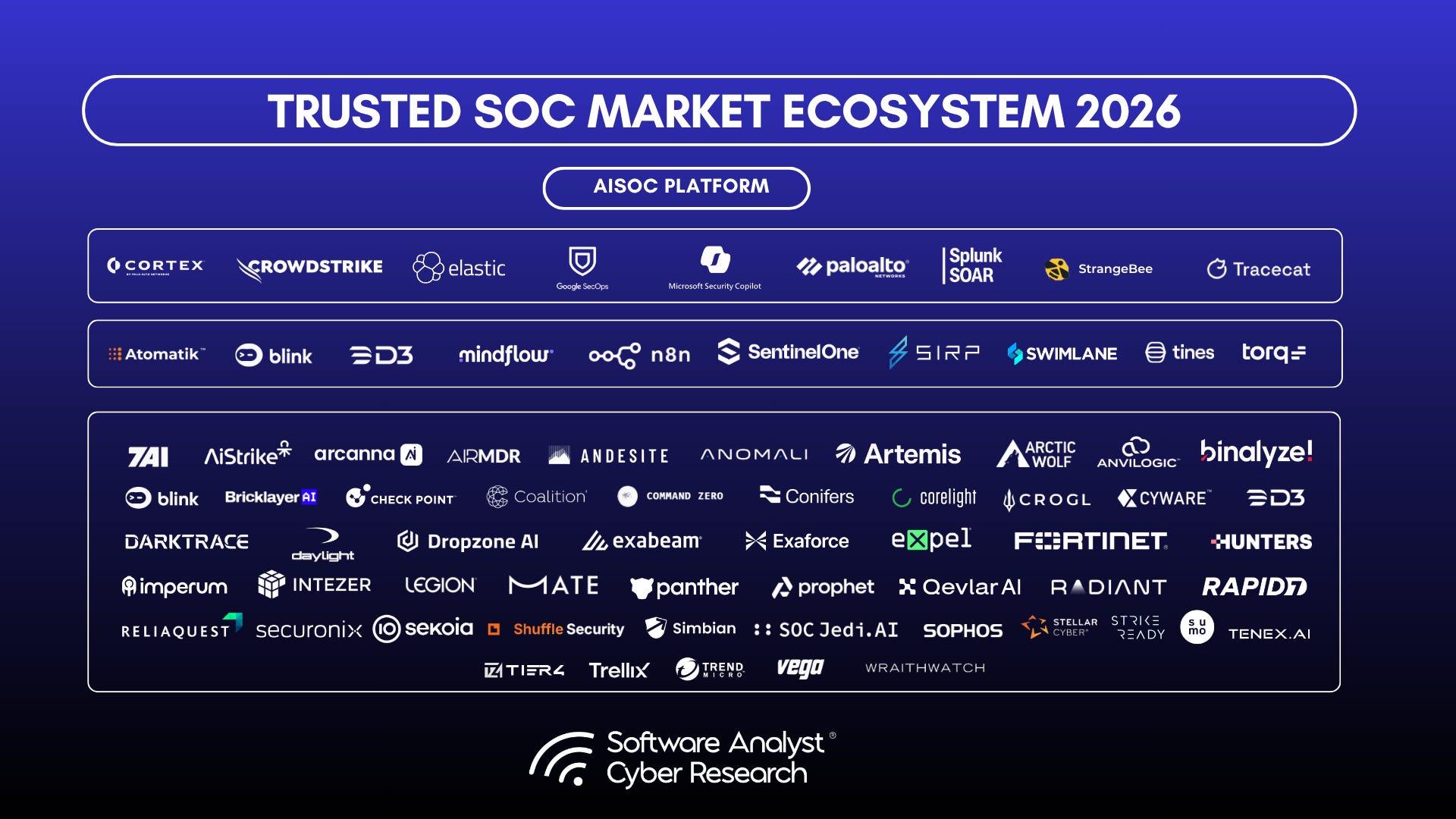
To select the ranked cohort we began with the broader AI SOC ecosystem, including AI-native SOC platforms, SOAR and automation providers, security-data and analytics platforms, large security suites, builder tools, and service-led offerings. We then applied a scope screen to narrow the list.
To be included in the ranked set, a product had to materially shape the path from case-level understanding to response: through AI-assisted decisioning, action recommendation or preparation, approval and policy controls, execution, verification, or a demonstrable combination of those functions. Products whose primary role is telemetry collection, data management, investigation support, or managed service delivery remain relevant to the broader market, but are not automatically comparable to response-layer platforms.
We evaluated products rather than entire companies. For broad platform vendors, only the AI SOC, SOAR, or response capabilities relevant to this analysis were assessed. A vendor’s larger security portfolio, revenue, market capitalization, or general brand presence did not determine inclusion or placement.
The evaluated set also required enough evidence to support a defensible comparison. SACR considered live workflows, product documentation, integration depth, generally available functionality, deployment maturity, customer evidence, and the distinction between production capabilities and roadmap claims.
Finally, the 18 vendors were selected to represent the principal architectural and operating choices available to buyers: AI-native SOC platforms, SOAR-derived platforms with AI, and broader security providers with identifiable AI SOC capabilities. The set is broad enough to compare those approaches across regulated SIEM-centric enterprise, hybrid mid-market, and cloud native data-lake environments without treating every adjacent product as a like-for-like competitor.
Inclusion in this report does not mean that these are the only relevant vendors in the market, neither does absence constitute a judgment that another product lacks value. It means we had a sufficient basis to evaluate these products against the specific case-to-response criteria and operating environments used in this analysis.
AI SOC Market Rankings
Cross-Environment Capability View
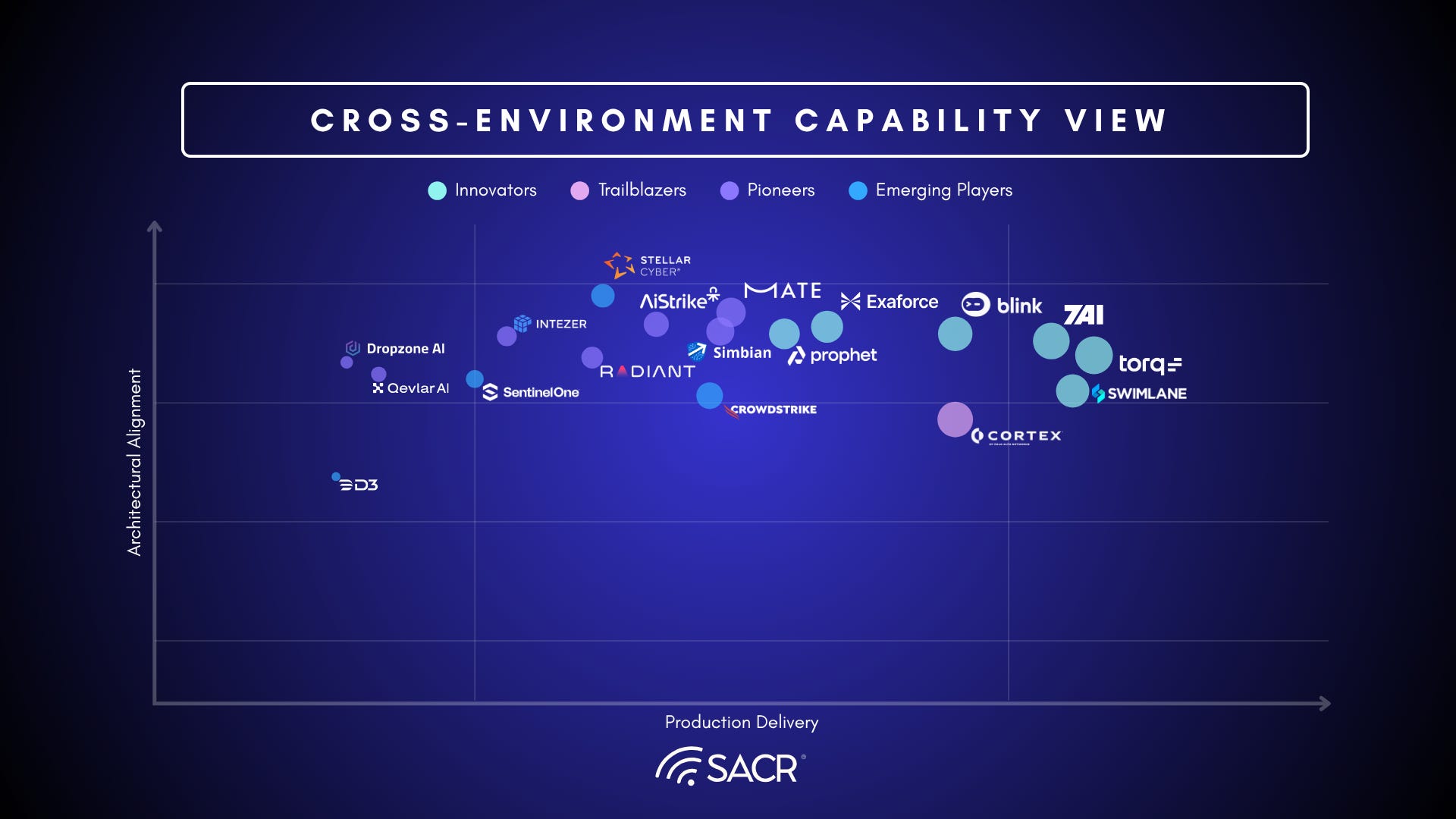
The comparative average consolidates performance across three operating environments. Vendor placement reflects two separate questions. Architectural Alignment measures how completely the product connects the AI SOC lifecycle from evidence through verified outcome. Production Delivery measures how reliably the product delivers those outcomes in real-world environments today. Together, the axes distinguish architectural completeness from demonstrated operational maturity.
Architectural Alignment does not reward a particular product heritage. AI-native, SOAR-derived, and platform-consolidated products can all score highly when they connect the complete lifecycle as a coherent system. Production Delivery is based on generally available capability, operational evidence, governance, scale, failure handling, and verified customer use.
Architectural Alignment
Architectural Alignment measures how completely the product’s core architecture supports the AI SOC lifecycle:
Evidence assembly
Investigation
Decisioning
Bounded authority
Response execution
Outcome verification
Continuous improvement
A high score means these capabilities operate as one connected evidence-to-outcome system. A lower score means ownership is distributed across the product and adjacent systems, requiring another platform, automation layer, investigation tool, or human team to complete one or more stages of the lifecycle.
Architectural Alignment measures the connectedness and ownership of the lifecycle. It is not a measure of overall product quality, company maturity, or architectural heritage.
Production Delivery
Production Delivery measures whether the product can reliably deliver AI SOC outcomes in real-world environments today. It considers:
Production maturity
Integration depth
Deployment burden
Governed execution
Operational scale
Failure handling
Case continuity
Evidence that response actions achieve the intended result.
A high score means the product can move supported incidents from investigation through controlled action and verified closure, with credible customer evidence. A lower score indicates narrower execution coverage, limited production proof, greater operational burden, or dependence on another system or human team to complete the workflow.
Innovators Category
Innovators combine strong Architectural Alignment with credible Production Delivery. They connect evidence, investigation, decisioning, bounded authority, response execution, and outcome verification within a continuous workflow, with sufficient production evidence to demonstrate that the model functions in real customer environments.
Vendors reach this position through different routes. Torq and BlinkOps emphasize automation and integration fabrics that make controlled action dependable across a wide stack. 7AI and Prophet Security emphasize AI-native case progression and graduated authority. Exaforce is differentiated by its data architecture and cloud native evidence assembly. Swimlane reaches the category through a SOAR-derived architecture that combines federated evidence access, production AI reasoning, mature governance, and dependable cross-stack execution. Their shared characteristic is demonstrated strength across both Architectural Alignment and Production Delivery.
Trailblazers Category
Trailblazers demonstrate strong Production Delivery with moderate Architectural Alignment. Their strengths include established integrations, durable workflows, governance, auditability, operational scale, and credible production use. Ownership of the complete AI SOC lifecycle is more distributed across the surrounding platform or automation architecture.
Palo Alto Networks reaches this position through platform consolidation, native telemetry and enforcement, and mature enterprise response controls. For buyers whose environment align with this operating model, it may provide the strongest practical fit.
Pioneers Category
Pioneers demonstrate strong Architectural Alignment with developing Production Delivery. Their products are closely organized around a connected AI SOC lifecycle, while the production record remains younger or less complete across execution breadth, deployment duration, governance depth, verification, integrations, or enterprise scale.
Mate Security and Simbian emphasize organizational context, agentic investigation, and staged authority. AIStrike connects detection improvement with investigation and response. Radiant Security and Dropzone AI emphasize analyst leverage and rapid case development. Intezer and Qevlar provide strong evidence assembly and reasoning with narrower governed-remediation depth. Broader verified execution and stronger production evidence can move these vendors toward the Innovator category.
Emerging Players Category
Emerging Players have relevant AI SOC capabilities and strong adjacent control planes, while complete lifecycle ownership and Production Delivery remain developing. Their capabilities may be concentrated in endpoint or XDR response, investigation, workflow automation, case management, or another portion of the AI SOC lifecycle.
CrowdStrike and SentinelOne bring mature native telemetry and enforcement platforms. Stellar Cyber brings an established Open XDR and case-management foundation. D3 Security brings deep SOAR, orchestration, and governance experience. Their placement reflects the current connectedness and demonstrated delivery of their evaluated AI SOC capabilities. It does not describe the maturity, market position, or overall quality of the companies.
Environment Specific Ranks
Each environment applies the same Trusted SOC destination under different operating conditions. What changes is the evidence, governance, integration, and operational burden a product must satisfy before it can credibly support response authority.
The depicted environments are meant to serve as examples of different types of SOCs. It is not an exhaustive list that captures every nuance an environment can have. Large enterprises may have fragmented security stacks, and a cloud native organization may be subject to strenuous industry regulation. We encourage buyers to leverage our analysis as a baseline of what a vendor can offer, and apply it to their own unique operating environment and regulations.
Environment 1: Regulated SIEM-Centric SOC
A mature SOC operating in a highly regulated industry where the SIEM remains the primary system of record for detection, alert correlation, investigation workflow, compliance reporting, and escalation. The mature SOC has established processes, tiered analysts, defined incident response procedures, and strict requirements for auditability, approval, and evidence retention.
Generic architecture
Enterprise SIEM as the central detection and correlation layer
Mature telemetry coverage across endpoint, identity, cloud, network, email, SaaS, and threat intelligence sources
SOAR, ITSM, ticketing, and case management workflows
Response integrations across EDR, IAM, email security, firewall, cloud controls, PAM, and vulnerability management
Formal governance through RBAC, policy libraries, audit logs, approval gates, and evidence retention
24/7 or follow-the-sun SOC coverage with clear analyst tiers and incident command structure
High regulatory pressure from financial services, healthcare, government, critical infrastructure, or public company obligations
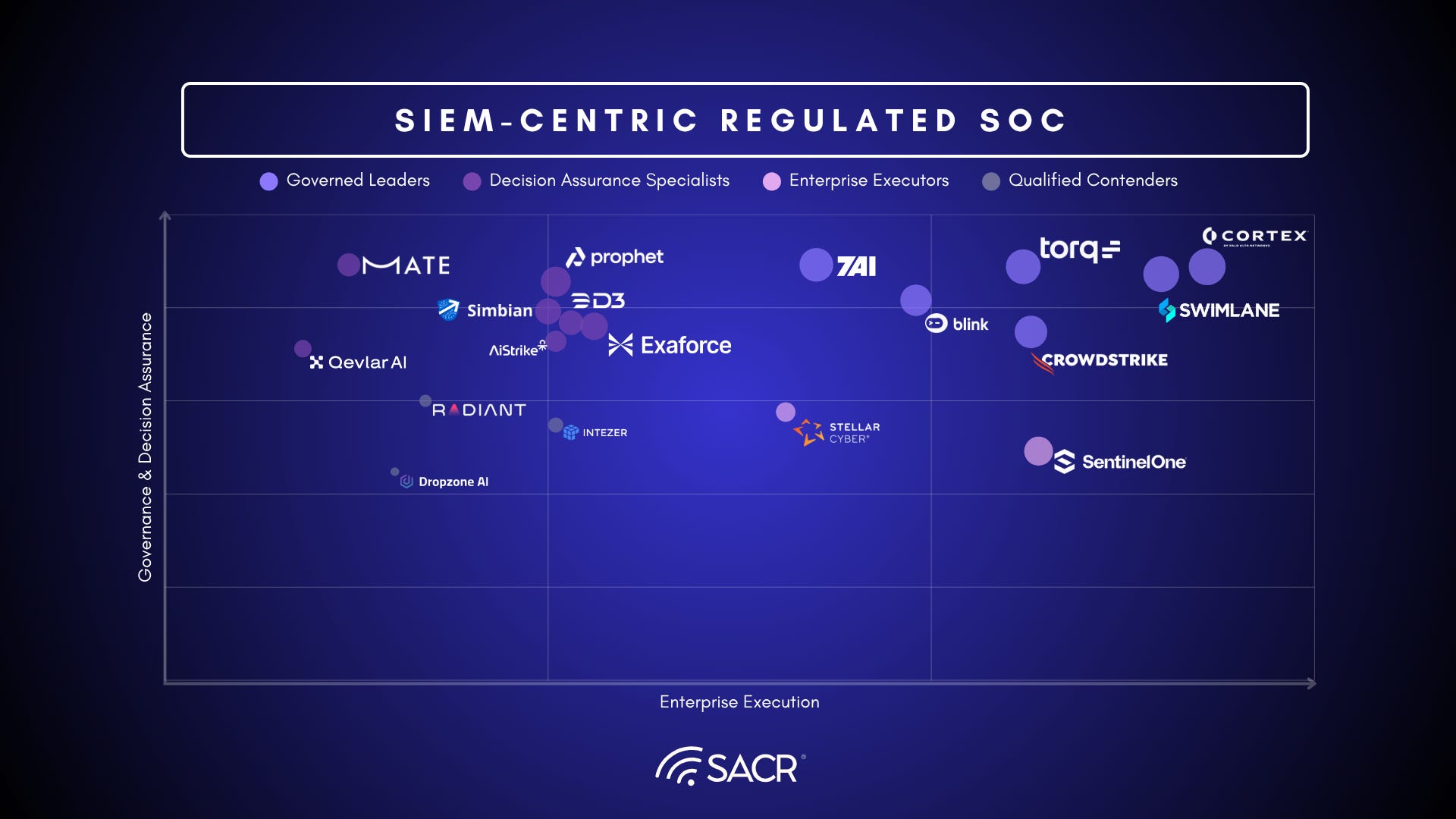
The regulated map rewards vendors that can prove both authority and accountability. Palo Alto Networks and Swimlane rise because mature platform or SOAR controls are highly valuable in this environment. Torq, 7AI, and BlinkOps remain strong because they combine modern reasoning with bounded execution. Vendors that are excellent at investigation but cannot yet show formal governance, durable case continuity, and verified post-action state are pushed toward the specialist or contender categories.
Enterprise Execution Axis
The horizontal axis measures whether the vendor can operate reliably as part of a large enterprise response system. It incorporates SIEM and workflow integration, breadth of response orchestration, deployment maturity, scale, failure handling, case continuity, and the practical ability to execute across a complex control stack.
A high score means the product can move beyond analysis into repeatable production action across enterprise systems. A lower score generally reflects narrower action breadth, less mature deployment evidence, a younger integration catalog, greater dependence on a particular architecture, or more limited proof that the product can carry enterprise operating load.
Governance and Decision Assurance Axis
The vertical axis measures whether the platform can make and govern consequential decisions in a way that a regulated enterprise can defend. It includes decision quality, evidence traceability, approval routing, policy controls, auditability, chain of custody, blast-radius limits, source-state verification, and outcome proof.
A high score means the platform can explain why an action was selected, constrain who or what can authorize it, preserve the decision record, and show what happened afterward. A lower score does not necessarily mean weak security efficacy; it often means the reasoning-to-action chain is fragmented, approval controls are incomplete, rollback is inconsistent, or post-action verification is not sufficiently mature.
Governed Leaders Category
This is the strongest position for a regulated enterprise buyer. Vendors in this quadrant combine substantial execution authority with the controls required to use that authority safely. They can support durable cases, policy-aware decisions, approvals, audit trails, and production response across meaningful parts of the enterprise stack.
The vendors are not identical. Some reach this quadrant through mature platform-native enforcement, some through SOAR and orchestration depth, and others through AI-native reasoning coupled to bounded action tools. Their common characteristic is that neither action breadth nor governance is an obvious disqualifier for a regulated deployment.
A regulated buyer should treat this quadrant as the primary shortlist, then separate vendors by operating model. Palo Alto Networks and CrowdStrike are strongest when platform consolidation is acceptable. Swimlane is strongest when mature SOAR governance and deployment optionality are central. Torq and BlinkOps are attractive when the buyer wants a more independent orchestration layer. 7AI is strongest when reasoning-led case progression and graduated autonomy matter more than long enterprise tenure.
Decision Assurance Specialists Category
These vendors show credible reasoning, transparency, policy control, or evidence assurance, but do not yet demonstrate the same breadth, scale, integration maturity, or production operating depth as the Governed Leaders. They are not weak products, their placement means that the buyer can more readily trust how they reach a decision than assume they can execute every enterprise action at scale.
This category contains several different product shapes. AI-native platforms such as Prophet, Simbian, and Mate score well because their control design is explicit. D3 Security reaches the quadrant through mature SOAR governance. Exaforce and Qevlar bring strong evidence models. AIStrike benefits from risk-tiered authority and detection feedback. Their common limitation is not necessarily reasoning quality; it is the maturity or breadth of enterprise execution proof.
This category is useful for enterprises that already possess a strong execution layer or are willing to keep consequential action under existing SOAR, platform, or human control. These products can materially improve decision quality and case confidence even when they are not selected as the universal remediation fabric. Buyers should test integration burden, approval handoffs, action coverage, and whether the product can preserve one continuous evidence record when execution moves to another system.
Enterprise Executors Category
Enterprise Executors can perform substantial security action and have credible deployment scale, but the full reasoning-to-case-to-action-to-proof chain is less mature than their enforcement capability. These vendors often have strong control-plane assets, installed bases, and deterministic response functions. Their lower assurance position reflects fragmentation, limited dynamic reasoning, connector-dependent verification, or incomplete evidence that the newest agentic layer operates with the same governance maturity as the underlying platform.
These vendors are credible when native platform action is more important than introducing a separate response layer. The diligence focus should be on whether the product can preserve one case record, explain why a dynamic action was selected, enforce approval and credential boundaries, and independently verify the resulting state. Buyers should not assume that mature deterministic response automatically proves mature agentic response.
Qualified Contenders Category
Qualified Contenders provide meaningful operational value but do not yet meet the regulated scenario’s highest bar on both dimensions. The placement often reflects a product whose strength is investigation, triage, or practical analyst acceleration rather than enterprise-wide governed remediation.
This category is not defined as an exclusion category. It identifies products that may be valuable in a narrower role, but which require additional controls, an external execution system, more human approval, or more evidence before they should become the primary autonomous response layer for a regulated enterprise.
Environment 2: Hybrid SOC
An organization with a mixed SIEM and data-lake architecture, a lean security team, uneven telemetry maturity, and a practical need to reduce analyst workload without rebuilding the SOC. The SIEM still exists, but it is no longer the only place where security data lives. The data lake or security data platform is used for broader telemetry, historical search, enrichment, and cost control.
Generic architecture
SIEM for high-value alerts, mature detections, and compliance-relevant logs
Data lake, security data platform, or warehouse for broader telemetry and lower-cost retention
Telemetry from endpoint, identity, cloud, email, SaaS, network, vulnerability, and application sources
Mixed workflow across ticketing, case management, Slack or Teams, SOAR-lite, and manual analyst processes
Response integrations across EDR, IAM, cloud console, email security, firewall, SaaS admin tools, and ticketing
Small internal SOC, hybrid SecOps/IT team, or co-managed MDR support
Moderate compliance pressure, but less formal governance burden than a regulated enterprise SOC
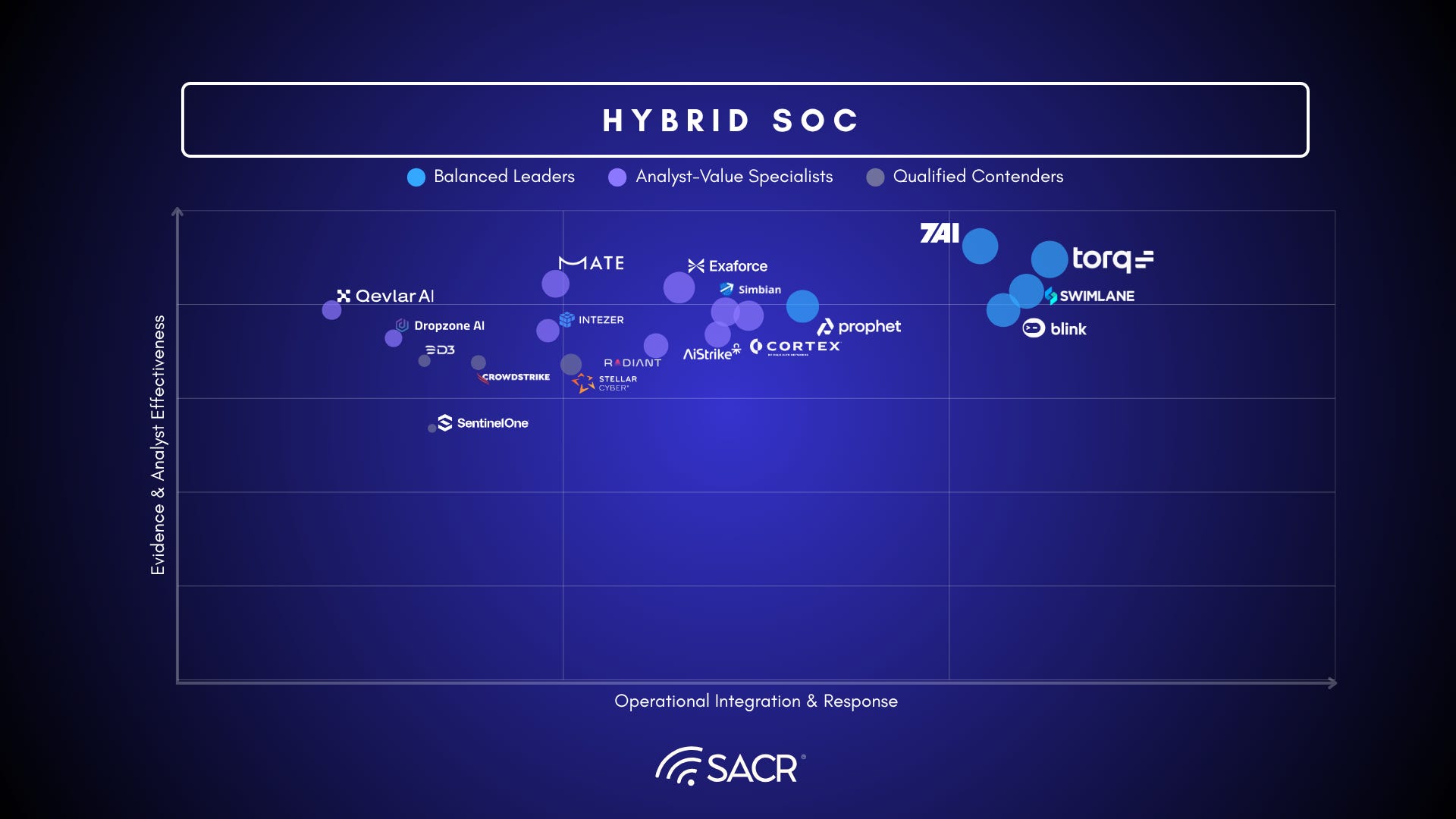
Bubble size directly correlates to the vendor’s final score in this environment.
The hybrid map rewards vendors that can create a coherent case and act across a mixed stack without demanding a major transformation program. Torq and 7AI lead, with Swimlane close behind after demonstrating production operation across hybrid and federated environments. BlinkOps and Prophet Security also clear both thresholds, with different implementation, reasoning, and maturity tradeoffs. Platform-native vendors fall when their strengths require the buyer to consolidate around their ecosystem, while investigation-first vendors fall when they cannot carry the workflow through governed closure.
Operational Integration and Response Axis
The horizontal axis measures how easily the platform can connect to a mixed environment, assemble actions across systems, and deliver useful response without forcing a major platform replacement. It incorporates integration flexibility, response breadth, deployment simplicity, time-to-value, cross-stack orchestration, and the practical burden placed on a smaller team.
A high score means the vendor can sit above a fragmented stack and turn alerts or cases into a coordinated action. A lower score may reflect platform dependence, heavier implementation, narrower response authority, a requirement for substantial workflow engineering, or insufficient evidence that the product can work efficiently in a hybrid mid-market environment.
Evidence and Analyst Effectiveness Axis
The vertical axis measures whether the product improves the analyst’s ability to reach a defensible decision quickly. It includes cross-system evidence assembly, case quality, transparency, contextual reasoning, productivity gains, useful recommendation, and the ability to reduce console switching and repetitive manual work.
A high score means the product creates a coherent case rather than compiling information to a queue or interface. A lower score may reflect fragmented case objects, weak cross-source correlation, limited reasoning transparency, or an operating model that still leaves substantial review and coordination work for a human analyst.
Balanced Leaders Category
Balanced leaders are the strongest fit for a hybrid environment because they combine practical cross-stack action with strong case assembly and analyst leverage. They do not require the buyer to choose between better reasoning and useful response. The differences among them are primarily in operating model, implementation weight, and maturity.
Torq, 7AI, and Swimlane form the leading hybrid shortlist. Torq and 7AI emphasize speed, flexibility, and reasoning-led operation, while Swimlane offers greater governance and automation maturity with additional administrative weight. BlinkOps remains attractive where workflow flexibility and rapid automation dominate. Prophet Security is attractive when backtesting and controlled progression into action are especially important to buyers.
Analyst-Value Specialists Category
This is the largest category in the hybrid scenario. The vendors ranked here generally improve investigation, evidence quality, or analyst productivity, but have a visible constraint in cross-stack deployment, response breadth, time-to-value, or operating-model neutrality.
The category captures several distinct reasons for falling below the Operational Integration and Response Axis threshold. Palo Alto Networks is highly capable but heavier and more platform consolidation-oriented than an independent mid-market layer. Exaforce is the most powerful when its data architecture can be used to the fullest extent. Mate, Simbian, and AIStrike are promising but have thinner production proof or integration maturity. Radiant, Intezer Qevlar, and Dropzone provide strong analyst value but narrower governed response.
These vendors can be excellent purchases when the buyer’s primary problem is investigation quality or analyst capacity rather than universal automated remediation. The question of diligence buyers should ask is where the workflow stops. Buyers should identify whether the platform directly executes, provides recommendations, triggers existing SOAR playbooks, or relies on a managed service. That handoff determines whether analyst value turns into measurable time-to-closure improvement.
Qualified Contenders Category
The vendors in this category are not low in quality compared to the others. They are less aligned to the hybrid mid-market operating model. They each carry a form of platform weight, workflow dependence, or product fragmentation that reduces both immediate analyst leverage and cross-stack simplicity for a lean team.
Environment 3: Cloud Native Data-Lake SOC
A cloud native organization that does not operate a traditional SIEM and relies on a data lake, warehouse, cloud native log store, or security data platform as the main evidence layer. The company has a small security team, an engineering-heavy operating model, and limited formal regulatory burden. Security work often happens through Slack, Jira, GitHub, cloud consoles, identity tools, and infrastructure workflows rather than a traditional SOC queue.
Generic architecture
Data lake, warehouse, cloud native log store, or security data platform as the main evidence layer
Telemetry from cloud logs, identity logs, endpoint tools, SaaS platforms, application telemetry, CI/CD systems, and infrastructure events
Detection from native cloud rules, open-source detections, EDR alerts, CSPM/CNAPP findings, identity alerts, and custom queries
Workflow through Slack or Teams, Jira or Linear, GitHub or GitLab, incident channels, and lightweight ticketing
Response through cloud IAM, IdP, EDR, email security, infrastructure-as-code, secrets management, SaaS admin tools, and cloud consoles
Small security team with engineering-led response
Low to moderate regulatory pressure, but meaningful customer trust, uptime, and breach-risk pressure
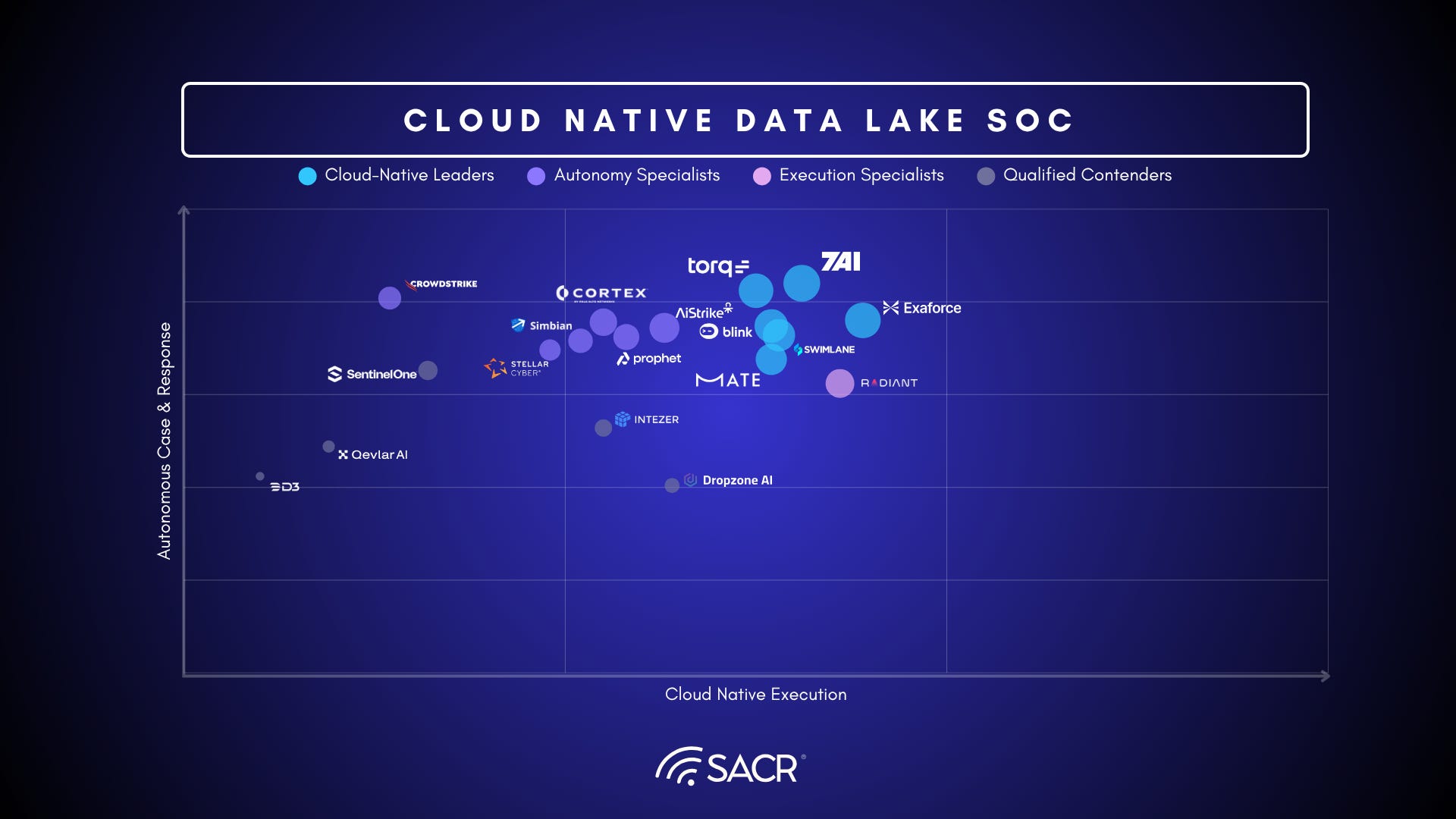
Bubble size directly correlates to the vendor’s final score in this environment.
The cloud native map rewards products that can work directly with modern data and engineering context without sacrificing case construction or governed response. 7AI and Exaforce lead through evidence and data architecture, while Torq and BlinkOps lead through API-driven action and workflow flexibility. Swimlane clears both leadership thresholds by combining direct and federated telemetry access with mature case management and governed execution. Platform and other SOAR vendors remain credible, but their administrative and consolidation burden pushes them into the Autonomy Specialist category. Investigation first vendors remain contenders until they can prove broader governed execution and outcome verification.
Cloud Native Execution Axis
The horizontal axis measures the vendor’s ability to operate in a no-SIEM or data lake centric architecture. It includes direct data lake access, raw cloud and identity context, engineering-native workflow integration, deployment speed, low administrative overhead, and the ability to function without requiring a traditional SOC process.
A high score means the product can become part of an engineering-led security operating model rather than merely connect to one. A lower score often reflects enterprise platform weight, SOAR-centric administration, dependence on upstream alerts, a requirement for a conventional SIEM or case process, or insufficient evidence that the product can work effectively against federated cloud native data.
Autonomous Case and Response Axis
The vertical axis measures whether the product can autonomously assemble a case, reach a defensible conclusion, and move into useful governed response. It includes no-SIEM case creation, evidence continuity, dynamic reasoning, response usefulness, authority controls, auditability, and outcome verification.
A high score means the platform can do more than query cloud data. It can turn that data into an actionable case and support or execute remediation. A lower score generally means the product is strong at data access or investigation but has narrower response authority, less mature governance, fragmented case continuity, or weaker post-action proof.
Cloud Native Leaders Category
Cloud native Leaders can operate without a traditional SIEM while still providing meaningful case reasoning and response. They are not simply cloud-hosted products. Their architectures support direct or federated access to cloud native data, engineering workflows, and dynamic evidence assembly, while preserving enough authority and governance to move toward closure.
This category is the primary shortlist for teams building a modern no-SIEM operating model. 7AI offers the strongest combined case and autonomy proposition. Exaforce is strongest when data architecture and raw cloud context dominate. Torq and BlinkOps are strongest when API-driven action and workflow flexibility dominate. Mate is differentiated by context quality and control design but requires more production diligence, while Swimlane is differentiated by its ability to apply mature response governance and case continuity to federated, and no-SIEM environments. Although its administrative model remains heavier than the leanest AI-native products.
Autonomy Specialists Category
Autonomy Specialists can provide strong reasoning, case management, governed action, or platform-native response, but are less naturally aligned to a lightweight data-lake-centric operating model. The limitation is usually architectural weight rather than a lack of security capability.
Some vendors in this category can technically replace a SIEM or provide their own data layer, but doing so may require broader platform adoption, higher cost, or more administration than a small engineering-led team wants. Others are strong AI-native products whose integration or production proof is not yet sufficient to clear the cloud-execution threshold.
These vendors are viable when the team is willing to adopt a broader platform or already owns the relevant ecosystem. Palo Alto Networks and CrowdStrike can be excellent choices when consolidation is intentional. Prophet, Simbian, and AIStrike fit teams willing to accept younger production evidence for a more modern reasoning model.
Execution Specialists Category
Radiant Security is the only vendor in this category. It performs well on fast cloud-oriented deployment, native log handling, practical triage, and useful response, but its autonomy-governance model remains less mature than the cloud native Leaders.
Radiant’s placement shows the difference between being operationally convenient in a cloud environment and serving as a fully governed autonomous response control plane. The product can create real analyst leverage and support one-click or selected zero-click actions, but deeper risk-tier policy, multi-stage approval logic, and independent verification of final risk reduction remain less complete.
Radiant can be a strong fit for a small team that prioritizes speed, broad triage, and practical containment over immediate delegation of high-impact actions. The buyer should define which actions can run unattended, how policies change by asset criticality and confidence, how failures are handled, and how the platform proves that the intended risk was actually reduced.
Qualified Contenders
These vendors provide useful capabilities but are less aligned to the complete no-SIEM operating model. Their strengths tend to be concentrated in endpoint response, investigation, forensic analysis, or governed SOAR workflows rather than in the combination of cloud native data access, lightweight deployment, autonomous case construction, and broad response.
Vendor Analysis Findings
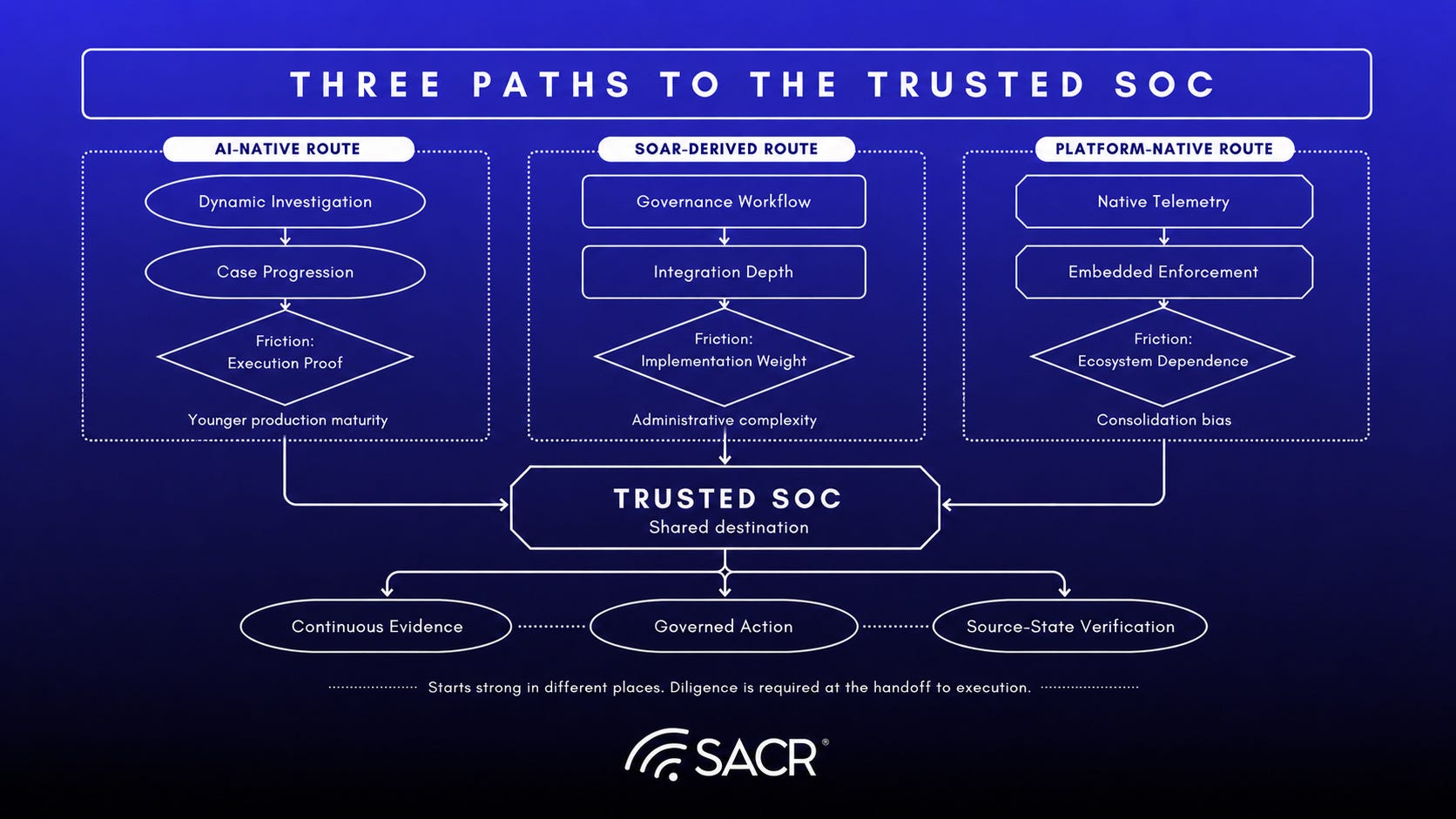
The broader market findings describe the common direction of AI SOC development. The comparative vendor analysis reveals how differently products reach that destination and why those differences matter across operating environments. Architecture, integration model, governance heritage, deployment burden, and control-plane ownership consistently influenced vendor placement, often making a product highly suitable for one SOC model and less natural for another.
Architecture has a significant influence on vendor placement and adoption. Palo Alto Networks, CrowdStrike, and SentinelOne benefit in regulated environments where buyers want a unified platform to provide telemetry, decisioning, policy, and enforcement. That same platform dependence creates more friction in hybrid environments where buyers prioritize an independent layer across a fragmented stack. SOAR heritage can introduce administrative and process weight, but it does not inherently limit hybrid or cloud native applicability. Swimlane demonstrates that a SOAR-derived platform can support those environments when it provides direct telemetry access, federated evidence assembly, independent case construction, and production AI reasoning. D3 Security retains more of the traditional SOAR tradeoff because comparable portability and production evidence for its newer AI layer remain less developed.
Modern reasoning and investigation capabilities also need to be separated from enterprise response maturity. Vendors such as 7AI, Torq, BlinkOps, Prophet, Simbian, and Mate demonstrate that AI-native systems can assemble strong cases and support graduated autonomy, but enterprise readiness still depends on production duration, integration breadth, rollback, source-state verification, and deployment evidence. Dropzone, Qevlar, Intezer, and Radiant similarly create substantial analyst value through investigation and evidence assembly, while narrower authority and less mature governance limit their ability to serve as the primary remediation layer. Buyers therefore need to determine whether they are purchasing an autonomous investigator, a governed response operator, or a platform capable of performing both roles.
Outcome verification remains the clearest dividing line across the market. Many vendors can demonstrate that an action was initiated or that an API request was accepted. Far fewer can re-query the source system, prove that the intended state changed, confirm persistence, and connect the result to a measurable reduction in risk. This gap explains why products with strong investigation and action capabilities can remain outside the leading categories. Automated response ultimately requires evidence the execution action worked.
Viewed through the TSRO lens, the market is not divided simply between autonomous and non-autonomous products, or between trusted and untrusted vendors. Vendors differ in the type of authority they can support, the environments in which that authority is credible, and the evidence available to sustain it. AI-native vendors often lead in dynamic investigation and case progression, SOAR-derived vendors often lead in orchestration and governance, and platform vendors often lead where native enforcement and consolidation are acceptable. The strategic question is which architecture can govern the buyer’s required authority portfolio without breaking evidence continuity, accountability, or operational fit. The Trusted SOC is built through that portfolio, not purchased as a designated platform.
Vendor Profiles
The following profiles explain the product architecture, operating strengths, tradeoffs, and market implications behind each vendor’s placement. The evaluation applies only to the AI SOC capabilities and product scope examined in this report. It should not be interpreted as a judgment of the vendor’s overall corporate maturity, financial position, installed base, or broader security portfolio.
Each profile assesses the role a product can play within a Trusted SOC authority portfolio: the actions it can support, the controls surrounding those actions, and the operating environments in which that authority is most credible.
Vendor placement may change across environments because the rankings reward different forms of operational fit. A platform may benefit from native telemetry and enforcement in a consolidated enterprise while imposing greater friction in a heterogeneous or engineering-led environment. A younger AI-native product may provide stronger investigation and analyst experience while carrying less production evidence, narrower execution breadth, or less mature governance.
Torq - Innovator
Vendor Overview
Torq provides an AI SOC platform built around Auto Triage, Case Management, Socrates, Torq HyperAgents™, and security hyperautomation. The company is best understood less as a conventional SOAR vendor with AI features and more as an AI SOC operating layer that can ingest alerts, classify triage outcomes, construct cases, assign work to Socrates, and route remediation through deterministic or agentic workflows depending on the use case.
Torq’s center of gravity is response/action, but the platform has a stronger triage and investigation story than its automation layer alone would suggest. The company reports a 60x increase in triage velocity, a 94% decrease in mean time to respond, and at least one customer where Tier 1 alerts are fully autonomously handled, with a stated path toward automating a larger share of Tier 1 and Tier 2 alert handling by the end of 2026. Those are vendor-provided performance claims and should be treated as validation targets, but they support the core positioning: Torq is trying to own high-volume alert triage and response closure, not simply accelerate analyst review.
Torq’s strongest buyer fit is a mature SOC, MSSP/MDR provider, or large enterprise security team with a heterogeneous security stack and enough historical alert data, integrations, permissions, and workflow maturity to benefit from customer-specific learning, automation routing, and governed action execution.
Product and Architecture
Torq’s architecture is a layered AI SOC and automation system. Auto Triage classifies alerts into false positive, benign, and malicious outcomes. False positives can feed a detection-engineering improvement lifecycle, while malicious alerts escalate into cases. The platform supports more than 50 opinionated triage investigations across common security vendors, as well as a generalist investigator designed to handle a broader range of alert types.
The case object is the operating unit. Torq demonstrated an investigation pattern where entity and business context materially changed the verdict. In the example, a finance analyst contractor using PowerShell to download a file became more suspicious after the system connected endpoint activity to Salesforce evidence showing bulk data export and a report named “All Accounts Spring export.” The important point is that Torq is not treating alerts as isolated artifacts. It is building a context pipeline around entities, access history, business role, device state, SaaS activity, and related evidence before determining whether an alert should be closed, escalated, or remediated.
Socrates is the AI analyst and orchestrator layer. It can be used interactively by analysts, embedded in predefined investigation templates, or assigned cases directly. Once assigned, Socrates can pivot the investigation based on discovered context. Socrates is also positioned as system-wide rather than only case-scoped, with applicability to threat hunts, cross-case analysis, and process planning. This makes Socrates more than a chat interface on top of a case. It is the reasoning and planning layer that decides how much work should be agentic, how much should be deterministic, and where the human should approve or intervene.
The deterministic-versus-agentic split is one of Torq’s sharper architectural claims. Socrates can analyze available integrations and build an EDR triage workflow with one AI step and multiple deterministic steps, explaining why each choice belongs in the workflow. The system asks human-in-the-loop questions at key decision points, including containment aggressiveness and whether actions should be fully automated or human-approved. This makes Torq’s model more precise than generic agentic automation: it is governed composition, where AI plans or reasons when useful, while deterministic workflow logic executes repeatable steps when reliability, cost, and auditability matter.
Torq also emphasizes model-selection discipline and learning architecture. The company uses a weekly model research process across model foundries such as AWS Bedrock, Azure AI Foundry, and Google, with task-level model selection based on human-tagged alert datasets and a metric that balances missed malicious detections against false-positive reduction. The platform also uses two learning systems: a customer-specific encoder/classifier model trained on historical alerts, and an opinionated memory store that preserves alert and case history in a similarity-searchable vector store. Customers can import historical alert records before go-live, which means the system can start with customer-specific context rather than beginning from a blank slate.
Market Context and Positioning
Torq receives an Innovator placement because its architecture connects dynamic evidence gathering, case reasoning, policy-aware authority, and deterministic execution, while mature deployments and broad integrations support strong Production Delivery. Torq is one of the clearest examples of the SOAR-to-AI SOC transition. Its automation heritage gives it execution depth and integration reach, while the current product posture is more substantively AI SOC-oriented around autonomous triage, Socrates-driven investigation, model governance, customer-specific learning, and case-to-action continuity. Compared with AI SOC point solutions, Torq’s advantage is the ability to connect AI decisioning to actual workflow execution. Compared with legacy SOAR, its advantage is that Socrates can reason over cases, plan workflows, and decide which portions of an investigation should be agentic versus deterministic.
The market tradeoff is proof and dependency. Torq’s strongest claims depend on the quality of customer integrations, historical alert data, available APIs, configured permissions, and clearly defined autonomy policies. Torq addresses this concern through auto-routing options such as do nothing, create case, or trigger workflow, and by positioning agentic reasoning and actions as documented, immutable, auditable, and exportable. Buyers should test whether the system can preserve traceability from alert intake to reasoning, workflow decision, approval, action, and outcome.
Torq’s buyer fit is strongest where the organization wants to operationalize autonomy gradually. The idea that autonomy is a dial, not a binary switch, aligns Torq with enterprise adoption patterns. A SOC can begin with triage and recommendation, move into human-approved action, and eventually automate narrower or higher-confidence alert classes. That makes Torq relevant for large enterprises and service providers that need measurable automation without losing control of high-impact response decisions.
Narrative Implication
Torq strengthens the AI SOC report’s argument that autonomous SOC value will be measured by closed-loop operating capability rather than AI summarization. Its product story ties together alert classification, case construction, context-aware investigation, Socrates-led reasoning, deterministic workflow execution, human approval, model selection, organizational learning, and auditable action records.
Torq is an action-centric AI SOC platform with unusually strong automation depth and a more developed learning architecture than a simple AI copilot. Its differentiation is not only that it can automate workflows. It is that it can learn from customer-specific alert history, decide when to use AI versus deterministic logic, assign cases to an AI analyst agent, and preserve proof as work moves from triage to response. Torq is neither legacy SOAR nor pure AI-native analyst replacement. It is better understood as a governed autonomy layer for SOCs that want to turn repeatable analyst judgment into system-owned triage, remediation, and closure.
7AI - Innovator
Vendor Overview
7AI is an AI SOC platform and managed service provider focused on automating investigation, decision support, and response workflows across customer environments. The same technology stack supports multiple consumption models: customers can operate the platform with their own SOC team, consume 7AI as a managed service through PLAID ELITE, or use the platform with MSSP and MDR partners.
The company’s positioning is strongest around the final mile of SOC work. 7AI’s argument is that the hardest operational question often comes after the case is assembled: what happens next, who approves it, and how much authority the system receives. The platform moves from evidence to action through customer-defined authority levels, including recommendation, approval-required execution, supervised execution, and policy-gated automation for lower-blast-radius actions. Action plans are generated from assembled case evidence and organizational context, while confidence and policy controls determine whether an action is recommended, queued for approval, or executed. Failed or higher-impact actions can follow defined retry, escalation, and action-specific recovery paths.
Product and Architecture
7AI’s architecture spans detection optimization, agentic investigation, threat hunting, organizational context, workflow automation, and optional managed service delivery. Detection Optimization analyzes rules across connected sources, identifies noisy or incomplete coverage, recommends tuning, and maps detection coverage to MITRE ATT&CK. The platform connects to security tools, consumes alerts and evidence, runs investigations through task-specific agents, and exposes agent reasoning. The product shows the mission assigned to each agent, the inputs used, tools called, requests made, responses received, and conclusions reached.
Enterprise Insights is the most important context feature. It allows customer-specific knowledge, including user roles, accepted tools, disallowed software, business processes, and known behavior patterns, to influence investigation and response decisions. That matters because the same signal can have different meaning across organizations or business units.
Threat Hunting supports analyst-directed, natural-language hunts and threat-intelligence-driven hunts across connected customer telemetry. Analysts can start with a hypothesis, behavior, or ATT&CK technique, while incoming intelligence can initiate hunts as new indicators become available. Separately, the Skills framework lets customers create, test, and reuse investigation, hunting, and automation routines tailored to their environment.
The integration story is broad, with the platform designed to connect across security and IT systems. Integration depth determines response value because actions depend on API quality, permissions, telemetry freshness, identity mapping, and available write scope. After an action executes, 7AI can re-query the source system to confirm the resulting state and record submission, execution, and verified completion separately in the case. Federated search is an important direction because it lets the platform search connected tools without requiring all data to be copied into a central SIEM.
Market Context and Positioning
7AI receives an Innovator placement because its architecture connects unified case construction, transparent reasoning, graduated authority, and conclusion-driven response, while named production outcomes support strong Production Delivery despite a younger response catalog than the mature orchestration leaders. 7AI fits the AI SOC market as a hybrid platform and service model for organizations that want investigation automation tied to action. Its competitors include AI SOC point solutions, MDR modernization providers, SOAR and automation platforms adding AI, and security platform vendors embedding autonomous response into their own control planes.
7AI’s market position combines cross-stack neutrality, organizational context, transparent agent reasoning, and flexible delivery across software, managed service, and partner-led models. Its architecture begins with agentic investigation and extends into governed response, while detection optimization and threat hunting create feedback loops that can improve future case quality. Hunting findings can inform detection coverage, and investigation or response outcomes can support subsequent rule tuning. The value of this model depends on integration depth, customer-specific context, and how consistently those feedback loops operate in production.
Narrative Implication
7AI sharpens an important point for the AI SOC report: the final mile of SOC automation is organizational judgment encoded into a repeatable workflow. The platform is designed around the idea that the SOC needs a system that can learn customer context, gather evidence, explain reasoning, suggest or execute next steps, verify the resulting state, and let humans decide where automation should stop.
The product’s publication story is delivery flexibility. 7AI can be consumed as software, service, or partner-enabled capability, making it relevant to buyers that want agentic SOC outcomes but differ in how much operational responsibility they want to retain internally.
Palo Alto Networks - Trailblazer
Palo Alto Networks is assessed in this profile only against the AI SOC capabilities available within the Cortex platform. Its placement does not reflect Palo Alto Networks’ overall cybersecurity market position or the breadth and maturity of its broader product portfolio.
Vendor Overview
Palo Alto Networks’ AI SOC proposition is centered on Cortex XSIAM and is informed by the company’s long history of building enterprise security tools and platforms. Palo Alto Networks frames AI as an important new capability within a 20-year security history of engineering security platforms. That maturity matters: the platform is not presented as a standalone AI assistant, but as an operational SOC environment shaped by enterprise security controls, scalability requirements, governance, playbooks, case management, and analyst workflow design.
The relevant product scope for this report includes XSIAM, Cortex XDR heritage, Demisto-derived SOAR and playbook capabilities, case management, automation, and data ingestion across Palo Alto and third-party sources. Palo Alto Networks’ core narrative is that the AI SOC must be a full-stack operating platform rather than a thin AI overlay. In practice, this means collection, normalization, enrichment, detection, grouping, risk scoring, case investigation, root-cause analysis, and remediation workflows are intended to sit in a common console and decision loop.
Palo Alto Networks is deliberately introducing automation gently rather than forcing an abrupt move to full autonomous response. The XSIAM command center highlights cases that “could have been automated,” which is designed to show SOC teams where they could have benefited from more automation and automatic response without immediately removing human control. This experience supports the twin objectives: reducing confirmed MTTD toward less than 10 minutes and reducing MTTR toward a similar single-digit-minute target, with the latter acknowledged as aspirational for many SOC teams because it depends on trusted playbooks and AI agents, permissions, approvals, and operational confidence.
Product and Architecture
XSIAM can be described as a three-layer operating model. The data layer ingests and normalizes evidence from endpoints, firewalls, network flows, identity systems, cloud sources, Cortex telemetry, and selected third-party EDR and telemetry providers, as well as any other data source. The decision layer correlates and clusters that evidence into cases, applies analytics, performs risk scoring, and provides AI-supported investigation. The execution layer uses playbooks, SOAR actions, case management, and agentic workflows to move from understanding an incident to taking approved action.
A key architectural differentiator is Palo Alto Networks’ emphasis on the complete SOC pipeline. The company positions XSIAM Command Center as a unified view across ingestion, normalization, detection, grouping, scoring, and case management. The case investigation view then adds AI-generated summaries, attack-chain visualization, next-step recommendations, agentic Q&A, and transparent explanation of why alerts have been grouped. This reinforces XSIAM’s role as a full-stack platform for collection, normalization, investigation, root-cause analysis, and remediation rather than a disconnected AI layer bolted onto existing SOC tooling.
Palo Alto Networks also states that AI SOC and the data platform must converge. Its position is that detection, investigation, and response quality depend on normalized, enriched, contextualized data before an incident occurs. The company supports federated search where appropriate, but its stated belief is that a core baseline dataset is necessary for high-fidelity detection and response. It also emphasizes that anomalous behavior alone is not proof of malicious activity; security research expertise and data science need to be combined to determine whether deviations from baseline are actually meaningful.
Palo Alto Networks’ platform is best suited for large enterprises and advanced mid-market organizations with mature SOC operations, high telemetry volumes, and complex, globally distributed environments. Its SaaS-only model is designed to handle large-scale data processing, analytics, and AI-driven automation, making it less suitable for organizations without dedicated security teams. With 26 global hosting regions, including federal and sovereign options, it is particularly well aligned to Fortune-scale and regulated customers that require strong data residency support and the ability to operate across multiple jurisdictions and distributed SOC teams.
Palo Alto Networks positions automation as a spectrum ranging from deterministic workflows to hybrid AI-assisted playbooks and fully agentic operations, emphasizing gradual adoption rather than immediate full autonomy. The platform defaults to human approval for sensitive actions and uses guardrails such as RBAC/SBAC and cost controls, while features like the “could have been automated” view help SOC teams build trust through repeated validation of automation outcomes. This staged, evidence-based approach aligns with customer hesitation around fully autonomous response and is reinforced by support for customer-built agents and external AI tools, enabling organizations to start with familiar processes and progressively expand automation as confidence grows
Market Context and Positioning
Palo Alto Networks receives a Trailblazer placement because Cortex demonstrates mature governance, native enforcement, source-state verification, and enterprise-scale Production Delivery, while complete lifecycle ownership remains distributed across the broader platform and its newest agentic capabilities are still maturing. Palo Alto Networks is positioned as a major platform vendor applying AI-enabled operations to the historical SOC stack. The competitive frame includes SIEM modernization, XDR expansion, SOAR consolidation, AI copilots, MDR-led operating models, and AI-native SOC entrants. XSIAM’s market relevance is strongest where the buyer wants a consolidated security-operations platform that can absorb more of the SOC decision loop rather than a narrow AI assistant or investigation overlay.
The Cortex XSOAR foundations remain an important part of this positioning because response orchestration is the point at which AI SOC capabilities move from investigation support into operational execution. In the XSIAM model, SOAR becomes less of a separate automation tier and more of an embedded execution mechanism within the SOC workflow. The demo’s emphasis on shift-change automation, AI-enabled playbook steps, and case handoff illustrates how Palo Alto Networks is using automation not only for response actions, but also for routine operational burden reduction.
The strongest differentiation is therefore not simply “AI in the SOC,” but the combination of enterprise platform depth, data normalization, integrated investigation, human-governed automation, and scaled deployment options. Palo Alto Networks is also making the analyst experience transparent: AI-generated summaries, attack-chain graphs, recommendations, and explanations are used to orient analysts and accelerate action without hiding the reasoning behind case construction.
Narrative Implication
Palo Alto Networks illustrates how the AI SOC category can be shaped by consolidated security platforms as well as AI-native vendors. XSIAM aligns with SACR’s category definition where AI SOC is understood as an operating model for the SOC decision loop rather than a chat interface. The solution applies AI across detection, investigation, explanation, automation, and response, while preserving enterprise guardrails and gradual human-in-the-loop adoption.
Palo Alto Networks’ platform is most suitable for very large, geographically dispersed customers with high data volumes; its 26-region hosting footprint including federal and sovereign options; and its full-stack approach to collection, normalization, investigation, root-cause analysis, and remediation are significant here. The distinctive approach to automation adoption: guiding teams toward more automation over time, building confidence through repeated iterations of specific SOC use cases, and allowing customers to use their own AI tools or agents are sure to improve trust and acceptance.
BlinkOps - Innovator
Vendor Overview
BlinkOps is an Agentic Security Operations Platform that packages AI SOC and SOAR capabilities as part of a broader security automation environment. The platform is organized around Workflow Studio, Agent Studio, and Solution Studio. Workflow Studio is the deterministic workflow layer, Agentix Studio is the agent-builder layer, and Solution Studio is the user-facing application, dashboard, and case-management layer.
BlinkOps is best understood as an AI-enabled security automation platform rather than a single-purpose AI SOC product. AI SOC is one capability area within a broader platform that also addresses SOAR, vulnerability management, cloud security, and other security program workflows. The strongest buyer fit is a team that wants to automate across an existing stack rather than replace core detection, SIEM, EDR, or case-management systems.
Product and Architecture
BlinkOps uses a layered operating design. Deterministic workflows handle ETL-style tasks, structured checks, and initial triage. A hybrid layer uses classic statistics, machine learning, and smaller models for enrichment, routing, and context assembly. Larger reasoning models are reserved for complex synthesis or novel situations.
The platform’s operating loop can be summarized as See, Understand, Decide, and Act, with a feedback arc that can revisit investigations as new evidence appears. BlinkOps separates decisioning from execution. A verdict can be challenged before an action proceeds, and agents operate with scoped abilities defined by customer roles, responsibilities, and policy constraints.
Human review is the default operating posture. Autonomy is earned over time as agent performance is observed and trusted. The platform starts with deterministic behavior and can increase autonomy as workflows mature. For situations outside known patterns, a novelty branch routes the work through a different reasoning path and updates future investigation artifacts.
BlinkOps’ scale claims, including integration counts and microagent counts, reinforce the platform’s breadth, but the key architectural issue is practical action depth: which connectors can gather evidence, which can change state, and how each action is governed, logged, retried, or reversed.
Market Context and Positioning
BlinkOps receives an Innovator placement because its architecture connects specialized agents, deterministic workflows, configurable authority controls, and broad action reach, while mature automation use supports strong Production Delivery despite less specific deployment evidence for the Agentic SOC layer. BlinkOps fits the SOAR + AI and security automation branch of the AI SOC market. It is relevant where buyers want AI SOC capabilities embedded in a workflow, automation, and orchestration platform rather than in a standalone AI analyst product. Its competitive set includes SOAR automation vendors, AI SOC point solutions, MDR-adjacent AI SOC vendors, and broad security platforms adding AI-powered SOC features.
BlinkOps’ go-to-market theme is augmentation of existing tools. The company helps customers identify, orchestrate, and improve workflows across the tools they already use. That makes BlinkOps strongest where a buyer has many fragmented tools, established workflows, and a desire to increase automation without rip-and-replace.
Narrative Implication
BlinkOps shows that AI SOC may become an automation capability embedded inside broader security operations platforms. Its strongest narrative is layered automation: deterministic workflow, scoped agents, human review, novelty handling, and progressive autonomy.
The product’s long-term relevance depends on proof at the action layer. The most important question is not whether BlinkOps can build workflows, but whether those workflows preserve evidence, challenge decisions before execution, handle failure, verify state change, and give teams enough control to trust automation in production.
Swimlane - Innovator
Vendor Overview
Swimlane Turbine is an agentic AI automation platform that sits above existing security stacks. It ingests alerts and context from customer-owned tools, converts them into durable case state, drives governed response actions, and preserves proof for analysts, managers, and auditors. Depending on the buyer’s starting point, Swimlane can serve as an AI SOC operating layer or as a path to modernize an existing SOAR program with AI.
This matters because many buyers will adopt AI SOC by upgrading the orchestration and action layer they already trust. Swimlane’s strongest fit is the enterprise, federal, regulated, and MSSP/MDR buyer that needs cross-tool execution, repeatable workflow control, progressive autonomy, and audit-grade reconstruction.
Product and Architecture
Swimlane Turbine’s architecture is best understood as three connected layers: a federated data fabric for querying customer-owned sources, Hero AI agents for investigation and workflow generation, and the case management and orchestration layer for execution and proof. The platform depends on customer telemetry for detection input, while Turbine can become the system of record for investigation, decision, action, and closure.
The case object is the most important architectural primitive. Swimlane describes the case as the durable work unit from evidence intake through enrichment, investigation, recommendation, approval, execution, verification, and closure. Each state transition is intended to remain visible in the case record, including agent decisions, human review, approval, execution, failure, retry, rollback, and final outcome.
The action surface is broad by AI SOC standards and mature by SOAR standards. Swimlane reports response coverage across endpoint, identity, cloud/runtime, email/collaboration, ITSM/workflow, network, and custom APIs. The buyer implication is straightforward: Swimlane can reach many control points where the customer has integrations, credentials, policies, and permissions configured.
Governance is central to Swimlane’s credibility. Agent identities are governed through RBAC, with agents authorized only for specific data and tools. Policy decisions can consider confidence, evidence completeness, asset criticality, user role, privilege level, business unit, action type, blast radius, incident severity, time window, and exception state. Analysts can edit, pause, reject, override, or escalate AI-generated action plans before or during execution.
Market Context and Positioning
Swimlane receives an Innovator placement because it combines mature orchestration, governance, case continuity, rollback, and enterprise-scale execution with demonstrated production AI reasoning and the ability to operate across SIEM-centric, hybrid, and no-SIEM environments. Its federated data architecture allows Turbine to assemble evidence directly from customer security and cloud systems, while Hero AI connects that evidence to investigation, recommendation, governed action, and durable case records. Swimlane reaches the Innovator category through a SOAR-derived architecture, demonstrating that architectural heritage does not determine leadership when the product can connect the AI SOC lifecycle and deliver it credibly in production.
The tradeoff is proof. Buyers should not reward AI labeling on top of conventional SOAR without case-to-action evidence. The strongest evaluation asks what evidence the agent used, what action it recommended, what policy applied, who approved it, what executed, what state changed, what failed, what rolled back, and what remained open.
Narrative Implication
Swimlane broadens the AI SOC narrative. The market will be built by AI-native startups and by automation platforms that already own response plumbing and can use AI to reduce the distance between evidence, decision, action, and proof.
The product’s strongest publication story is trustworthy execution. Swimlane can bring AI into operational workflows without abandoning deterministic controls, approval paths, analyst override, or auditability. That makes it an important reference point for buyers that want autonomous security operations to evolve from governed automation rather than from open-ended reasoning alone.
Exaforce - Innovator
Vendor Overview
Exaforce’s core bet is that autonomous SOC response requires a real-time model of the environment rather than an LLM layered over alerts. The platform is built around a knowledge graph that combines alert data, configuration state, identity behavior, session context, and connected system activity. The broader platform spans detection, triage, investigation, and response, with Exabot Respond serving as the action-oriented component that carries the context assembled earlier in the lifecycle into governed execution.
Exaforce is best positioned as a context-driven AI SOC platform with response capability, not as a generic AI assistant. Its differentiation comes from connecting evidence, context, policy, and scoped action inside a single operating model.
Product and Architecture
Exaforce’s operating model is built on a knowledge graph that combines alert data with configuration, identity, session, and behavioral context. The graph feeds a multi-phase reasoning workflow covering classification, planning, analysis, generation, and validation. The output is a structured verdict with plain-English rationale and action plans. Business context rules allow customers to encode constraints such as protected user groups or business units at the planning stage.
Exabot Respond is the response-oriented task agent within the broader Exaforce platform. It uses the evidence, entity relationships, behavioral context, and verdict developed during detection and investigation to generate and execute response actions. The response model includes stateful workflows, retry policies, escalation when connectors are unavailable, timeout and escalation chains for unavailable approvers, and case records that remain open until actions resolve.
Common automation use cases include user confirmation workflows, session revocation, password resets, ticketing, and email actions. Exabot Respond can execute across endpoint containment, identity session revocation, cloud isolation, email purge, and custom API actions where configured. Customers can tailor response behavior through configurable workflows, action catalogs, business-context rules, approval points, and custom API actions. Approval requirements are governed by policy.
Exaforce’s response strength comes from applying investigation context and policy to configurable actions across multiple control domains. Granular session control is a concrete example of that precision: the platform can terminate higher-risk sessions while preserving lower-risk activity where appropriate. This reduces exposure while limiting unnecessary business disruption. Source-system state confirmation strengthens the model by checking whether the expected change occurred before a risk finding is closed. Automated rollback is less mature than forward execution, leaving manual inverse actions and compensating controls important for recovery.
Market Context and Positioning
Exaforce receives an Innovator placement because its architecture connects a real-time evidence model, defensible reasoning, policy constraints, and source-aware response, while credible production use supports delivery and action-dependent rollback remains the principal maturity constraint. Exaforce sits between SIEM incumbents applying AI to log data, AI SOC specialists focused on triage and investigation, and SOAR platforms extending playbook automation with AI reasoning. Its market argument is that response reliability depends on context depth, policy constraints, and scoped action precision rather than reasoning quality alone.
The platform works with existing tools, including SIEM environments, and can pass verdicts and context back to originating systems. Customers can retain their current detection investments while using Exaforce to add contextual detection, triage, investigation, and governed response across the existing stack. The strongest buyer fit is a security team that wants broader case-to-resolution automation without replacing its established control and telemetry layers.
Narrative Implication
Exaforce reinforces a broader AI SOC pattern: reliable response depends on the quality and continuity of the work performed before an action is selected. Detection, triage, investigation, organizational context, policy, and execution operate as parts of one case-to-resolution system. Exaforce’s contribution is the connection between that broader operational coverage and governed response, with granular session control, scoped blast-radius controls, and graduated deployment providing concrete examples of how autonomy can be constrained.
Exaforce’s publication story is strongest when framed around comprehensive case context, configurable execution, precision, and governance. The platform has a credible path to owning the last mile of response where customers can supply the integrations, permissions, policies, and audit requirements needed to support controlled execution.
Prophet Security - Innovator
Vendor Overview
Prophet Security provides an agentic SOC platform centered on Prophet AI SOC Analyst, with adjacent capabilities for AI Threat Hunter, Watchtower human oversight generally available, and Detection Engineer functionality on the product roadmap. The platform is designed for enterprise SOC teams that want to increase investigation coverage, reduce manual triage, and introduce governed remediation without replacing their existing SIEM, EDR, identity, email, cloud, ITSM, or collaboration systems.
Prophet’s primary AI SOC control point is detection and decision with response extensions. The platform meets customers where their telemetry and workflows already live. It is not positioned as a SIEM migration platform, data lake product, MSSP operating console, or full SOAR replacement.
Product and Architecture
Prophet AI SOC Analyst ingests alerts, builds and executes investigative plans, queries connected tools, groups related findings into investigations or cases, dispositions activity, and recommends or executes Agent Actions. Prophet uses frontier models rather than training a proprietary foundation model. The product differentiation is investigative depth, evidence transparency, and an analyst-oriented user experience.
The platform does not require customers to replicate or migrate data into a new SIEM. It queries evidence where it resides, including SIEM, Databricks, Snowflake, S3, EDR, identity, email, SaaS, cloud, network, and ITSM sources. Prophet emphasizes API-based integration, arbitrary webhook ingestion for custom alert sources, and Prophet-built retrieval agents where raw API-query traceability and auditability are required. MCP can support some technology classes, while Prophet’s own retrieval layer is more relevant where transparency and accuracy are critical.
Agent Actions are the response layer. The product supports natural-language workflow creation, translation into deterministic branches and REST API calls, autonomy settings across autonomous, approval-required, and recommend-only modes, and rate limits to restrict action frequency. Backtesting allows customers to see which historical investigations would have triggered an action before enabling it in production. Actions can cover identity, endpoint, cloud, email, and ITSM or workflow domains, with enforcement executed through customer-owned tools.
Prophet AI Threat Hunter extends the platform into autonomous hunting with prebuilt MITRE ATT&CK hunts, custom natural-language hunt creation, scheduled reporting, remediation actions, and a threat-researcher agent that monitors emerging threats. Watchtower is an optional 24x7 human oversight service that can review selected investigations, add analysis, tune agents, orchestrate remediation, and provide daily rollups.
Market Context and Positioning
Prophet Security receives an Innovator placement because its architecture connects contextual investigation, governed action, backtesting, rate limits, and source-aware verification, while current product evidence supports Production Delivery and broader independent deployment proof remains the primary diligence item. Prophet sits in the AI SOC segment as an investigation and governed response layer around existing SOC tooling. Its most natural buyer is an enterprise SOC with existing telemetry, established workflows, and a desire to improve coverage and response consistency without replacing the current operating model.
The company’s go-to-market focus is the enterprise segment, particularly large organizations that want to control outcomes directly. Prophet is not primarily positioned around MSSP partnerships. Watchtower provides a managed oversight option, but the product’s primary market posture remains enterprise-direct.
Narrative Implication
Prophet represents a case- and evidence-centered AI operating layer that connects alert intake, investigation, decisioning, governed action, and proof. Its strongest claims are durable investigation objects, chain of custody from evidence to action, source-system action verification, rollback where supported, policy constraints, approval handling, and operational metrics.
The product’s publication story is case-to-action discipline. Prophet’s decisioning and orchestration are native, while enforcement occurs in customer-owned tools. Completeness therefore depends on connector availability, API permissions, source-system capabilities, and the customer’s willingness to define autonomy boundaries.
Mate Security - Pioneer
Vendor Overview
Mate Security’s core bet is that AI SOC outcomes degrade when environment understanding is treated as an afterthought. The platform is built around a Security Context Graph that captures architecture, ownership, SOPs, investigation history, and operational nuance, then uses that graph as the substrate for investigation and decision support.
Mate positions itself on the augmentation path. The vendor expects SOC roles to evolve toward a more engineering-led operating model, where detections and agents are iterated and benchmarked over time. The platform aims to increase analyst throughput and decision quality while keeping humans in the loop for business-impacting response decisions.
Product and Architecture
Mate’s platform is anchored in a Security Context Graph designed to learn a customer environment the way a new analyst would, but faster and more systematically. It ingests and continuously updates context from SIEM and data lake schemas, ticketing system case history, Slack incident channels, onboarding guides, SOPs, architecture diagrams, and cloud segmentation configurations.
The output is not just a static knowledge base. Mate organizes context into structured primitives such as memories, playbooks, architecture maps, and policies. Investigation is graph-first and transparency-forward. The platform includes an investigation queue and case-management interface with AI-generated summaries, prioritization, and suggested response actions. A browser extension can overlay context and task guidance inside third-party tools, allowing analysts to review collection steps, user profiling, and tool queries without switching platforms.
Mate has expanded into detection engineering and threat hunting. The product centralizes detections spread across tools, tracks coverage and quality, and supports federated execution where detections and hunts run against data at the source rather than requiring full SIEM ingestion. Analysts can initiate a hunt by providing a threat-intelligence report or a free-text hypothesis. Mate extracts relevant indicators and techniques, searches connected tools, correlates the results, and can translate the findings into detection content. Mate frames this as a hybrid stance that recognizes compliance and near-real-time requirements still require hot storage for some use cases.
Mate provides governed remediation capabilities such as session revocation, password reset, email purging, false-positive closure, and emerging device isolation. Response actions are governed by the CPR model: Confidence, Precision, and Rollback. Production use is staged, with lower-impact actions more broadly suited to automation and user-account or device-level actions adopted more cautiously.
Market Context and Positioning
Mate Security receives a Pioneer placement because its Security Context Graph, constrained tools, judge agents, and execution-time validation create strong Architectural Alignment, while limited deployment history and downstream-dependent rollback keep Production Delivery in a developing stage. Mate sits in the detection and decision band of the AI SOC landscape, competing with vendors that pair investigation quality with governed remediation. Its differentiation is the context substrate. Mate argues that many vendors are beginning to talk about context, but that context must be foundational and continuously refreshed to support defensible AI decisions.
The platform also intersects with detection engineering, investigation automation, response guidance, and supervised remediation. Its comparison set includes AI SOC point solutions, context-first investigation platforms, and SOAR + AI vendors that rely more heavily on deterministic workflow automation.
Narrative Implication
Mate reinforces a core AI SOC pattern: the limiting factor is often whether the system can reliably acquire and apply environmental context without burdening teams with manual knowledge engineering. The strongest AI SOC approaches are converging on an explicit context substrate as the prerequisite for trustworthy decisions.
The product’s publication story is context-led trust. Mate is strongest where buyers believe AI SOC requires a durable model of the environment, not just faster alert investigation. Its remediation path remains governed, staged, and aligned to customer SOPs rather than framed as broad fully autonomous execution.
Simbian - Pioneer
Vendor Overview
Simbian positions itself as an AI-native first responder for security operations. The platform sits alongside the existing stack rather than replacing the SIEM, with the goal of compressing the alert lifecycle from triage into decision and action without forcing teams through a heavy playbook-authoring exercise.
The company’s center of gravity is an agent family tied to a shared reasoning engine and context lake. Simbian’s pitch is that the SOC functions better as a connected decision system that learns from analyst feedback and repeated patterns than as a collection of disconnected automations.
Product and Architecture
Simbian uses a reasoning engine that runs investigations end to end, selects and cross-checks models to reduce hallucination risk, and uses contextual knowledge to reach a defensible conclusion. The platform is organized around multiple agents that share the same underlying reasoning engine and context substrate. The AI SOC agent is the common anchor, while peer agents such as threat hunting and pen testing can feed and consume shared context.
The product performs alert-to-case normalization across a heterogeneous tool layer. It aggregates alerts across common sources such as SIEM, EDR, identity, and cloud, with the goal of completing many investigations before an analyst begins work. For MDR-style delivery, the value is partly translation and normalization across heterogeneous customer stacks.
Simbian’s autonomy model is staged and selectable. The vendor distinguishes “human in control” from strict human-in-the-loop gating. Autonomy can be configured by environment, alert type, user group, and confidence threshold. The adoption path starts with read-only operation, moves into auto-close for false positives, then notifications, then containment. Containment is intentionally scoped toward reversible actions as the default safety posture.
The Context Lake is the self-improvement substrate. It stores supplementary organizational knowledge and feedback rather than raw logs. It can incorporate SOPs, travel schedules, organizational constraints, and agent-discovered patterns, then reuse those patterns to reduce repeated work and improve decision consistency.
Market Context and Positioning
Simbian receives a Pioneer placement because its architecture connects AI-native reasoning, durable cases, customer-controlled authority, and bounded execution, while independent production evidence and source-system validation remain less mature than the breadth of its capability claims. Simbian sits between triage relief, governed containment, and MDR-compatible AI SOC delivery. It is strongest for environments where humans cannot investigate everything, where outcomes are measured by closure rate and time to disposition, and where buyers want a staged path from investigation into containment.
Simbian is structurally compatible with MDR delivery through RBAC based multi-tenate architecture, and normalized heterogeneous tool stacks and autonomy tuning by customer. Its market role depends on whether buyers want AI SOC as a first-responder system that works across existing tools, learns from local context, and gradually assumes more operational authority.
Narrative Implication
Simbian is a strong example of the AI SOC market moving from investigation assistance into an execution-oriented operating layer. The important signal is the operating model: a unified reasoning engine and durable context substrate, paired with an autonomy progression that starts in read-only and can move toward containment under customer policy.
The product’s publication story is staged operational trust. Simbian does not need to claim immediate full autonomy to be relevant. Its value comes from converting repeated investigative work into context-aware response patterns while keeping containment scoped, reversible, and adjustable by customer policy.
CrowdStrike - Emerging Player
CrowdStrike is assessed in this profile only against the AI SOC capabilities available within the Falcon platform. Its placement does not reflect CrowdStrike’s overall cybersecurity market position or the breadth and maturity of its broader product portfolio.
Vendor Overview
CrowdStrike positions the Falcon platform as the foundation for its AI SOC strategy, integrating AI, telemetry, SIEM, automation, and response into a single security operations platform. The relevant product scope includes Falcon Next-Gen SIEM, Charlotte AI (including Charlotte AI AgentWorks, and Charlotte AI Agentic SOAR), managed detection and response services, strategic advisory services, and adjacent Falcon controls across endpoint, identity, cloud, browser, data protection, exposure management, and threat intelligence.
CrowdStrike represents the platform-consolidation path for AI-enabled security operations. Falcon combines native telemetry with data and controls from the customer’s broader security stack, providing a common environment for visibility, detection, unified case management, investigation, workflow coordination, and response. This extends Falcon’s SIEM, AI, automation, and response capabilities into a broader operating model for SOC modernization, although the degree of continuity across the environment depends on integration depth, licensing, and customer configuration.
Product and Architecture
The Falcon architecture can be understood as a three-layer operating model. The onboarding layer collects and prepares data through the Falcon sensor integrations and data-pipeline capabilities. The operational layer uses Falcon Next-Gen SIEM and Charlotte AI capabilities, as well as customer-defined knowledge sources to support triage, investigation, recommendation, and workflow construction. The orchestration layer uses Charlotte Agentic SOAR capabilities, and integrations to coordinate actions across first-party modules and third-party systems.
CrowdStrike’s strongest AI SOC relevance is in cross-layer telemetry, case-centered investigation, governed automation, human-in-the-loop approval, traceable agent execution, managed detection, and integration breadth. The platform benefits most where Falcon already serves as a major control plane, because endpoint, identity, cloud, threat intelligence, SIEM, MDR, and response context can be brought into a common operating environment.
Data-pipeline and acquisition-driven capabilities strengthen the broader architecture when they are integrated into Falcon workflows. Falcon Onum and related data movement, enrichment, transformation, routing, monitoring, and reduction capabilities are relevant to the AISOC data foundation. Other adjacent modules can expand identity, cloud, browser, AI security, exposure management and data protection coverage. The degree of operational continuity depends on module licensing, integration maturity, deployment scope, and customer configuration.
CrowdStrike can support recommendation, governance, coordination, and execution with operator-defined autonomy. The operator may be the customer or CrowdStrike’s managed service, depending on the deployment model. Closed-loop risk-reduction verification, multi-tier approval chains, and cross-module action depth vary by use case, licensed capabilities, deployed Falcon modules, integration depth, and customer policy.
Market Context and Positioning
CrowdStrike receives an Emerging Player placement because Falcon provides mature native enforcement, governance, and production reach, while the complete cross-stack reasoning, case-continuity, verification, and rollback chain remains less fully connected across the broader AI SOC lifecycle. CrowdStrike is the platform-native consolidation path in the AI SOC market. Its competitive frame includes SIEM vendors adding AI, XDR vendors expanding into cross-domain operations, SOAR platforms adding generative workflows, MDR providers using AI to scale service delivery, and AI SOC point solutions. Its differentiation lies in the breadth of Falcon-native telemetry, threat intelligence, managed detection, unified case handling, response control points, data-pipeline capabilities, and ecosystem integrations.
The strongest fit is an organization that already uses Falcon extensively or wants to consolidate security operations around a common data and response platform. Large and technically mature enterprises are best positioned to operate the broader architecture directly, while smaller or resource-constrained teams can access portions of the model through Falcon Complete MDR and strategic services. Broad internal AI SOC adoption still requires maturity around data-source onboarding, policy design, workflow governance, connector management, standard operating procedure maintenance, and agent-trace review.
Narrative Implication
CrowdStrike shows how the AI SOC category will be shaped by major platform vendors as well as AI-native startups. A platform-native approach can connect telemetry, threat intelligence, unified case management, AI-assisted reasoning, orchestration, managed services, and response controls inside a broader security operating environment. This gives AI agents access to more consistent context than they would receive when operating independently across fragmented tools.
The tradeoff remains dependence on platform footprint and integration maturity. CrowdStrike’s strongest AI SOC value emerges when Falcon is central to the customer’s SOC architecture. In more fragmented environments, realized value depends increasingly on data onboarding, integration depth, workflow design, licensing, and governance discipline.
AIStrike - Pioneer
Vendor Overview
AIStrike positions itself as an AI-native security operations control plane that sits above existing SIEM, EDR, cloud, identity, and ITSM systems. The company’s core argument is that the SOC bottleneck has shifted from detection and summarization toward triage, investigation, and action. AIStrike therefore frames AI SOC as a closed-loop operating model: operationalize threat intelligence and environment context, produce defensible case decisions, drive governed response actions, and feed outcomes back into continuous improvement.
AIStrike’s center of gravity is a hybrid of detection engineering, AI-powered investigation, and response automation. Autonomous response becomes more trustworthy when upstream detection posture is improved: coverage gaps are identified, noisy rules are tuned, and investigation context becomes consistent enough that action recommendations are repeatable.
Product and Architecture
AIStrike uses an AI orchestrator that generates a runbook across enrichment, prioritization, investigation, and response, with each step visible and auditable. The platform combines external threat intelligence with customer context such as assets, identities, vulnerabilities, misconfigurations, and historical case data. That context supports case grouping and pattern recognition rather than treating alerts as isolated units.
The product story is strongest around case-to-action orchestration. AIStrike generates response plans from investigation context rather than relying only on static, pre-authored playbooks. The action surface includes notification and workflow systems, ticketing systems with bidirectional updates, and state-changing containment or identity actions such as endpoint isolation, process termination, password reset, token revocation, and IP or hash blocking where configured.
AIStrike’s autonomy model is tiered by action impact. Low-risk or clear-cut actions can move toward human-on-loop operation, while high-impact actions require explicit approval. Timer-based autonomy allows AIStrike to schedule an action, notify the analyst, and proceed if no one intervenes within a defined window. This creates a governed response mechanic rather than blanket hands-off remediation.
Detection posture improvement is part of the architecture. AIStrike produces detection health outputs that identify coverage gaps, silent rules, noisy rules, and ready-to-deploy fixes. This improves the upstream conditions that make downstream automation safer.
Market Context and Positioning
AIStrike receives a Pioneer placement because its architecture connects knowledge-graph context, detection feedback, risk-tiered authority, and broad response claims, while uneven live evidence across representative action families keeps Production Delivery in a developing stage. AIStrike sits between AI triage and investigation vendors, SOAR and workflow vendors, and platform-native SIEM/XDR suites. Its differentiation is the claim that action becomes defensible when the system understands threat intelligence, customer context, and detection posture together.
The market fit includes enterprise SOCs that want efficiency and consistency without replacing the existing stack, and MSSP/MDR providers that want higher operational throughput. The enterprise buyer will likely focus on policy, approval, auditability, rollback, and governance. Service-provider buyers may emphasize throughput and repeatability.
Narrative Implication
AIStrike pushes the AI SOC narrative toward action-capable AI SOC rather than better summarization. Its product story is built around case management, case-to-action continuity, and visible orchestration across enrichment, prioritization, investigation, and response.
The product’s publication story is that closed-loop response depends on the quality of the upstream decision system. AIStrike is strongest where it can connect threat intelligence, customer context, detection health, investigation evidence, and governed response into a single operating path.
Stellar Cyber - Emerging Player
Stellar Cyber is assessed in this profile only against its AI SOC capabilities available within its platform. Its placement does not reflect Stellar Cyber’s overall cybersecurity market position or the breadth and maturity of its broader portfolio.
Vendor Overview
Stellar Cyber provides a cross-layer security operations platform for enterprise SOCs, co-managed environments, MDR providers, and MSSPs. The product combines data collection, normalization, enrichment, native NDR, SIEM-like data handling, threat intelligence, case correlation, analyst workflow, AI-driven investigation, and response orchestration in a single operating environment.
Stellar Cyber is broader than a pure AI SOC point solution. Its historical Open XDR posture remains relevant to the architecture, but the current AI SOC fit comes from case-centered investigation, AI-driven triage, governed response, and auditability. Stellar Cyber’s customer base spans direct enterprise use and service-provider scale, including co-managed and fully outsourced delivery models.
Product and Architecture
The platform can be deployed as SaaS, on-premises, hybrid, or air-gapped, which makes it relevant for regulated, government, service-provider, and enterprise environments with different hosting requirements. The architecture begins with data collection through modular sensors, server sensors, log forwarding, API connectors, webhooks, and cloud storage inputs. Data is normalized, enriched with threat intelligence, placed into storage tiers, analyzed by detection pipelines, and correlated into cases.
The case is the primary work object. It carries evidence from intake through investigation, AI analysis, recommended actions, response workflow, and audit history. Stellar Cyber’s modular sensor is a key architectural element and can support functions such as deep packet inspection, IDS, malware analysis, vulnerability scanning, response actions, and log forwarding depending on configuration. The platform also integrates with endpoint, identity, vulnerability management, firewall, SaaS, cloud, and other sources.
Stellar Cyber does not provide a proprietary EDR and instead integrates with endpoint products such as CrowdStrike, SentinelOne, and Microsoft Defender. Action depth depends on configured connectors, permissions, deployment model, observables, and customer policy. The AI layer is multi-layered, using rules, machine learning, graph ML, LLM-supported case analysis, and task-specific AI agents. AI Case Analysis provides natural-language case summaries, while Alert Auto Triage / VSC performs deeper investigation of observables and produces verdicts with supporting findings.
Market Context and Positioning
Stellar Cyber receives an Emerging Player placement because its established Open XDR platform provides mature deployment, broad telemetry, cases, playbooks, and response reach, while its agentic decision layer and connector-level outcome verification remain early. Stellar Cyber occupies a position between SIEM/XDR, NDR, SOAR, and AI SOC categories. It is best evaluated as a broad security operations platform that includes AI SOC capabilities rather than as a narrowly scoped AI investigation assistant. The most relevant comparisons are SIEM platforms adding AI and automation, EDR/XDR platforms extending into cross-layer case management, SOAR products adding generative AI, MDR/MSSP platforms using AI to improve analyst capacity, and newer AI SOC point solutions.
Its differentiation is the combination of native NDR, SIEM-like data handling, graph correlation, AI triage, multi-tenancy, and case-to-action workflow in one platform. The service-provider route is important because MSSPs and MDR providers can use the platform to increase analyst capacity without linear headcount growth.
Narrative Implication
Stellar Cyber represents a platform-oriented approach to AI-driven security operations. The product starts with broad telemetry collection and correlation, then uses AI to summarize cases, investigate observables, explain entity relationships, recommend actions, and support analyst decisions.
The strongest publication framing is governed progression toward autonomy. Analysts validate AI verdicts, review findings and raw evidence, approve or execute actions, and feed overrides into institutional knowledge. Stellar Cyber’s strength is not narrow agent purity; it is the breadth of the operating platform and its ability to connect data, case, investigation, workflow, and service-provider delivery.
Radiant Security - Pioneer
Vendor Overview
Radiant Security is a pure-play AI SOC vendor focused on autonomous alert triage, AI-generated case intelligence, and human-governed response. Its strongest claim is broad alert coverage combined with accurate triage across both recurring and less familiar security signals. The platform is designed to handle common alert categories such as identity and email alongside less standardized signals from areas including WAF, DLP, IT, supply-chain, and external-threat sources.
Radiant differentiates through customer-specific Context Memory, generative triage that can construct investigation plans for unfamiliar alerts, persistent case management, integrated response actions, and native log management. These capabilities give the platform a broader operational role than an alert-summarization assistant, although the depth of response remains dependent on connected systems, permissions, and customer-defined authority.
Radiant’s current fit is strongest as a triage-to-case-to-governed-response platform. The product supports one-click actions and limited zero-click automation for approved scenarios. Where connected tools expose the necessary APIs and permissions, analysts can execute response actions directly from Radiant’s case environment. The platform records those actions in an audit trail, while reversibility depends on the underlying source system and action type. Broader context-aware autonomous response remains an area of product expansion rather than the default operating model today.
Product and Architecture
Radiant’s architecture has three main components: AI triage, integrated response actions, and log management. The triage pipeline classifies alerts, enriches them with endpoint, identity, threat-intelligence, and other relevant telemetry, constructs a triage plan, executes the required queries, and produces a malicious or benign conclusion. It can reuse plans for familiar alert types and generate new plans for unfamiliar signals.
The evidence model is a strength. Findings in the interface can be traced to the queries and evidence used to reach the conclusion, while cases serve as the durable operational work unit. Related alerts can be grouped automatically around shared users, devices, IP addresses, indicators, or other significant artifacts. The case view includes the summary, grouping anchors, verdict and confidence, recommended response actions, assignment, notes, and a full action history. Supported actions can be initiated directly from the case when the connected source system exposes the appropriate controls.
Integrations span endpoint, identity, email, cloud, network, SIEM, threat intelligence, ITSM, collaboration, custom API actions, and native log management. Response execution depends on active connectors, source-system APIs, and granted permissions. Radiant Log Manager can use customer-owned S3 buckets through a bring-your-own-bucket model, providing a lower-cost evidence store for AI-driven triage queries.
Radiant differs from traditional playbook-first SOAR by generating investigation plans and response recommendations from case context rather than requiring every scenario to be predefined. Execution remains governed by integrations, permissions, customer policy, and the authority assigned to the system. The platform can support one-click actions and limited zero-click automation, while higher-impact remediation depends on operational confidence and customer-defined controls.
Market Context and Positioning
Radiant Security receives a Pioneer placement because its architecture connects coherent investigation, case continuity, analyst feedback, and reversible one-click response, while zero-click governance and verified autonomous-response breadth remain developing. Radiant’s go-to-market is shaped around SOC insourcing rather than wholesale MSSP replacement. Many direct customers are organizations dissatisfied with previous MSSP or MDR outcomes and seeking greater context, broader alert coverage, and more consistent operations without adding headcount at the same rate. Radiant offers after-hours coverage as an add-on, but its primary positioning is to support an internally operated SOC rather than become a full-service 24/7 provider.
Radiant competes most naturally with AI SOC point solutions, MDR-modernization providers, and automation vendors adding AI. Its differentiators are alert-triage coverage, practical case management, evidence-linked AI reasoning, predictable pricing, integrated Log Manager capabilities, and a staged path from human-approved actions toward more automated response.
Narrative Implication
Radiant shows the AI SOC category moving from alert triage into case-level operational systems. Its strongest narrative is that AI can compress investigation, preserve evidence, group alerts into cases, and give customers a controlled way to determine how much response authority the system receives.
The product’s publication story is practical SOC insourcing. Radiant can help smaller teams increase investigative coverage and operational consistency without scaling analyst headcount at the same rate, while keeping response governed, visible, and bounded by customer-defined autonomy thresholds.
Intezer - Pioneer
Vendor Overview
Intezer is an AI SOC platform focused on autonomous alert triage, investigation, case management, detection engineering, and governed response across existing enterprise security stacks. The company has expanded from its roots in malware analysis, endpoint forensics, live-memory analysis, and reverse engineering into a broader SOC operating layer that works across SIEM, EDR, identity, cloud, email, network, and ITSM environments.
Intezer’s strongest differentiation is the combination of AI-led SOC automation with deep forensic analysis. Its genetic code and binary-similarity capabilities analyze assembly-level code fragments to identify relationships among unknown, modified, polymorphic, and previously observed malware. That evidence is combined with process trees, endpoint and network forensics, live-memory analysis, phishing analysis, threat intelligence, and MITRE ATT&CK mapping to support verdict generation and escalation.
The platform is best suited to enterprises and MDR or MSSP providers with established SIEM and EDR investments, significant alert volumes, and a need to expand SOC coverage without replacing their core detection estate. It is also relevant to organizations that value predictable licensing, evidence retention, regional data tenancy, expert escalation, and approval-gated response for higher-impact actions.
Product and Architecture
Intezer operates as a cross-layer SOC control plane that ingests alerts, gathers evidence, groups related activity into cases, performs forensic investigation, assigns verdicts, and recommends or initiates response actions according to customer policy. The platform can work with telemetry held in SIEMs, data lakes, or both, allowing customers to retain existing detection investments while adding a common investigation and response layer.
The forensic engine is central to the architecture. Intezer uses its proprietary genetic-code analysis alongside endpoint, network, process-tree, memory, phishing, and threat-intelligence evidence to support investigation. LLMs contribute to analysis, but Intezer describes a compartmentalized design in which model outputs are separated by triage component so a single anomalous response does not directly determine the final verdict.
The integration model includes standard connectors, custom APIs, customer-built extensions, and an MCP server that exposes the Intezer engine to external AI platforms, agents, and analyst interfaces. Customers can also build custom agents for reporting, threat hunting, and environment-specific workflows. Detection-engineering services extend the platform through posture reviews, MITRE ATT&CK gap analysis, ongoing rule assessment, and customer-owned detection content.
Intezer’s autonomy model centers on autonomous triage and investigation, with response authority governed by customer policy, action type, asset criticality, user privilege, and incident severity. The platform can support a spectrum from read-only recommendation through supervised execution, narrow automation, and broader automated response. Human escalation remains part of the operating model, supported by feedback mechanisms and access to forensic experts.
Market Context and Positioning
Intezer receives a Pioneer placement because its architecture connects deep forensic reasoning, cross-source investigation, and routine-case automation, while approvals, policy hierarchy, rollback, audit export, and broad outcome verification remain under-evidenced for Production Delivery. Intezer competes with AI SOC point solutions, MDR and MSSP automation platforms, AI-enabled SOAR vendors, and platform-native autonomy from SIEM, EDR, XDR, identity, and cloud-security providers. Its strongest positioning is where buyers value evidence-backed verdicts, low-severity alert coverage, malware and endpoint depth, and the ability to operate across heterogeneous security tooling.
Its commercial model is also a differentiator. Intezer describes pricing based on EDR license count rather than alert volume, tokens, agents, or consumption credits, with unlimited triage included. That model may be attractive to organizations with high alert volumes or those seeking to expand coverage gradually across multiple security domains without introducing usage-based constraints.
The strongest fit is an organization that already operates a SOC and has enough process maturity to define approval policies, automation thresholds, and escalation pathways. More mature teams may place greater value on MCP access, API extensibility, and customer-owned workflows, while resource-constrained organizations may rely more heavily on detection-engineering services, case grouping, and expert escalation. MDR and MSSP providers may benefit where multi-tenancy, alert scale, and consistent triage across customer environments are priorities.
Narrative Implication
Intezer reinforces the AI SOC market shift from alert summarization toward case-to-action continuity. Its category contribution is the combination of autonomous triage and investigation with forensic evidence designed to raise confidence before response actions are taken. This gives the platform a credible role as an operating layer across existing SOC infrastructure rather than as an isolated AI assistant.
The product appears broad across endpoint, malware, phishing, SIEM-connected alerts, detection engineering, case management, and customer-configured response. Buyers should validate the depth of required integrations, the approval model for high-impact identity and cloud actions, confirmation of response outcomes in source systems, rollback procedures, and the maturity of real-time organizational context in their environment.
SentinelOne - Emerging Player
SentinelOne is assessed in this profile only against the AI SOC capabilities available within its platform. Its placement does not reflect SentinelOne’s overall cybersecurity market position or the breadth and maturity of its broader portfolio.
Vendor Overview
SentinelOne is a platform-native security operations vendor with origins in endpoint protection and XDR. Its relevance to the AI SOC market comes from the Singularity Platform, which brings endpoint, cloud, identity, AI security, data, and security operations capabilities into a common operating layer. SentinelOne is not best understood as a pure-play AI SOC vendor. It is better understood as a large security platform attempting to make AI-assisted investigation, AI SIEM, automation, and response work from the same control plane.
The company’s AI SOC fit is strongest where the buyer already treats SentinelOne as a core security operations platform. In those environments, SentinelOne can connect investigation and response more directly than vendors that sit only above the stack. The platform has native control points in endpoint and adjacent identity, cloud, and workload security, and those control points give SentinelOne a credible path from detection and investigation into containment.
SentinelOne’s positioning reflects a broader market shift. AI SOC value is moving away from summarization alone and toward systems that assemble evidence, reason across security context, recommend or execute actions, and preserve proof of what happened. SentinelOne’s public platform messaging emphasizes a shared data foundation, one AI engine, one console, and real-time context across endpoint, AI SIEM, Purple AI, and Hyperautomation.
Product and Architecture
The AI SOC-relevant product set is centered on the Singularity Platform, Singularity AI SIEM, Purple AI, Hyperautomation, endpoint protection, cloud security, identity security, and emerging AI security capabilities. The architecture is platform-first. SentinelOne brings telemetry, detections, investigations, and response actions into a shared operating model rather than treating AI SOC as a separate assistant bolted onto an existing alert queue.
Purple AI is the most visible analyst-facing AI layer. It supports investigation, search, reasoning, and workflow acceleration across SentinelOne-native and integrated third-party security data. Singularity AI SIEM extends the platform into broader telemetry ingestion and analytics, while Hyperautomation provides the response and workflow layer across SentinelOne-native controls and third-party systems through integrations and APIs. Hyperautomation currently delivers broad deterministic workflow execution; more dynamic, reasoning-driven paths using LLM Actions and Dynamic Snippets remain in development.
SentinelOne’s control-plane advantage is also its architectural constraint. The product story is strongest when response actions run through native SentinelOne surfaces or well-integrated systems. In heterogeneous environments, the buyer still needs to understand which actions are native, which depend on third-party integrations, which require human approval, and how consistently the platform verifies closure after action. Those are normal deployment questions for any platform-native AI SOC approach, not signs that SentinelOne lacks relevance to the category.
SentinelOne has also expanded the platform through AI and data acquisitions. Prompt Security adds runtime visibility and protection for enterprise GenAI and agentic AI usage, including controls for sensitive data leakage and AI-specific threats. Observo AI, now offered as Singularity AI Data Pipelines, adds a native telemetry-management layer that filters, enriches, and normalizes security data before it enters AI SIEM or the Singularity Data Lake. These moves reinforce SentinelOne’s strategy to own more of the AI SOC stack: data intake, investigation, AI reasoning, response, and AI application security.
Market Context and Positioning
SentinelOne receives an Emerging Player placement because Singularity provides strong native response authority and proven production maturity, while unified incident cases, deeper reasoning-driven workflows, and end-to-end agentic continuity remain incomplete or on the roadmap. SentinelOne occupies the platform-native autonomy path in the AI SOC market. It competes less like a narrow autonomous investigation vendor and more like a security operations platform that can embed AI SOC capabilities across a large installed base. That gives the company a different buyer motion from pure-play AI SOC vendors. SentinelOne can appeal to teams that want to consolidate security operations around endpoint, XDR, AI SIEM, and automation rather than introduce a separate AI SOC control layer.
The strongest buyer fit is an enterprise that already relies on SentinelOne for endpoint or XDR and wants to expand into AI-assisted investigation, AI SIEM, and governed response without rebuilding the SOC architecture from scratch. For these buyers, SentinelOne’s value is continuity. The same platform that sees and controls a large part of the environment can increasingly assist with investigation and response. That can reduce handoffs, improve action speed, and make AI SOC adoption feel like an extension of current operations.
The fit requires a different evaluation for buyers committed to a mixed, best-of-breed stack. SentinelOne can ingest and normalize third-party telemetry, including through OCSF-aligned schemas, allowing Purple AI to investigate across a heterogeneous environment while Hyperautomation executes through integrated systems. Its differentiation remains anchored in the Singularity data and control foundation. For these buyers, the decision is not only about tool consolidation; it is also about how much telemetry, investigation context, and response workflow they are willing to consolidate onto SentinelOne’s platform.
SentinelOne also benefits from scale. The company has crossed the $1 billion annualized recurring revenue threshold, giving it a large customer base and commercial foundation for expanding AI SOC adoption. That scale matters because platform adoption, telemetry breadth, and customer trust shape how quickly autonomy can move from assisted investigation into governed response.
Narrative Implication
SentinelOne’s AI SOC narrative is that autonomous security operations will be easier to trust when AI is embedded inside the platform that already observes, investigates, and acts. The company does not need to argue that every SOC action should be handed to a standalone autonomous analyst. Its stronger argument is that response autonomy should grow from a security operations platform with native telemetry, native controls, AI-assisted investigation, and automation.
SentinelOne is one of the more credible platform-native candidates in the AI SOC market. Its strength is the ability to connect AI SOC capabilities to real control points, especially endpoint and related platform surfaces, while extending investigation and automation across third-party data and tools. Its constraint is that the current reasoning-to-action chain remains distributed across linked but separate records, and broader cross-stack autonomy depends on integration depth, governance design, and deployment maturity.
The implication for buyers is that SentinelOne supports more than a closed, native-only estate, but it does not operate as a neutral overlay. Its mixed-stack value comes from consolidating third-party telemetry and investigation context into Singularity, then extending response through Hyperautomation. The current platform is strongest where buyers want an increasingly converged data, investigation, and response foundation. A single unified incident case, deeper reasoning-driven workflows, and fuller agentic continuity remain important maturity markers rather than completed capabilities.
Qevlar - Pioneer
Vendor Overview
Qevlar AI is a pure-play AI SOC investigation and response platform for large enterprises and MSSP/MDR providers that want autonomous, repeatable case-building with governed containment. The company positions itself as an intelligence and investigation layer rather than a chat-first copilot, traditional SOAR clone, or narrow alert-triage assistant.
The product’s strongest claim is a deterministic, graph-based investigation engine that converts alerts into evidence graphs, explains how it reached a verdict, and then drives bounded actions across endpoint, identity, email, and other control planes. Qevlar’s buyer profile tends toward organizations with heterogeneous stacks, high alert volume, and a desire to amplify existing SIEM, XDR, and SOAR investments rather than replace them.
Product and Architecture
The product covered in this profile is Qevlar AI for SOC Teams. It is offered as an AI SOC investigation and response platform with packaged tiers spanning entry triage, L2-level investigation automation, advanced response, and proactive hunting. The platform autonomously investigates alerts, builds an evidence graph, reaches an explainable verdict, and recommends or executes next-step actions under policy. Deployment options include SaaS, bring-your-own-cloud on supported hyperscalers, and self-hosted or sovereign configurations for customers with data-residency and compliance requirements.
Qevlar’s architecture centers on a deterministic graph-based engine rather than an LLM-first copilot. Each investigation is modeled as a graph of observables, actions, evidence, and relationships. Qevlar combines deterministic tool and action selection with more adaptive reasoning for semantic interpretation, unfamiliar detections, and changing data models. LLMs can interpret context and synthesize findings, while executable tools and critical actions remain constrained by controlled workflows and customer policy. This boundary supports consistency, auditability, and resilience against prompt injection.
The platform is stack-agnostic and integrates across SIEM, EDR/XDR, identity, email and collaboration, ITSM, threat intelligence, SOAR, and custom APIs. A context module combines structured inputs such as VIP lists, trusted domains, and file hashes with unstructured organizational knowledge and context inferred through investigations and analyst feedback. Proposed context changes can be tested against historical investigations before they are promoted into production.
Response is governed and containment-oriented. Qevlar can move from investigation into response, with unattended automation best suited to low-risk or highly trusted use cases. Higher-impact containment remains better suited to approval-gated operation. Beyond individual alerts, Qevlar can correlate activity across sources and group related alerts into incident or campaign narratives spanning multiple users, timeframes, and security surfaces.
Market Context and Positioning
Qevlar receives a Pioneer placement because its graph-based reasoning, exposed evidence, persistent case construction, and bounded containment create strong Architectural Alignment, while consequential actions remain predominantly supervised and broader response delivery is still developing. Qevlar fits the AI SOC category as a detection and decision layer with response extensions. It spans autonomous investigation, multi-source evidence collection, case continuity, guardrailed action, and SOC performance insight. Its structured investigation history can also support detection-engineering recommendations, ingestion-gap analysis, and asset-risk context without positioning the platform as a full vulnerability or exposure-management system. Its go-to-market is both direct and MSSP-led, with a strong fit for providers operating across heterogeneous customer estates.
Competitive reference points include AI SOC point solutions, MDR modernization providers, SOAR and automation vendors adding AI, and platform-native autonomous response from endpoint, identity, SIEM, or cloud vendors. Qevlar’s differentiation is its graph/evidence architecture, traceability, governance claims, heterogeneous-stack fit, and intentional non-copilot posture.
Narrative Implication
Qevlar shows how the AI SOC category can move beyond recommendation text and chat interfaces into case-to-action continuity with strong governance. Its role is best understood as an autonomous security investigation and response system designed to turn alerts into evidence-backed decisions and bounded actions.
The clearest differentiator is persistent case construction. Qevlar preserves evidence, reconstructs activity across related alerts, applies context, and connects investigation to containment and targeted posture improvements. Its market relevance depends on whether customers want AI SOC as an independent investigation layer across heterogeneous security stacks rather than as a feature inside a single platform vendor’s control plane.
Dropzone AI - Pioneer
Vendor Overview
Dropzone is an AI-native SOC platform focused on agentic investigation, threat hunting, threat intelligence analysis, detection improvement, and governed response support. The product functions as an augmentation layer for security teams: human analysts retain responsibility for strategic direction and high-impact decisions, while specialized agents take on repeatable investigation, enrichment, hunting, and operational follow-through.
Dropzone’s strongest fit in the AI SOC market is the agentic SOC pattern. Multiple specialized agents work across SOC functions rather than limiting the product to alert summarization. The platform covers analyst, threat hunter, threat intelligence, detection engineering, incident response, and resilience workflows. Its customer posture spans direct enterprise use and MSSP/MDR environments.
Product and Architecture
Dropzone’s architecture is organized around specialized agents that operate across the existing security stack. Each agent replicates the techniques of expert human analysts. For example, the core AI SOC Analyst follows the OSCAR methodology: Obtain, Strategize, Collect, Analyze, and Report. Not bound by strict playbook rules, the system reasons through an investigation dynamically and adapts the investigation path as new evidence appears.
Transparency is central to the product architecture. The platform exposes the agent’s action graph, findings, raw API queries, SIEM queries, reasoning steps, and conclusions. This gives analysts a way to inspect how a conclusion was reached and turns the investigation record into a reviewable evidence trail.
Dropzone integrates with existing customer infrastructure rather than replacing the SIEM, EDR, ticketing, SOAR, or case-management layer. Customer-specific context can be ingested through APIs, entered manually, or learned from investigation feedback. The Context Graph and custom strategy features allow customers to encode environment-specific facts, exceptions, VIP accounts, known-safe configurations, and operational rules.
Response is governed rather than unrestricted. Dropzone supports response actions, notifications, and workflow-based response support, while high-impact remediation remains bounded by customer policy and analyst judgment. Native case-management demand is increasing, with many workflows continuing to rely on existing ticketing and case-management systems.
Market Context and Positioning
Dropzone AI receives a Pioneer placement because its multi-agent investigation model, evidence transparency, and contextual case progression align strongly with the AI SOC lifecycle, while unattended action breadth, risk policy, approval chains, retry behavior, and independent outcome verification remain developing. Dropzone sits in the AI SOC-native category, with particular strength around agentic investigation, evidence transparency, and role-based SOC augmentation. It is not a SIEM replacement, MDR provider, or traditional SOAR platform. Its market role is an agent layer that works across existing security investments and increases investigation, hunting, and response-preparation capacity.
Competitive comparisons include other AI SOC-first platforms, SOAR vendors adding generative AI, MDR/MSSP platforms using AI to increase analyst capacity, and SIEM/XDR vendors embedding AI into investigation workflows. Dropzone’s differentiation is its multi-agent operating model, visible investigation graph, OSCAR-based reasoning pattern, custom strategies, context memory, hunt-pack library, and support for SOC functions beyond alert triage.
Narrative Implication
Dropzone shows how the AI SOC category is moving from alert investigation into broader agent-led security operations work. The product’s strongest narrative is human-augmented agentic operations: agents take on structured investigation, evidence gathering, threat hunting, context application, and response support, while analysts retain judgment over trust, policy, and high-impact actions.
The result is a model of AI SOC that expands operational capacity without requiring buyers to replace the core security stack or surrender control over material response decisions.
D3 Security - Emerging Player
D3 Security is assessed in this profile only against its AI SOC capabilities available within its platform. Its placement does not reflect D3 Security’s overall cybersecurity market position or the breadth and maturity of its broader portfolio.
Vendor Overview
D3 Security is an established SOAR and automation platform vendor whose Morpheus platform combines AI-driven triage and investigation with native SOAR, case management, and governed response. Its go-to-market focus includes large enterprises and managed security service providers, with multi-tenant support and per-tenant controls supporting service-provider environments.
Morpheus gives D3 a SOAR-native path to AI SOC rather than operating as a standalone AI layer. The platform spans alert triage, investigation, decision support, response, case management, and audit on one system, while retaining a human-controlled and policy-governed response posture.
Product and Architecture
Morpheus is integrated into the D3 SOAR platform and runs on what D3 describes as a purpose-built Cybersecurity Triage Reasoning Graph. The architecture is designed to preserve security investigation logic independently of any single language model. Morpheus triages incoming alerts, gathers context, and assembles an incident workspace. Analysts can use natural-language adaptive tasking to launch broad or targeted investigations. Attack Path Discovery gathers evidence across connected security domains, maps affected entities and blast radius, and feeds a two-stage plan-and-build process that generates an incident-specific remediation playbook for analyst review before executable steps are created.
Morpheus exposes four configurable autonomy modes: Deterministic, AI-Assisted, AI-Led, and Autonomous. These modes can be set by workflow and tenant, allowing customers to vary approval requirements by action risk and operating environment. D3’s strongest current operating model remains deterministic or approval-gated execution. Broader autonomous operation is available on a more limited basis and should be evaluated by workflow, action type, and customer evidence.
The workflow begins with alert intake from SIEM, EDR, or other integrated tools. Morpheus performs triage and context gathering, collecting evidence, enrichment data, and relevant telemetry into an incident workspace with a case narrative, supporting artifacts, and recommended next steps. Analysts can inspect, edit, reject, pause, or approve the proposed plan. Approved actions execute through D3’s integrations across containment, identity, network, email, ticketing, and messaging where the customer has configured the required connectors, permissions, and approval policy. A durable incident case and unified audit trail preserve evidence, reasoning, approvals, integration calls, action outcomes, and closure history, although explicit policy-decision records and execution-identity attribution are less complete.
D3 highlights local knowledge injection as a differentiator. Morpheus can incorporate how a specific team handles incidents, including its tools, preferred steps, and established workflows, to align investigations and response plans with customer-specific practice. D3 also constrains agentic tasks through tool-scope limits, iteration caps, output validation, and approval gates.
Market Context and Positioning
D3 Security receives an Emerging Player placement because its SOAR foundation provides mature governance, integrations, case records, and auditability, while broad AI-led autonomous response and production proof for the newer Morpheus execution layer remain limited. D3’s primary positioning is a SOAR-native AI SOC platform that connects autonomous investigation to governed execution on a common case-management and audit foundation. The intended user is generally a Tier 2 or more senior analyst with enough experience to evaluate AI-suggested steps. Market fit is strongest for teams that value graduated autonomy, broad integration leverage, multi-tenant controls, and configurable oversight before consequential actions.
D3 competes with SOAR and automation platforms adding AI, AI SOC point solutions, and other vendors that connect investigation to response. Its differentiation is the combination of a model-independent reasoning architecture, native SOAR and case management, evidence-driven playbook generation, integration leverage, local knowledge injection, and multi-tenant support for service-provider environments.
Narrative Implication
D3 demonstrates a pragmatic, governed version of AI SOC. Many buyers are not ready to grant broad autonomous authority, especially for high-impact containment or identity actions. D3 addresses that constraint through graduated autonomy, evidence-driven playbook generation, and a shared case-to-action audit trail, while allowing customers to keep consequential execution approval-gated.
The strongest narrative is disciplined automation rather than unrestricted autonomy. The Reasoning Graph and Attack Path Discovery accelerate triage, investigation, and playbook construction, while D3’s SOAR, case-management, and integration foundation provides the governance and execution substrate for response at the buyer’s chosen autonomy level. The principal maturity question is how broadly customers are using the AI-Led and Autonomous modes beyond supervised, policy-gated workflows.
Critical Enablers: Upstream Architecture Behind AI SOC
The quality of automated response is bounded by the systems upstream of it. Endpoint, identity, cloud, network, email, application, and SaaS platforms determine what the AI SOC can see and what it can change. Endpoint isolation, token revocation, email quarantine, and cloud containment depend on reliable telemetry, safe write APIs, and correctly scoped credentials in the underlying tools.
Data fabric and ingest platforms determine whether the response system can reason across the environment from multiple signals. Collection, routing, normalization, enrichment, filtering, and cost-aware data movement affect the completeness and freshness of the case. Cleaner events and stronger entity context reduce avoidable uncertainty. Poor routing, inconsistent schemas, and missing history can make a sophisticated investigation engine reach the wrong conclusion quickly.
Storage, detection, and analytics platforms shape the evidence state before action begins. Correlation, entity resolution, anomaly detection, behavioral analysis, and case construction determine whether the response platform receives the right incident at the right confidence. These capabilities sit upstream of remediation authority and remain essential to response quality.
Control-plane design is equally important. Buyers should test whether integrations can distinguish read permissions from write permissions, enforce least privilege, report partial failure, support non-repetitive actions, and verify state after execution. AI SOC functions as the governing layer of an evidence and control chain, and the weakest dependency can limit the safety of the entire loop.
Vega - Post-SIEM Security Analytics Mesh
Vendor Overview
Vega is an upstream, AI-native detection, evidence, and security analytics vendor for AI SOC. Its center of gravity is not autonomous remediation in the narrow sense. The company is focused on the detection fabric and case-state foundation that makes higher-confidence action possible across fragmented security data. That distinction matters because automated response is not only a remediation market. It is also an evidence and detection quality market. Before a SOC can trust an AI system to recommend or execute a state-changing action, it needs a reliable way to detect relevant behavior, assemble the evidence, explain the case, and preserve the facts behind the decision.
Vega’s core product is the Security Analytics Mesh (SAM), a platform designed to federate analytics across heterogeneous security data sources without forcing all telemetry into one SIEM, data lake, or storage architecture. The platform is built for environments where relevant evidence lives across Splunk, Microsoft Sentinel, object storage, endpoint tools, identity systems, cloud logs, and other operational data stores. Vega abstracts that fragmentation so analysts, detection engineers, and AI agents can search, detect, correlate, and reason across data that would otherwise remain difficult to operationalize during an investigation.
This gives Vega a distinct role in AI SOC. It is best understood as a detection and decision-confidence layer. It helps the SOC determine what should be detected, whether the organization has the data required to detect it, what happened when a signal fires, why it matters, and whether the case is strong enough to act. In that sense, Vega supports the market’s move from alert handling to evidence-backed case work.
Product and Architecture
Vega’s architecture is anchored in federated security analytics and detection engineering. The platform connects to distributed telemetry sources and lets analysts query across them without needing to centralize every dataset first. This is especially relevant for modern SOCs because cost, data volume, schema variation, and retention strategy often leave important security evidence outside the primary SIEM. Vega’s premise is that the SOC should be able to use that evidence during detection, hunting, triage, and investigation even when it lives in different systems or storage tiers.
The detection engineering capability is a central part of the product. Vega is designed to let teams write detection logic once and apply it across relevant connected data sources. In the March demo, Vega demonstrated detections written against OCSF-normalized event types and fields rather than against a single vendor’s schema. A detection written for an EDR event type, for example, can apply across multiple EDR products when the connected tools report the required normalized fields. This allows detection logic to become more portable across tools and reduces the need to maintain separate versions of the same behavioral detection for each backend.
Vega also supports detection coverage and blind-spot analysis. The platform can show which detections apply to connected data sources, map coverage against techniques, and identify places where a technique is theoretically important but the organization lacks the right telemetry or active detection coverage. That shifts detection engineering from a content-library problem toward a detectability problem. The useful question is not only whether a detection exists, but whether the customer has the data, fields, and connected sources required to make that detection meaningful in its environment.
The platform’s natural language capabilities extend into both search and detection creation. Vega can translate analyst intent into KQL and distribute the query across connected environments. It can also use natural-language-to-KQL workflows to help generate detections, breaking down tactics and sub-techniques into candidate detection logic. This lowers the barrier for analysts who understand the behavior they want to find but do not want to hand-code each query variant across multiple backend systems.
Vega’s AI Triage Agent extends the platform from federated search and detection into autonomous investigation. The agent can generate investigative queries, correlate findings, build a timeline, identify relevant assets and observables, and produce a conclusion or verdict. The case output includes the data sources used, key findings, attack sequence, assets, IOCs, and enrichment context. This is the part of Vega that most directly aligns with the AI SOC thesis: the platform is not merely retrieving data or emitting alerts, it is turning detection output and fragmented evidence into a structured case state that can support downstream decisions.
Vega also has response adjacency. Actions such as blocking IPs or revoking identity sessions can be initiated from the same analytics framework, and customers can push recommended actions into existing SOAR platforms or other workflow systems. The product posture is hybrid rather than purely autonomous. High-impact or destructive actions remain subject to confirmation, while Vega’s stronger near-term role is to produce the detection, evidence package, and decision context that make those actions more defensible.
Market Context and Positioning
Vega sits upstream of many remediation-first AI SOC vendors. Its strongest alignment is with the part of the workflow where telemetry becomes detections, detections become case-ready evidence, and case-ready evidence becomes a decision that the SOC can defend. That makes it structurally different from vendors whose primary differentiation is governed execution, action approval, or closed-loop remediation. Vega is closer to the analytical substrate that those systems need before they can act responsibly.
This positioning is important because many SOCs do not fail at response only because they lack playbooks. They fail because their detection and evidence layers are fragmented. Detection logic is often tied to specific backends, telemetry lives in multiple storage locations, schemas drift, and analysts must reconstruct timelines across tools before they can decide whether an action is justified. In that environment, response automation can only go so far. A system that acts quickly on incomplete, non-portable, or poorly explained evidence increases operational risk. Vega’s value is that it improves the quality of the detection-to-case path before the action decision is made.
Vega’s cyber defense engineering story also connects to a broader market shift away from static detection-as-code as the end state. The next phase of detection engineering is not just writing better rules. It is building systems that understand what data exists, where it lives, which behaviors are detectable, how coverage changes across connected tools, and how detections should be promoted into investigation-ready cases. Vega’s federated model gives it a strong position in that shift because detection logic can be applied across the customer’s distributed data estate rather than being trapped inside one SIEM or one vendor’s control plane.
The buyer fit is strongest in mature, large enterprise, or data-fragmented SOCs where telemetry is distributed across multiple SIEMs, data lakes, object stores, endpoint platforms, cloud systems, and identity tools. These organizations often have enough data to detect and investigate more effectively, but they lack a practical way to access and operationalize it at investigation speed. Vega gives those teams a way to make more of their existing data estate useful without requiring full re-platforming into a single analytics backend.
Vega also fits organizations that want to improve AI SOC readiness before expanding autonomous action. The platform can support detection engineering, human-led investigation, AI-assisted triage, and downstream response recommendations while preserving human control over high-impact actions. That makes it relevant for enterprises that are not yet ready to grant broad autonomous response authority but still want to reduce the manual burden of detection development, evidence gathering, and case construction.
Narrative Implication
Vega shows that the AI SOC market should not be defined only by who executes the final remediation step. Action authority depends on detection authority and evidence authority. The vendors that earn the right to recommend or execute state-changing actions will need a reliable way to detect the right behaviors, assemble the right evidence, explain the case, and preserve case state across fragmented security data. Vega’s role is to make the SOC confident enough to act, even when the final action is executed through another control plane.
The company’s narrative strengthens the core AI SOC thesis by exposing a dependency that can otherwise be underweighted. Autonomous response is not trustworthy because a workflow can technically disable an account, block an IP, isolate a host, or create a ticket. It becomes trustworthy when the system can show why the signal mattered, which detection fired, what data supported the conclusion, what context changed the interpretation, and what uncertainty remains. Vega’s detection-first and evidence-first architecture aligns directly with that requirement.
Vega is therefore best positioned as a detection fabric and decision-confidence platform for AI SOC. It need not be the primary system of action in every customer environment, but it is a system of detection portability, investigation record, and case-state assembly. That role matters because the future SOC will need more than faster remediation. It will need higher-quality detections, stronger detectability awareness, better provenance, and a more durable link between fragmented telemetry and the actions taken in response.
Panther - Detection-as-Code and Security Data Foundation
Vendor Overview
Panther is a cloud native security operations platform centered on security data, detection-as-code, and AI-assisted detection engineering. Its relevance to AI SOC is primarily as an upstream architectural enabler: it improves the telemetry, detection logic, evidence quality, and investigation readiness on which reliable automated response depends. The platform combines centralized log ingestion, a customer-oriented data lakehouse, Python-based detection engineering, AI-assisted detection creation, AI triage, scheduled prompt-based hunting, and an emerging path toward agentic runbooks and approval workflows.
Panther has remediation capabilities through agentic runbooks, approval workflows, and response actions executed through connected tools. These capabilities allow the platform to move selected investigations into human-approved or policy-governed action. Its architectural center remains further upstream, where Panther collects and normalizes telemetry, operationalizes detection logic as code, supports recurring hunts, and exposes the evidence and reasoning behind alert triage. The maturity and breadth of response execution, rollback, approval-chain governance, source-state confirmation, case management, and broader autonomous remediation vary by release state and deployment scope.
Product and Architecture
Panther’s architecture centers on collecting security telemetry into a customer-oriented data lakehouse and applying detection logic, enrichment, AI triage, and response workflow on top of that evidence base. The platform can ingest from cloud and application security sources, Snowflake, Databricks, AWS Security Lake, and other log streams. Panther positions this architecture as a consolidation point for environments with disconnected SIEM, data, or log-management systems.
This architecture matters to automated response because weak telemetry, inconsistent schemas, and noisy or poorly maintained detections increase uncertainty before an action is selected. Panther’s role is to improve the evidence state that downstream analysts, agents, or response platforms use to determine whether an incident is actionable and what response is justified.
The AI Detection Builder lets users create or modify detections in natural language. The system generates Python detection code and presents a before-and-after view for human review, bridging plain-language analyst intent and Panther’s detection-as-code model. Panther also supports AI-assisted connector and schema creation for custom streaming sources, reducing some of the engineering burden associated with onboarding new telemetry.
AI Scheduled Prompts give customers a way to run recurring hunting questions over time. Self-tuning detection agents are intended to learn from false positives and suggest or apply detection changes. The AI Triage Agent investigates alerts, provides reasoning, follows runbook steps, and can recommend or initiate remediation through connected workflows while retaining human approval for sensitive actions. This gives Panther a credible path from detection and investigation into governed response, even though the product’s deepest capabilities remain in the data, detection, and evidence layers. Panther-hosted managed SaaS is available in supported US and EU regions, while bring-your-own data lake deployment provides more flexibility for customers with specific hosting needs.
Market Context and Positioning
Panther sits at the intersection of cloud native security data infrastructure, SIEM modernization, detection engineering, and AI-assisted SOC operations. Its primary market role is to provide the evidence and detection layer that supports investigation and downstream response, with agentic workflows extending the platform toward governed action.
Its competitive context includes cloud native SIEM and security data platforms, detection-engineering platforms, data-lake security analytics vendors, and broader SOC platforms adding AI-assisted investigation and response. Panther’s differentiation is the combination of a customer-oriented evidence layer, detection-as-code, AI-assisted detection creation, AI triage, open integration, MCP support, and engineering-native workflows.
The strongest buyer fit is a cloud-oriented or technology-forward SOC with substantial log sources and enough security engineering maturity to manage detections, schemas, data pipelines, approvals, and policy boundaries. Panther can support remediation through connected runbooks, approval workflows, and response actions, while its primary differentiation remains the programmable and inspectable evidence foundation that improves the quality of downstream investigation and action.
Narrative Implication
Panther shows that AI SOC readiness begins before investigation and remediation. Reliable action depends on whether the SOC can collect the right telemetry, normalize custom sources, maintain high-quality detections, preserve evidence, and continuously improve the signals that initiate the response loop. Panther’s architectural contribution is to make that upstream evidence and detection layer more programmable, inspectable, and adaptable.
The product’s publication story is a disciplined evolution from detection-as-code into AI-assisted security operations. Panther is strongest where the buyer values customer-controlled security data, detection quality, engineering-native workflows, and analyst-supervised automation. Its remediation capabilities extend that architecture into governed action, while its central contribution to AI SOC remains the evidence and detection foundation on which trustworthy response depends.
The Managed AI SOC: Service-Led Security Operations
The AI SOC market is developing through both customer-operated platforms and managed service models. Some organizations want to own the architecture and workflow, while others need the operational outcomes without the staff or maturity to achieve them alone.
TSRO is independent of whether the SOC is operated internally, through a managed service, or in a hybrid model. In many cases a managed AI SOC can execute portions of the response process, but the customer still defines which authorities are delegated, who is accountable, evidence standards, and outcome verification. The Trusted SOC describes the governance and reliability of action, not the sourcing model used to staff it.
Modern MDR providers can fill this role by combining AI-enabled investigation and response platforms with a human service layer. The provider operates the workflow from detection to response on the customer’s behalf. MDR providers should not be ranked directly against a software platform because the customer is purchasing a different operating model. A platform is evaluated by what the customer can configure, govern, and operate. An MDR provider is evaluated by the quality, speed, and transparency of the outcomes they deliver.
The service-led model is particularly relevant for cloud native companies without mature internal security operations, and organizations with persistent staffing constraints. Its effectiveness still depends on integration depth to customer systems, data and telemetry access, clear permissions, transparency, and the provider’s ability to adapt at scale across multiple tenant environments.
Daylight Security - Service-Led AI SOC
Vendor Overview
Daylight Security is a managed agentic security services provider that offers MDR, continuous threat hunting, and security data lake services with an AI-native investigation and response platform. The company is best understood as a service-led AI SOC operating model rather than a standalone software product for customer self-operation.
Daylight delivers managed agentic security services for organizations that need security operations outcomes without building or staffing a full internal SOC. The platform handles alert investigation, telemetry-driven detection, enrichment, verdict generation, response support, and case communication. Daylight’s security experts build and tune integrations, detections, and context repositories, and step in where cases require expert involvement.
Product and Architecture
Daylight’s architecture has three connected elements: a managed services layer, the investigation and response platform, and a customer-context/data layer. The platform can ingest alerts from third-party tools and can also operate on raw telemetry using Daylight-authored detections. Customers are not required to operate a SIEM for Daylight to investigate events, although the service can integrate with existing security tools.
The Daylight data lake functions as an investigation context repository. Standard MDR customers receive a defined retention window for investigation context, while longer retention and searchable historical data are provided through the separate agentic security data lake service. The platform is cloud-oriented, with regional isolation options for customers operating in different jurisdictions.
Daylight’s integration model is open and service-assisted. The platform can collect identity, endpoint, network, SASE/VPN, cloud, and organizational context to build a timeline and reach a verdict. Custom integration work is part of the service model, which allows Daylight to adapt investigations to customer-specific environments.
Response is policy-dependent. Non-destructive and lower-friction actions can be executed where customer policy allows, while higher-impact actions generally require customer permission or customer execution. The platform preserves case evidence, user verification, chat transcripts, Slack or Teams discussion context, and response/remediation audit information.
Market Context and Positioning
Daylight occupies the managed-service branch of the AI SOC market. It is not a like-for-like substitute for a customer-operated AI SOC platform where the buyer intends to own every operating step internally. Its most direct competitive frame is legacy MDR and MSSP providers, especially for customers seeking more tailored cloud coverage, AI-assisted investigation, and higher service quality.
The company fits two primary buyer groups: AI-native or high-growth cloud native organizations that need coverage without building an internal SOC, and mid-enterprise organizations that already use MDR but want better customization, speed, and outcome quality. This makes Daylight most relevant where the buyer wants an outcome-oriented security operations service with a platform-enabled investigation and response layer.
Narrative Implication
Daylight shows that the AI SOC market is not only developing as software for internal SOC teams. A credible branch of the category is emerging around service-led agentic security operations, where the AI platform and human service layer are designed together.
The completeness of Daylight’s model is service-led. Its value depends on the combined platform-plus-service design, customer-granted integrations and permissions, Daylight-operated detection and context work, and jointly agreed response policies. That makes Daylight an important example of AI SOC as an outcome delivery model, not just a software architecture.
Conclusion
Building the Trusted SOC established that AI SOC maturity is determined at the level of individual response actions through the Trusted Security Response Operations model. This market analysis applies that operating model to the products buyers can evaluate today. It shows where vendors can support the Trusted SOC, how reliably they can deliver capability in production, and which operating environments strengthen their fit.
The two ranking dimensions reflect that connection. Architectural Alignment measures how completely a product preserves the trust model from evidence through verified outcome. Production Delivery measures whether the product has the integrations, governance, and controls to sustain the operation model in practice. Together they indicate how well each vendor can support an earned response authority.
The rankings also show why a Trusted SOC will take different forms across organizations. AI-native vendors can strengthen a heterogeneous environment, while SOAR-derived vendors can provide a mature deterministic foundation to a regulated environment. Broader security platforms can connect native telemetry and enforcement with a lower integration friction. Critical upstream enablers improve evidence and detection foundations required for trustworthy decisions, while managed providers can operate portions of this lifecycle for customers that need outcomes instead of self-management. Each path supplies different parts of the Trusted SOC and places different responsibilities on the customer.
The authority portfolio should guide vendor selection. Buyers should define which actions software may recommend, prepare, execute, or verify, then use this analysis and their own diligence to select the architecture and delivery model best suited to those responsibilities in their environment. A Trusted SOC develops as the organization expands that authority only when evidence, controlled execution, and verified outcomes support it.
